




























Views
Downloads

Muscular System Anatomy Quiz | Essential Grade 6-8 Science

Paste this activity's link or code into your existing LMS (Google Classroom, Canvas, Teams, Schoology, Moodle, etc.).
Students can open and work on the activity right away, with no student login required.
You'll still be able to track student progress and results from your teacher account.
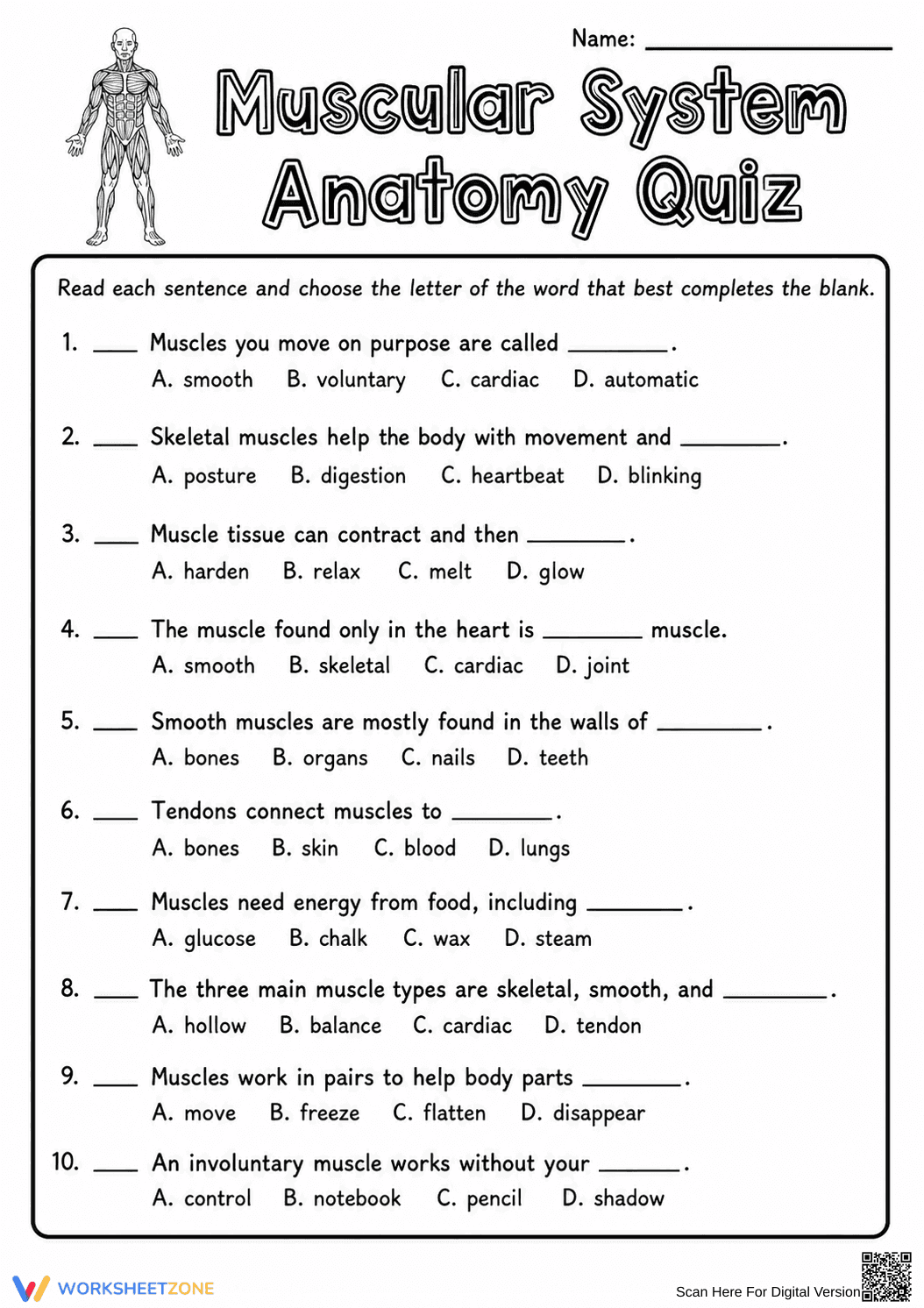
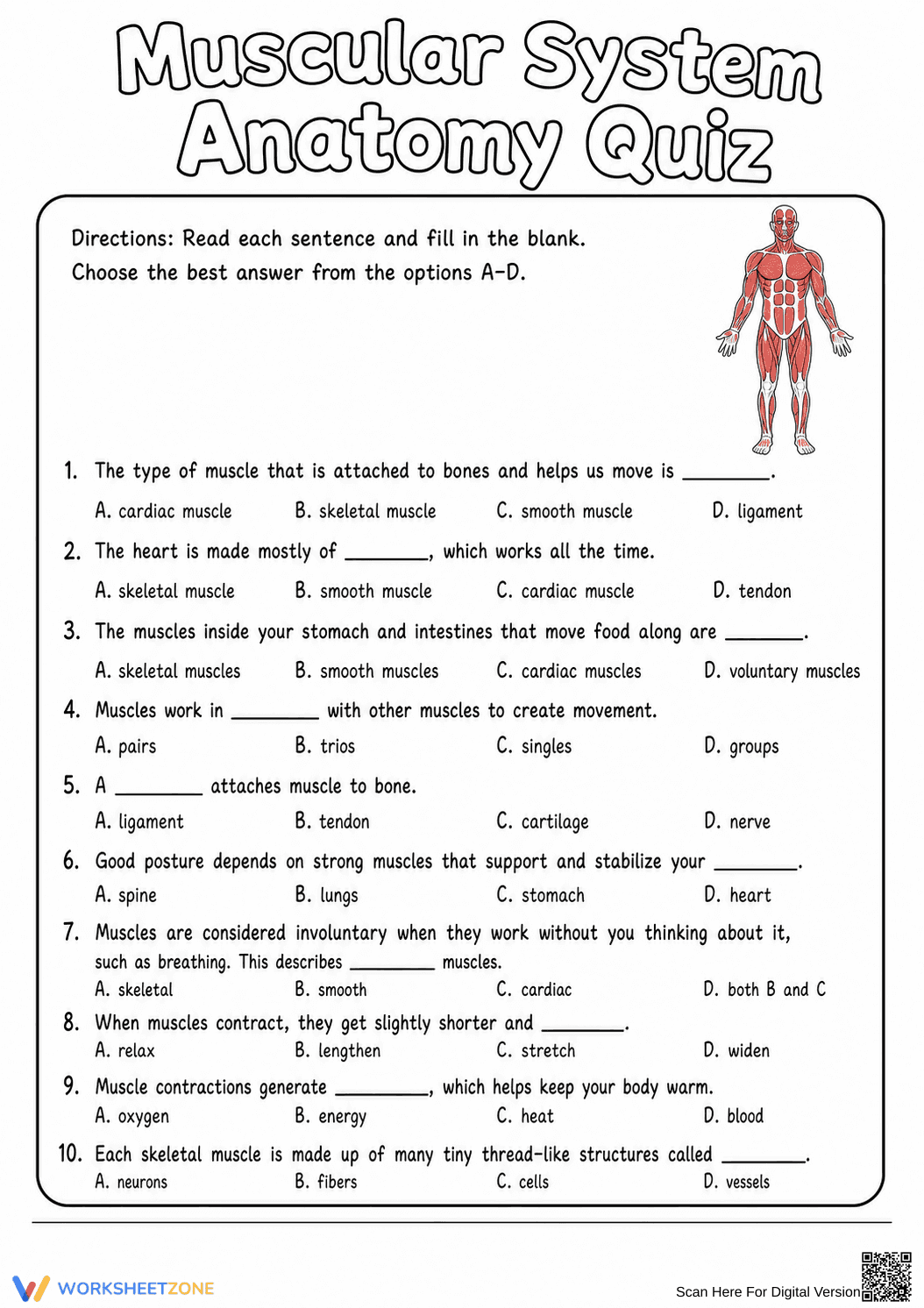
This muscular system anatomy quiz provides a comprehensive review of human physiology for middle school students. By identifying muscle types and their specific roles, learners solidify their understanding of how the body maintains movement and stability. It serves as a high-impact tool for reinforcing biological vocabulary and conceptual frameworks.
At a Glance
- Grade: 6-8 · Subject: Life Science
- Standard:
MS-LS1-3— Use evidence to explain how body systems interact to maintain function- Skill Focus: Muscular System Anatomy
- Format: 2 pages · 20 problems · Answer key included · PDF
- Best For: Formative assessment or quick review
- Time: 15–20 minutes
The resource contains two distinct pages of assessment, each featuring 10 multiple-choice questions designed to test recall and application. Students encounter tasks related to skeletal, smooth, and cardiac muscle tissues, as well as the mechanics of tendons and involuntary control. The clear layout includes a human anatomy diagram for visual reference and a structured answer key for rapid grading.
This zero-prep worksheet is designed for immediate classroom implementation. First, print the two-page PDF (under 1 minute). Next, distribute the quiz to students for independent completion (15 minutes). Finally, review the answers using the provided key to provide instant feedback (5 minutes). This streamlined workflow makes it an ideal choice for emergency sub plans or end-of-unit checks.
The primary alignment is `MS-LS1-3`, which requires students to gather evidence that body systems are specialized for particular body functions. This worksheet specifically addresses the muscular system's role in movement and internal regulation. Both standard codes can be copied directly into lesson plans, IEP goals, or district curriculum mapping tools.
Use this quiz as a "ticket out the door" after a lecture on human body systems to gauge immediate retention. Alternatively, assign it as a pre-assessment before starting a lab on muscle fatigue to identify existing knowledge gaps. Teachers should observe if students struggle to differentiate between voluntary and involuntary actions, as this indicates a need for further modeling.
This resource is tailored for Grade 6 through Grade 8 science students, though it remains accessible for advanced Grade 5 learners. It is particularly effective for students requiring structured vocabulary support. Pair this worksheet with a 3D muscular system model or an interactive anatomy anchor chart to provide a multi-sensory learning experience.
Effective science instruction relies on frequent, low-stakes retrieval practice to move information from short-term to long-term memory. According to Fisher & Frey (2014), the use of targeted assessments like this muscular system quiz allows educators to monitor student progress toward mastery of complex biological systems. By focusing on the specific functions of cardiac, smooth, and skeletal muscles, the worksheet aligns with the NGSS MS-LS1-3 framework for understanding body system interactions. Research indicates that structured multiple-choice formats help students organize scientific terminology more effectively than open-ended prompts during the initial phases of learning. This 20-task resource provides the necessary repetition to ensure students can accurately describe how the muscular system supports homeostasis and physical movement. It is a reliable tool for data-driven instruction in any middle school life science or biology classroom.


