




























Views
Downloads
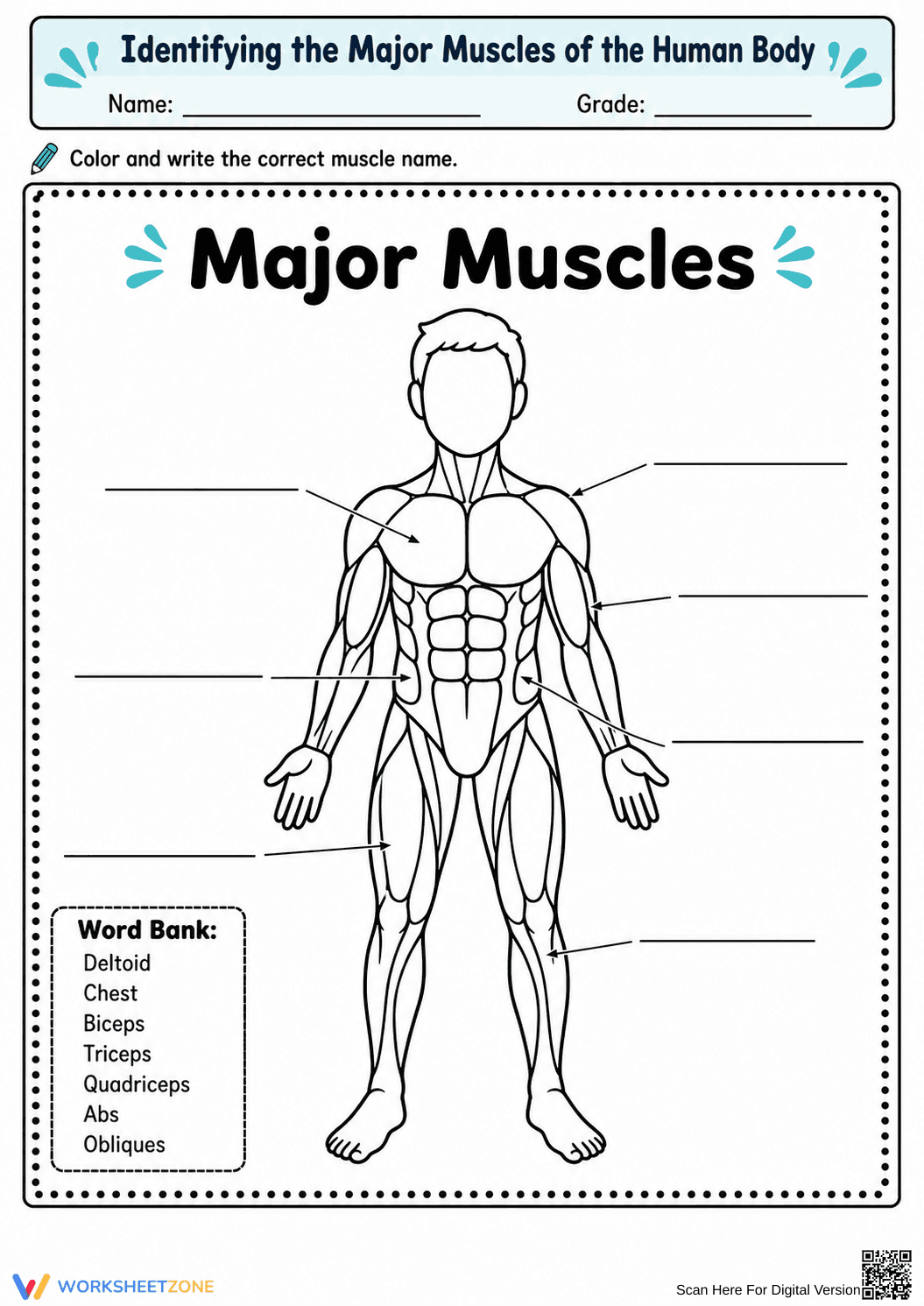

Major Muscles Worksheet | Grade 7-9 Essential Science

Paste this activity's link or code into your existing LMS (Google Classroom, Canvas, Teams, Schoology, Moodle, etc.).
Students can open and work on the activity right away, with no student login required.
You'll still be able to track student progress and results from your teacher account.
This Grade 7-9 muscular system worksheet provides a clear, visual framework for students to identify and label the primary muscle groups of the human body. By connecting anatomical terminology to a physical diagram, learners develop a concrete understanding of the muscular system's structure, facilitating better retention of biological concepts and physiological functions.
At a Glance
- Grade: 7-9 · Subject: Biology
- Standard:
MS-LS1-3— Use evidence to support how body systems interact to maintain life.- Skill Focus: Major muscle identification
- Format: 1 page · 7 problems · Answer key included · PDF
- Best For: Anatomy review and quick formative assessment
- Time: 15–20 minutes
The resource features a high-quality anatomical diagram of the human torso and limbs, accompanied by seven distinct labeling lines. A dedicated word bank includes essential terms: Deltoid, Chest, Biceps, Triceps, Quadriceps, Abs, and Obliques. The single-page PDF format ensures all necessary information is contained in one view, including a coloring component to engage kinesthetic learners during the identification process.
This worksheet follows a zero-prep workflow designed for maximum efficiency. Teachers can print the document in less than 30 seconds. Distribution takes approximately 1 minute during the transition into a science block. Reviewing the completed diagrams as a whole-class activity requires only 5 minutes, making the total instructional footprint minimal while maintaining high student engagement. It serves as an ideal emergency sub plan or a quick "do-now" activity to start the period.
This resource aligns with `MS-LS1-3`, focusing on the structural organization of the human body. By identifying specific muscle groups, students build the foundational knowledge required to explain how the muscular system interacts with the skeletal system to facilitate movement. Both standard codes can be copied directly into lesson plans, IEP goals, or district curriculum mapping tools.
Use this worksheet as a formative assessment immediately following a lecture on the human body systems. Observe students as they work; those struggling to differentiate between the biceps and triceps may need a brief demonstration of antagonistic muscle pairs. Alternatively, assign it as a pre-assessment to gauge prior knowledge before beginning a unit on human physiology or physical education fundamentals.
This activity is designed for middle school science students, including those in Grade 7, 8, and 9. It is particularly effective for visual learners and students who benefit from word banks to reduce cognitive load during vocabulary acquisition. Pair this worksheet with a 3D torso model or an interactive muscle movement video for a comprehensive multi-sensory lesson that reinforces anatomical positioning.
Research from RAND AIRS 2024 emphasizes that visual-spatial tasks, such as labeling anatomical diagrams, significantly improve the encoding of scientific vocabulary in middle school learners. By utilizing a word bank, this worksheet reduces the split-attention effect, allowing students to focus on the spatial relationship between muscle groups rather than just rote memorization. The inclusion of the MS-LS1-3 standard ensures that the activity remains grounded in rigorous academic expectations while providing the necessary scaffolding for diverse learners. Studies in the ScienceDirect TpT Analysis suggest that single-page, high-utility worksheets like this one increase instructional consistency across different classroom settings. This resource provides a reliable method for verifying student mastery of basic human anatomy, ensuring that all learners can accurately identify the major muscles responsible for human locomotion and stability before moving on to complex physiological processes.


