


























0
Views
0
Downloads

0.0
0
Save
0 Likes
Share
Neck Muscle Anatomy Worksheet
0 Views
0 Downloads
Paste this activity's link or code into your existing LMS (Google Classroom, Canvas, Teams, Schoology, Moodle, etc.).
Students can open and work on the activity right away, with no student login required.
You'll still be able to track student progress and results from your teacher account.
Information
Description
What It Is:
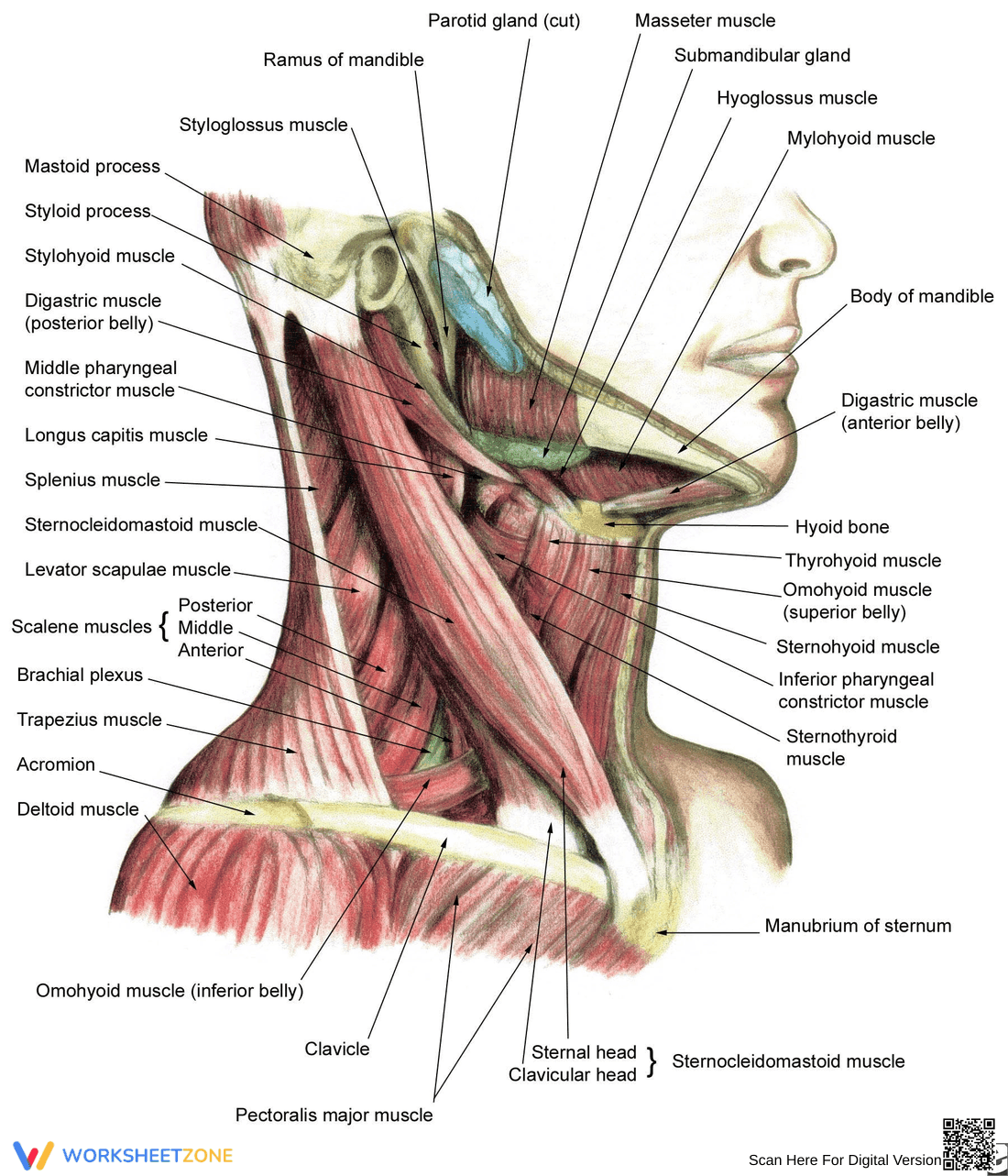
This is a diagram of the human neck and upper chest muscles. It includes detailed illustrations and labels identifying various muscles such as the sternocleidomastoid, trapezius, omohyoid, and digastric muscles, as well as bones like the clavicle and manubrium of sternum. The diagram also shows the parotid gland, submandibular gland, and hyoid bone.
Grade Level Suitability:
This worksheet is most suitable for high school (grades 9-12) and college-level anatomy and physiology courses. The detailed anatomical information and specific muscle names require a solid understanding of biology and human anatomy.
Why Use It:
This worksheet is valuable for learning and reinforcing knowledge of the muscles in the neck and upper chest. It promotes visual learning, anatomical identification skills, and a deeper understanding of the musculoskeletal system. It can be used for studying, review, or as a reference during dissections or lab activities.
How to Use It:
Use the diagram as a visual aid to study the location and names of the muscles in the neck and upper chest. You can label blank versions of the diagram for practice, or use it as a reference while identifying muscles on a model or during a dissection. You can also use it to quiz yourself or others on muscle identification.
Target Users:
This worksheet is ideal for high school biology students, college-level anatomy and physiology students, medical students, and anyone interested in learning about human anatomy, specifically the muscles of the neck and upper chest. It is also useful for instructors teaching anatomy courses.
This is a diagram of the human neck and upper chest muscles. It includes detailed illustrations and labels identifying various muscles such as the sternocleidomastoid, trapezius, omohyoid, and digastric muscles, as well as bones like the clavicle and manubrium of sternum. The diagram also shows the parotid gland, submandibular gland, and hyoid bone.
Grade Level Suitability:
This worksheet is most suitable for high school (grades 9-12) and college-level anatomy and physiology courses. The detailed anatomical information and specific muscle names require a solid understanding of biology and human anatomy.
Why Use It:
This worksheet is valuable for learning and reinforcing knowledge of the muscles in the neck and upper chest. It promotes visual learning, anatomical identification skills, and a deeper understanding of the musculoskeletal system. It can be used for studying, review, or as a reference during dissections or lab activities.
How to Use It:
Use the diagram as a visual aid to study the location and names of the muscles in the neck and upper chest. You can label blank versions of the diagram for practice, or use it as a reference while identifying muscles on a model or during a dissection. You can also use it to quiz yourself or others on muscle identification.
Target Users:
This worksheet is ideal for high school biology students, college-level anatomy and physiology students, medical students, and anyone interested in learning about human anatomy, specifically the muscles of the neck and upper chest. It is also useful for instructors teaching anatomy courses.


