




























Views
Downloads

Muscular System Worksheet | Essential Grade 5-8 Science

Paste this activity's link or code into your existing LMS (Google Classroom, Canvas, Teams, Schoology, Moodle, etc.).
Students can open and work on the activity right away, with no student login required.
You'll still be able to track student progress and results from your teacher account.
This comprehensive muscular system worksheet provides a structured pathway for students to master human anatomy and physiology. By engaging with multiple modalities—including categorization, diagram labeling, and short-answer explanations—learners develop a concrete understanding of how muscles facilitate movement and support vital life functions. Students will successfully differentiate between muscle tissues and locate major muscle groups on a human anatomical map.
At a Glance
- Grade: 5-8 · Subject: Science
- Standard:
MS-LS1-3— Describe how the body is a system of interacting subsystems composed of cells- Skill Focus: Muscular system anatomy and physiology
- Format: 2 pages · 24 problems · Answer key included · PDF
- Best For: Middle school life science units
- Time: 30–45 minutes
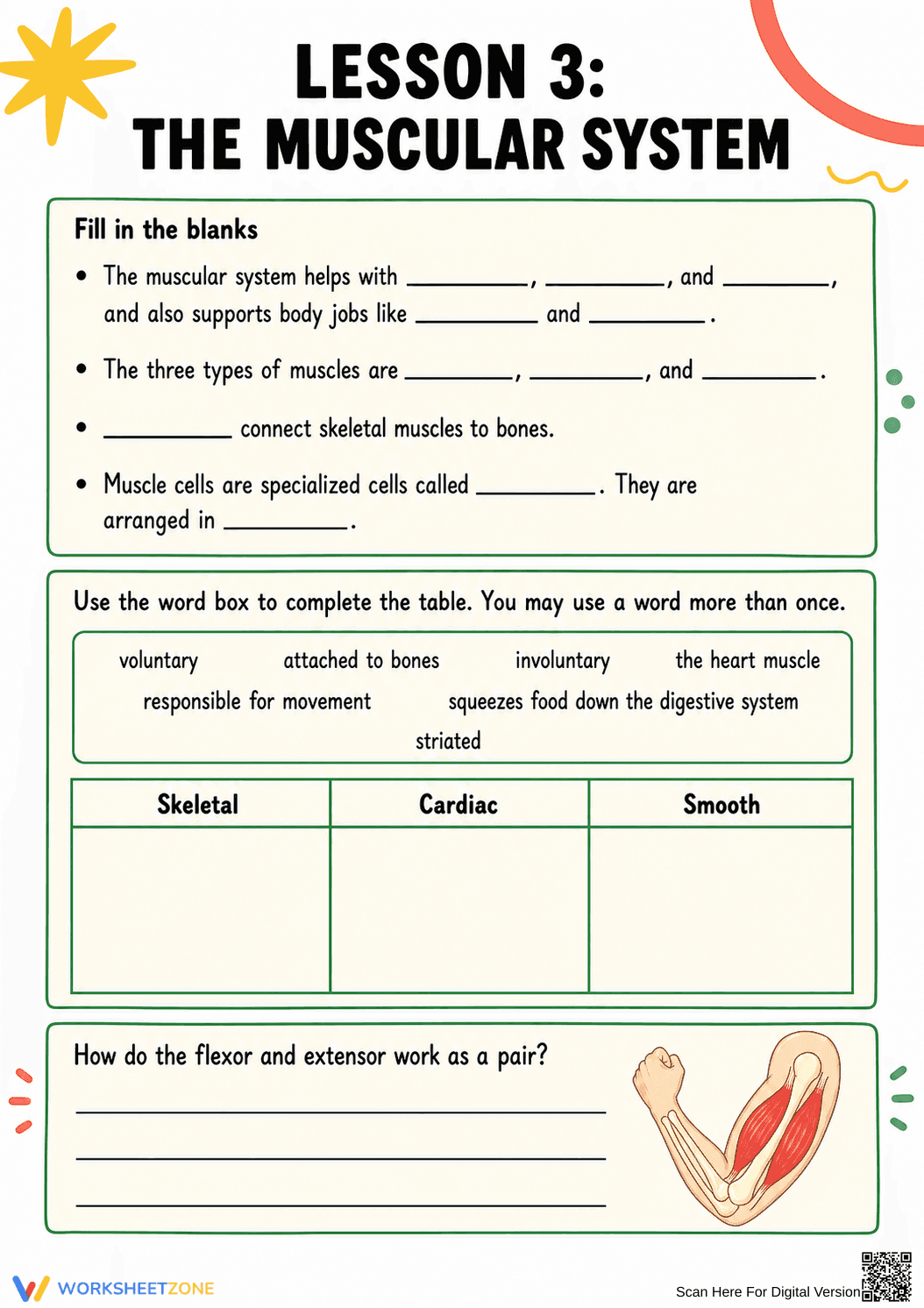
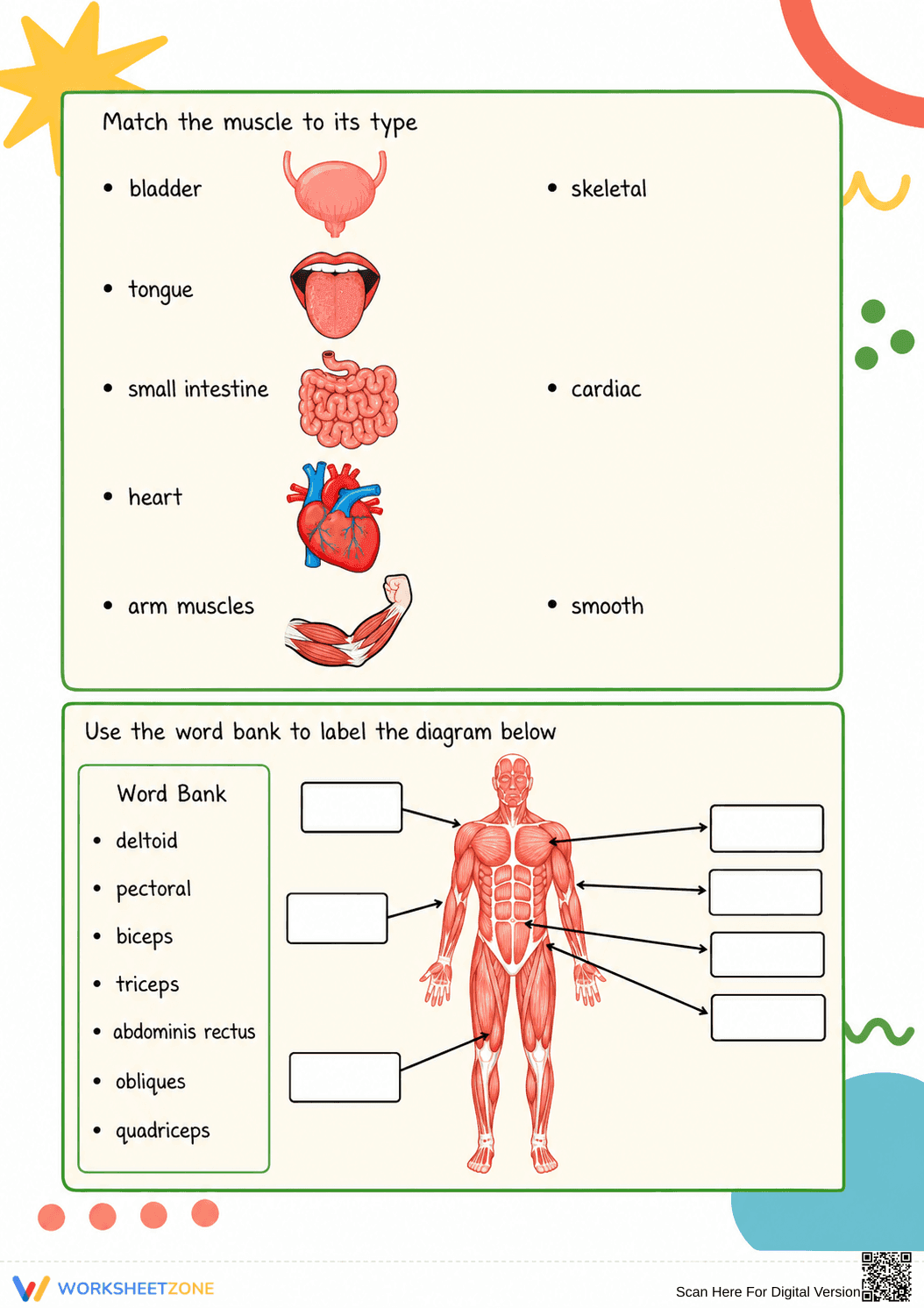
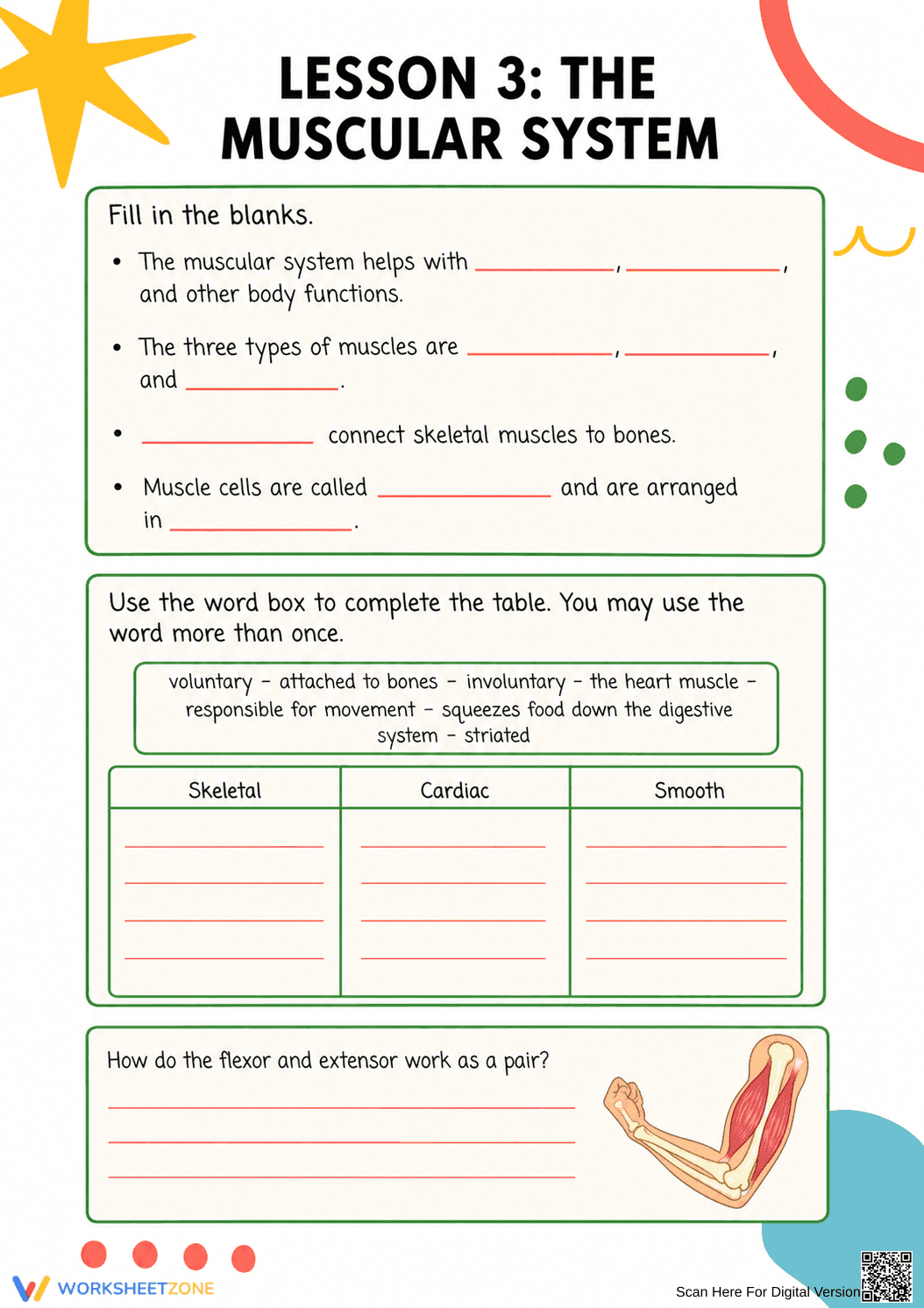
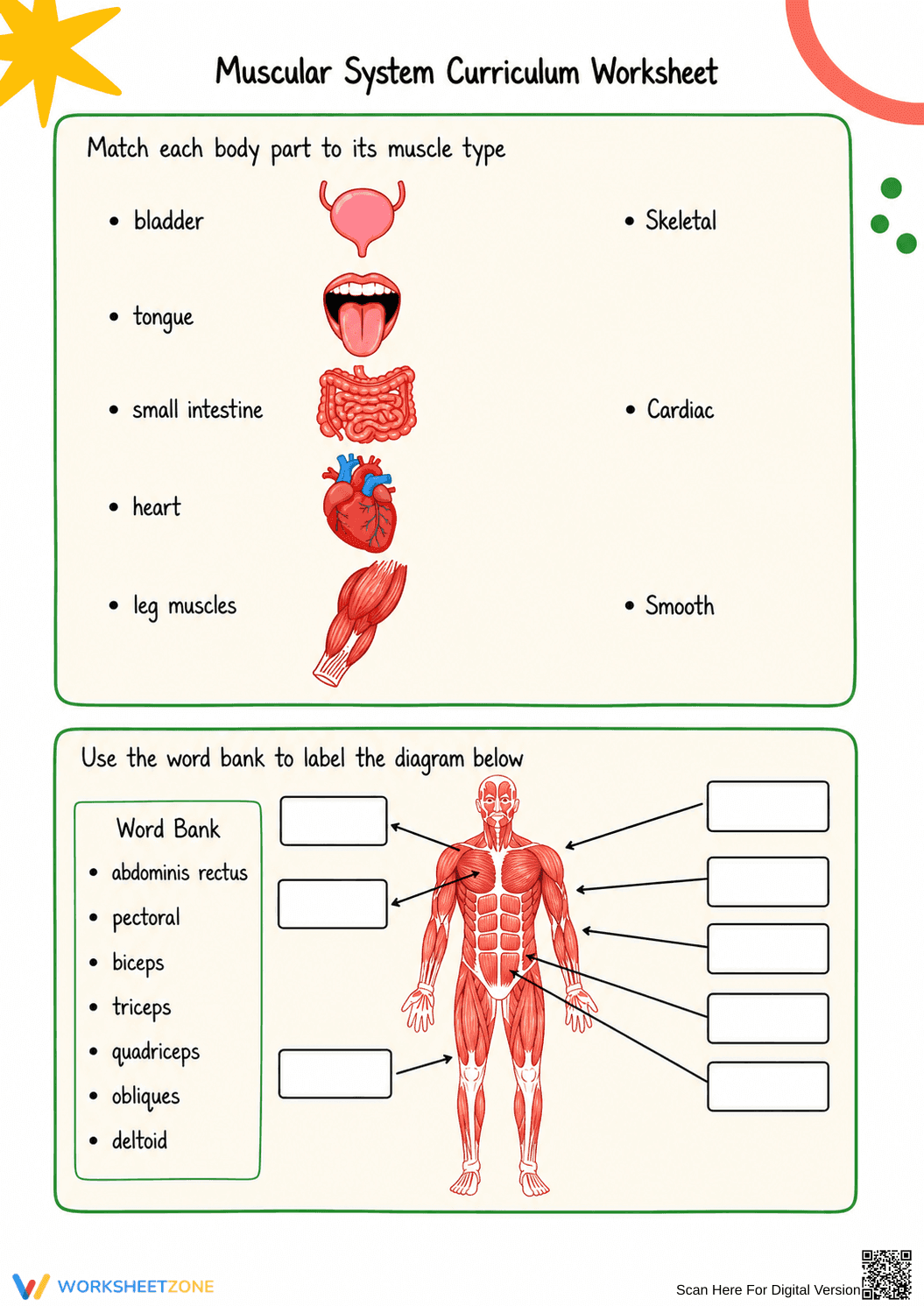
What's Inside: This two-page instructional resource features four distinct activity zones. The first page includes a fill-in-the-blank conceptual overview, a categorization table for skeletal, cardiac, and smooth muscles using a word bank, and a mechanical explanation of flexor and extensor pairs. The second page transitions to identification, featuring an organ-to-muscle-type matching exercise and a detailed full-body diagram for labeling seven major muscle groups, including the pectorals, deltoids, and quadriceps.
Zero-Prep Workflow
- Print: Select the two-page PDF and print enough copies for your cohort (1 minute).
- Distribute: Hand out the worksheets as a standalone activity or a guided lesson supplement (1 minute).
- Review: Use the included answer key for rapid grading or a whole-class review session (10 minutes).
This resource is designed for immediate implementation, requiring less than two minutes of total teacher preparation time, making it an ideal choice for emergency sub plans or high-impact independent practice.
Standards Alignment: This worksheet is built to support MS-LS1-3: "Use argument supported by evidence for how the body is a system of interacting subsystems composed of groups of cells." It specifically addresses how specialized muscle cells form tissues that work together to move the skeletal subsystem. Both standard codes can be copied directly into lesson plans, IEP goals, or district curriculum mapping tools.
How to Use It: Assign this worksheet during the "Explain" or "Evaluate" phase of a 5E instructional cycle. It serves as an excellent formative assessment after a direct instruction session on the human body. For a quick check for understanding, observe students as they complete the voluntary vs. involuntary categorization in the table; this often reveals common misconceptions about internal organ functions. Completion time typically ranges from 30 to 45 minutes depending on prior knowledge.
Who It's For: This resource is tailored for middle school students in grades 5 through 8, though it is accessible for advanced 4th graders. It provides necessary scaffolding for diverse learners through the use of word banks and visual diagrams. This worksheet pairs naturally with a human body system anchor chart or a digital 3D anatomy model to provide a multi-sensory learning experience.
According to Fisher & Frey (2014), the use of graphic organizers and labeled diagrams is a high-leverage strategy for developing academic vocabulary in the sciences. This muscular system worksheet applies these principles by requiring students to translate conceptual knowledge into visual identification. By aligning with the MS-LS1-3 standard, the resource ensures that students are not just memorizing names, but are understanding the functional relationships between different muscle types—skeletal, cardiac, and smooth—and their roles within the larger human body system. The inclusion of 24 specific tasks provides sufficient data points for teachers to measure student mastery of anatomical structures. Research from the RAND AIRS 2024 report suggests that structured, printable scaffolds significantly improve retention of complex biological systems in middle school populations. This document serves as a reliable tool for evidence-based science instruction and curriculum alignment.


