




























0
Views
0
Downloads

0.0
0
Save
0 Likes
Share
Muscles of the Head and Neck Anatomy Worksheet
0 Views
0 Downloads

Paste this activity's link or code into your existing LMS (Google Classroom, Canvas, Teams, Schoology, Moodle, etc.).
Students can open and work on the activity right away, with no student login required.
You'll still be able to track student progress and results from your teacher account.
Information
Description
What It Is:
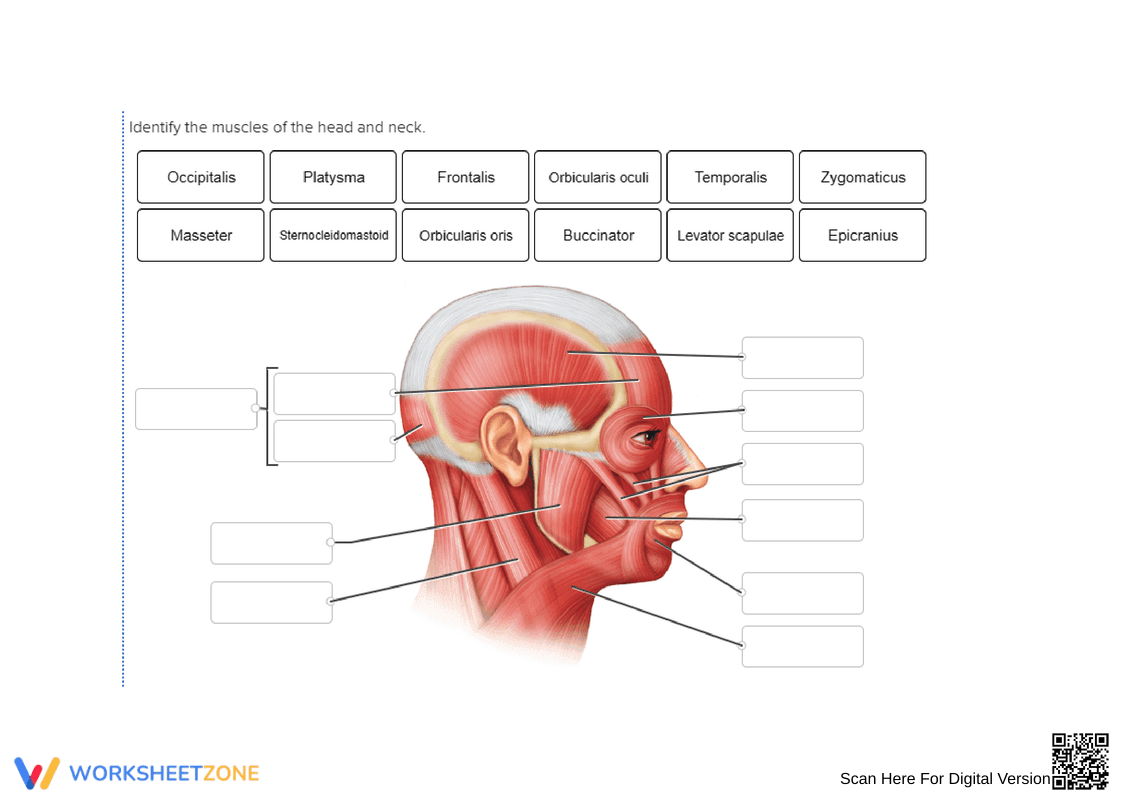
This is an anatomy worksheet focused on identifying muscles of the head and neck. It features a detailed illustration of the head and neck with lines pointing to various muscles. Students are expected to label the muscles by dragging and dropping labels from a provided list that includes terms like 'Occipitalis,' 'Platysma,' 'Frontalis,' 'Orbicularis oculi,' 'Temporalis,' 'Zygomaticus,' 'Masseter,' 'Sternocleidomastoid,' 'Orbicularis oris,' 'Buccinator,' 'Levator scapulae,' and 'Epicranius.'
Grade Level Suitability:
This worksheet is suitable for high school biology or anatomy and physiology courses (Grades 9-12), as well as introductory college-level anatomy courses. The complexity of muscle identification and anatomical knowledge required makes it appropriate for older students.
Why Use It:
This worksheet provides a visual and interactive way for students to learn and reinforce their knowledge of head and neck muscle anatomy. It helps students develop their anatomical identification skills and understand the location and names of key muscles in this region.
How to Use It:
Students should use the provided word bank of muscle names to label the muscles indicated on the diagram. They will drag and drop the correct name next to the corresponding pointer line. The activity tests their knowledge of muscle location and nomenclature. Teachers can use it as a practice activity, a quiz, or a review exercise.
Target Users:
The target users are high school and college students studying anatomy, physiology, or biology. It is also suitable for students in pre-med or other health-related fields needing a strong foundation in anatomical knowledge.
This is an anatomy worksheet focused on identifying muscles of the head and neck. It features a detailed illustration of the head and neck with lines pointing to various muscles. Students are expected to label the muscles by dragging and dropping labels from a provided list that includes terms like 'Occipitalis,' 'Platysma,' 'Frontalis,' 'Orbicularis oculi,' 'Temporalis,' 'Zygomaticus,' 'Masseter,' 'Sternocleidomastoid,' 'Orbicularis oris,' 'Buccinator,' 'Levator scapulae,' and 'Epicranius.'
Grade Level Suitability:
This worksheet is suitable for high school biology or anatomy and physiology courses (Grades 9-12), as well as introductory college-level anatomy courses. The complexity of muscle identification and anatomical knowledge required makes it appropriate for older students.
Why Use It:
This worksheet provides a visual and interactive way for students to learn and reinforce their knowledge of head and neck muscle anatomy. It helps students develop their anatomical identification skills and understand the location and names of key muscles in this region.
How to Use It:
Students should use the provided word bank of muscle names to label the muscles indicated on the diagram. They will drag and drop the correct name next to the corresponding pointer line. The activity tests their knowledge of muscle location and nomenclature. Teachers can use it as a practice activity, a quiz, or a review exercise.
Target Users:
The target users are high school and college students studying anatomy, physiology, or biology. It is also suitable for students in pre-med or other health-related fields needing a strong foundation in anatomical knowledge.


