




























Views
Downloads

Muscular System Labeling Worksheet | Grade 7 Printable

Paste this activity's link or code into your existing LMS (Google Classroom, Canvas, Teams, Schoology, Moodle, etc.).
Students can open and work on the activity right away, with no student login required.
You'll still be able to track student progress and results from your teacher account.
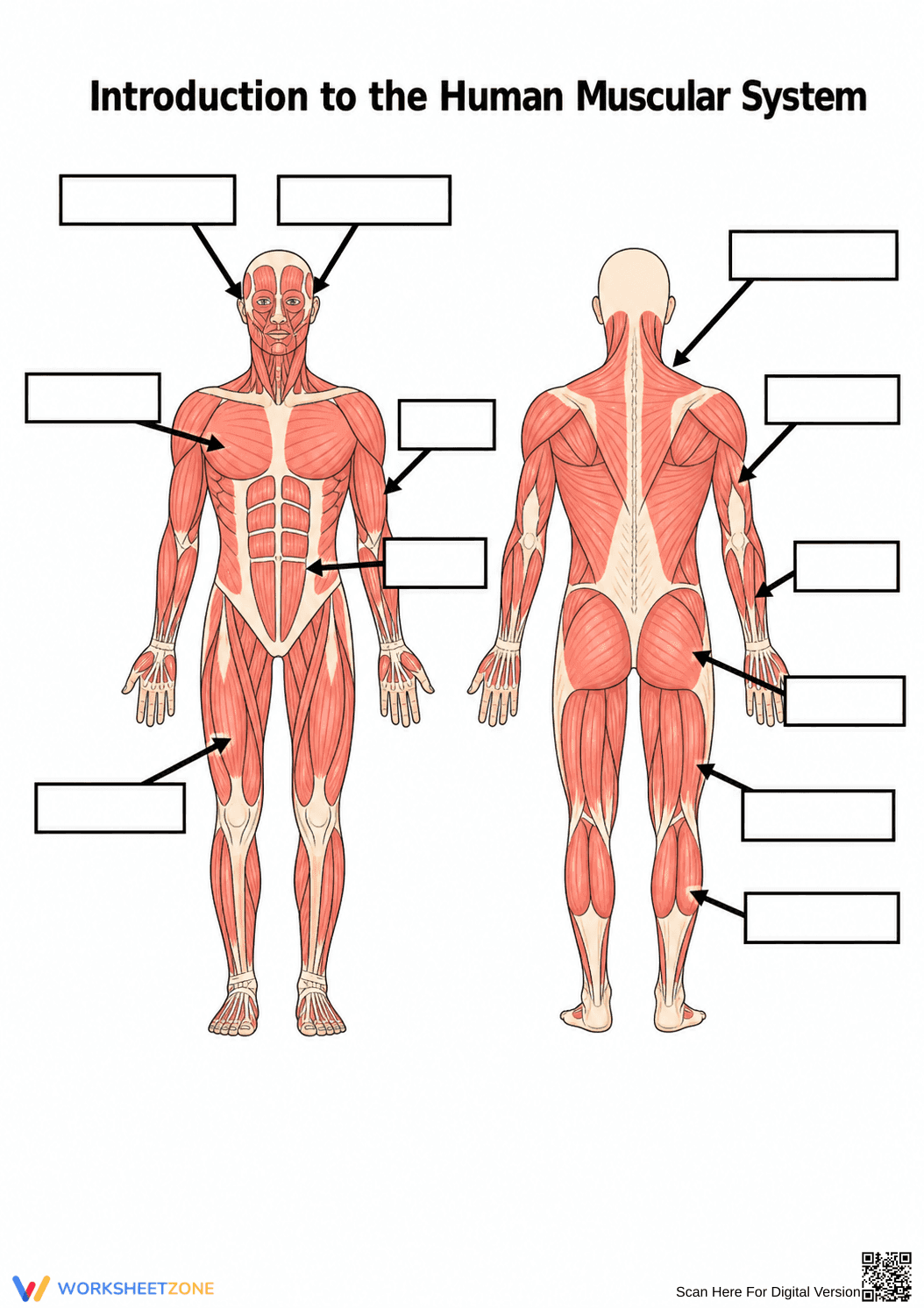
This Grade 7 science worksheet helps students identify and memorize the major muscles of the human body. By labeling anterior and posterior anatomical diagrams, learners build a foundational understanding of the muscular system and how different muscle groups support movement and stability.
At a Glance
- Grade: 7 · Subject: Science
- Standard:
MS-LS1-3— Identify body subsystems and their interactions- Skill Focus: Labeling major human muscles
- Format: 1 page · 12 problems · Answer key included · PDF
- Best For: Independent practice or review
- Time: 10–15 minutes
This single-page resource features detailed, high-quality illustrations of the human muscular system from both front and back views. Students are tasked with filling in twelve blank text boxes pointing to key muscle groups, such as the pectorals, abdominals, quadriceps, and glutes. A complete answer key is provided to ensure accurate self-correction or rapid teacher grading.
- Print (1 min): Generate enough copies of the PDF for your entire class.
- Distribute (1 min): Hand out the diagrams alongside textbooks or reference materials.
- Review (3 mins): Quickly check student labels using the provided answer key.
Total teacher prep time is under two minutes, making this an excellent option for emergency sub plans or immediate classroom deployment.
Aligned to MS-LS1-3, this activity supports the understanding that the body is a system of interacting subsystems. Recognizing specific muscles is the first step in modeling how the muscular system interacts with the skeletal system to facilitate movement. Both standard codes can be copied directly into lesson plans, IEP goals, or district curriculum mapping tools.
Deploy this worksheet during direct instruction as a guided note-taking tool, or assign it as independent practice after introducing human anatomy. As a formative assessment tip, observe which muscle groups students frequently confuse to guide your follow-up review. Expect students to complete the labeling within 10 to 15 minutes.
This resource is designed for middle school science and biology students learning human anatomy. To support diverse learners, teachers can provide a word bank on the board for students who need spelling or recall assistance. It pairs perfectly with a 3D anatomical model or a direct instruction lesson on the musculoskeletal system.
Research from ScienceDirect TpT Analysis highlights that visual aids and diagram labeling significantly improve retention of complex anatomical vocabulary in middle school science classrooms. By actively mapping terms to visual representations, students transition from rote memorization to spatial understanding. This resource targets MS-LS1-3, requiring students to identify body subsystems and their interactions. When learners can accurately locate major muscle groups, they are better equipped to understand how these tissues interact with bones and nerves to produce movement. Providing clear, uncluttered diagrams reduces cognitive load, allowing students to focus entirely on mastering the terminology. This targeted practice ensures foundational knowledge is solidified before moving on to more complex physiological processes, ensuring students build a robust mental model of human anatomy that will serve them in advanced biology courses.


