


























Views
Downloads
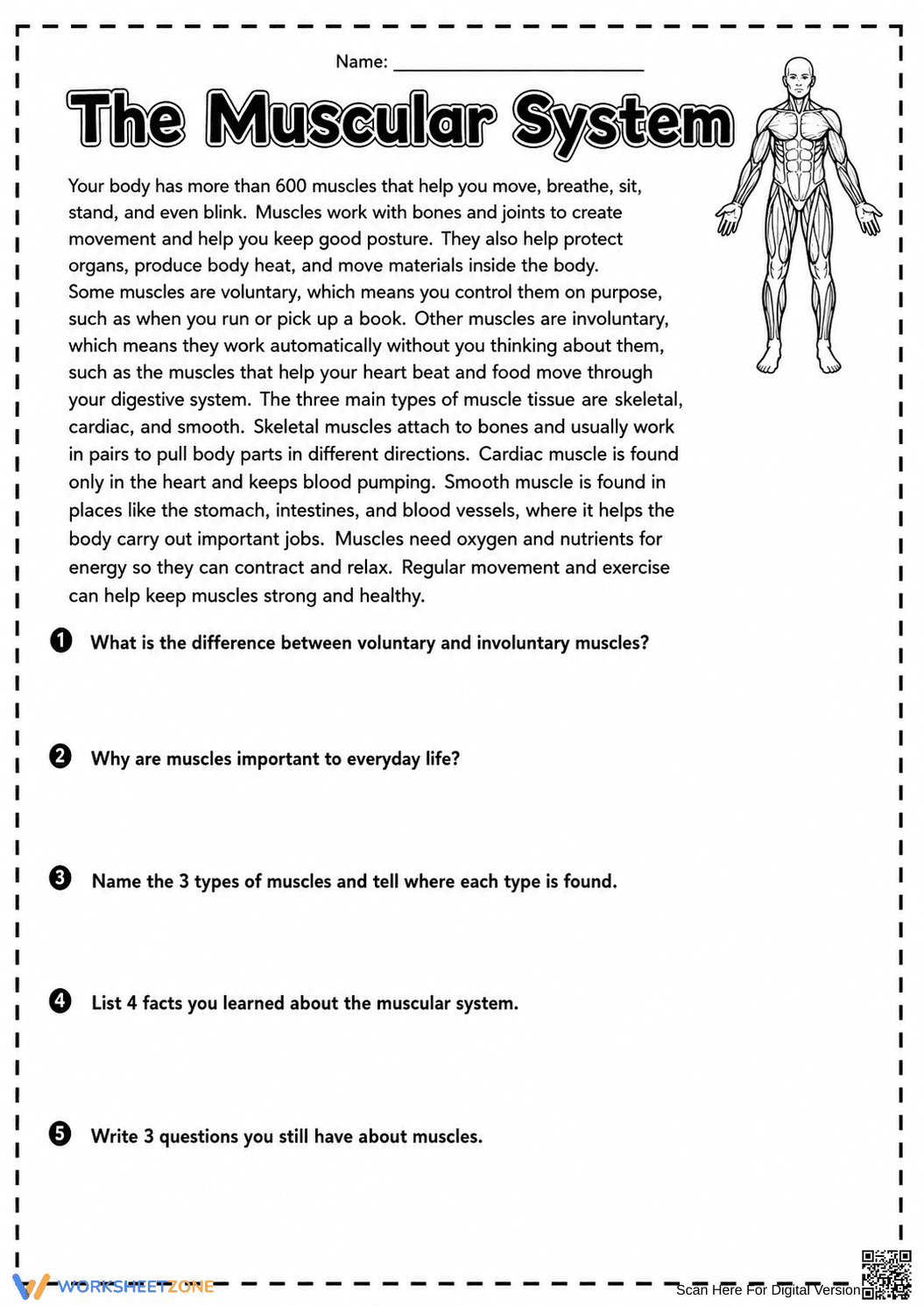

Grade 6 Muscular System — Printable No-Prep Worksheet
Paste this activity's link or code into your existing LMS (Google Classroom, Canvas, Teams, Schoology, Moodle, etc.).
Students can open and work on the activity right away, with no student login required.
You'll still be able to track student progress and results from your teacher account.
This muscular system reading comprehension worksheet helps students identify the functions and types of muscles in the human body. By reading a short informational passage and answering targeted questions, learners build foundational science literacy while exploring how voluntary and involuntary muscles keep the body moving.
At a Glance
- Grade: 6 · Subject: Science
- Standard:
MS-LS1-3— Explain how body subsystems interact to function- Skill Focus: Reading comprehension and body systems
- Format: 1 page · 5 problems · Answer key included · PDF
- Best For: Independent practice or sub plans
- Time: 15–20 minutes
This single-page resource features a concise reading passage about the muscular system, followed by five open-ended comprehension questions. The text covers key concepts like voluntary versus involuntary muscles, and the roles of skeletal, cardiac, and smooth tissues. The questions require students to recall facts, synthesize information, and generate inquiry questions. A complete answer key makes grading fast.
Zero-Prep Workflow
This worksheet is designed for immediate classroom use with absolutely no teacher preparation required. The entire activity can be deployed in under two minutes:
- Print (1 minute): Simply print the single-page PDF. The integrated reading passage means no textbooks or external articles are needed.
- Distribute (1 minute): Hand out the worksheet as a bell-ringer, independent assignment, or emergency sub plan.
- Review (5 minutes): Use the included answer key to quickly check student responses or guide a whole-class discussion on muscle functions.
Standards Alignment
This resource is aligned to the Next Generation Science Standards, specifically MS-LS1-3: Use argument supported by evidence for how the body is a system of interacting subsystems composed of groups of cells. It also supports cross-curricular ELA standards for reading informational text in science. Both standard codes can be copied directly into lesson plans, IEP goals, or district curriculum mapping tools.
How to Use It
This worksheet is highly versatile and fits easily into any human body systems unit. Use it as an introductory activity before direct instruction to build background knowledge, or assign it as independent practice after a lesson on the muscular system. As a formative assessment tip, review students' responses to question five (writing their own questions about muscles) to gauge their curiosity and identify any lingering misconceptions. Most students will complete the reading and questions within 15 to 20 minutes.
Who It's For
This activity is primarily designed for middle school students in grades 5 through 8 learning about human biology and anatomy. The straightforward text and clear layout make it accessible for general education students, while the open-ended questions provide natural differentiation for varying writing abilities. It pairs perfectly with a 3D anatomical model demonstration or a broader unit on how the skeletal and muscular systems work together.
Integrating literacy into science instruction is a critical component of modern STEM education. According to a RAND AIRS 2024 report, students who engage with subject-specific informational texts demonstrate higher retention of complex scientific concepts compared to those who only receive direct instruction. This worksheet directly supports that pedagogical approach by combining reading comprehension with core biology content. By aligning with the MS-LS1-3 standard, the activity ensures students can explain how body subsystems interact to function while simultaneously practicing essential evidence-gathering skills. The structured format—moving from basic recall of muscle types to generating independent inquiry questions—mirrors best practices in cognitive scaffolding. Educators can rely on this resource to provide rigorous, standards-based practice that reinforces both science content and cross-disciplinary literacy without requiring additional preparation time, making it an invaluable tool for busy teachers.


