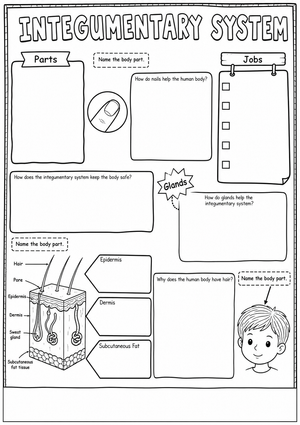
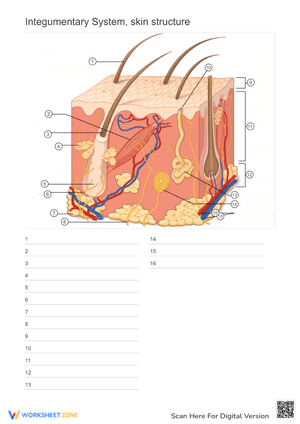
These 4th grade human body systems printable worksheets resources give teachers a focused set of standalone activities covering the skeletal, muscular, circulatory, respiratory, digestive, and nervous systems — the six systems that anchor the fourth-grade life science curriculum. Each worksheet targets a specific system, asking students to label diagrams, sequence processes, classify organ functions, and connect structure to purpose rather than simply memorizing organ names.
Concepts Covered Across the Set
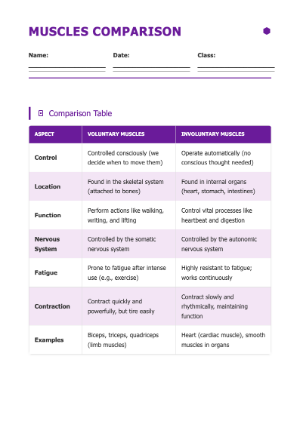
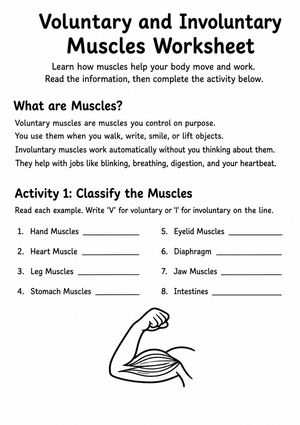
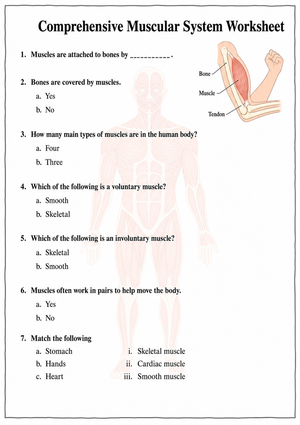
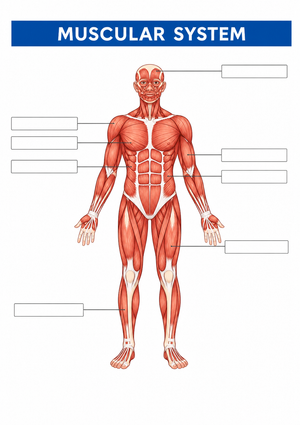
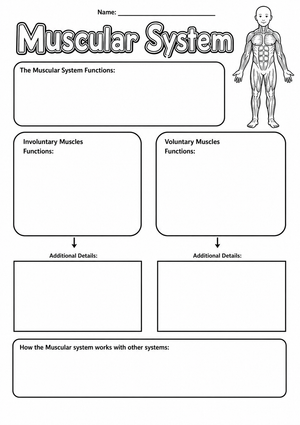
The skeletal and muscular system worksheets open with structure and work toward function. Students label major bones — the femur, humerus, vertebrae, sternum — then shift to identifying the three muscle types and sorting them by voluntary versus involuntary control. That distinction deserves time because fourth graders reliably conflate "muscle" with "the ones you flex," which makes it worth slowing down on smooth and cardiac muscle before moving on to the next system.
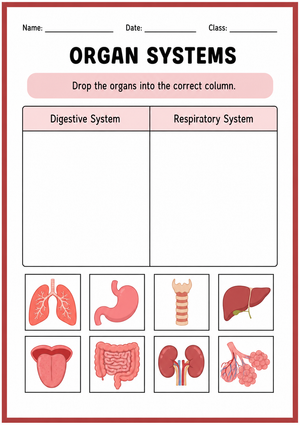
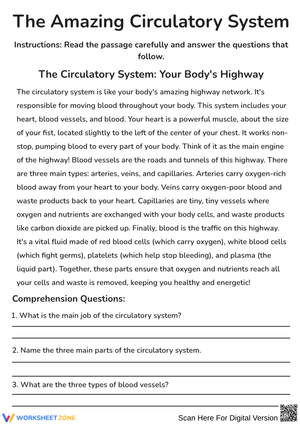
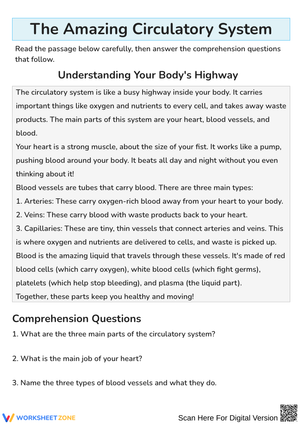
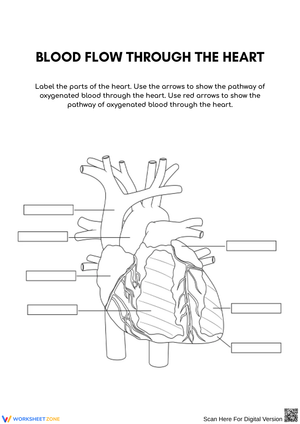
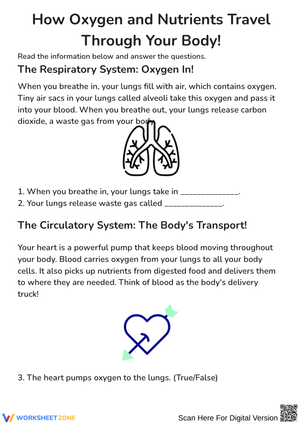
The circulatory and respiratory worksheets treat the two systems as partners, because that is how they function. Students trace the path of a red blood cell from the right ventricle through the pulmonary artery, into the lungs, back through the pulmonary vein, and out through the aorta — a route that becomes genuinely memorable once students understand it represents every breath they take. Related vocabulary — trachea, bronchi, diaphragm, capillaries — appears in labeling tasks and short written explanations, not just word-bank fill-ins.
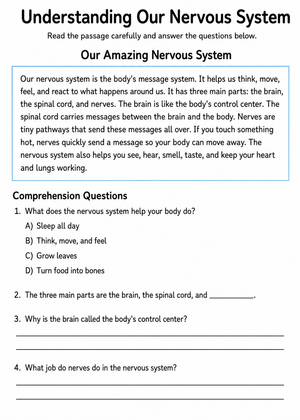
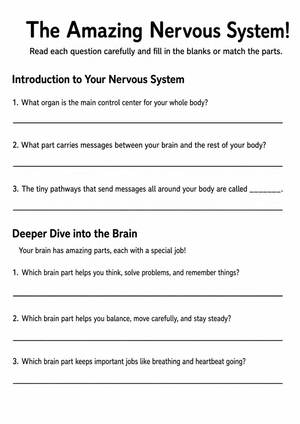
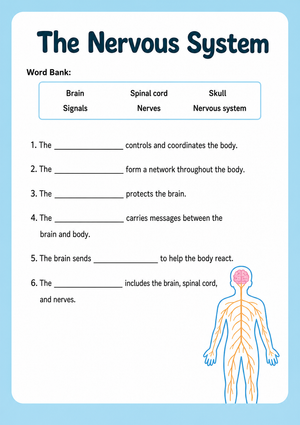
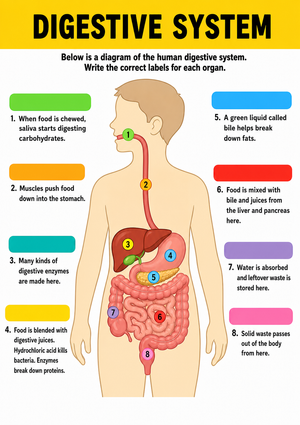
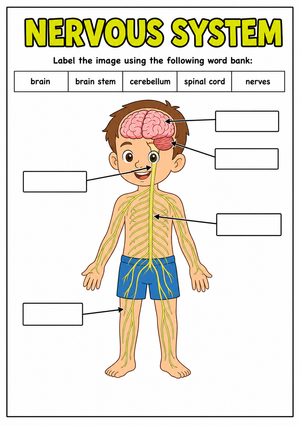
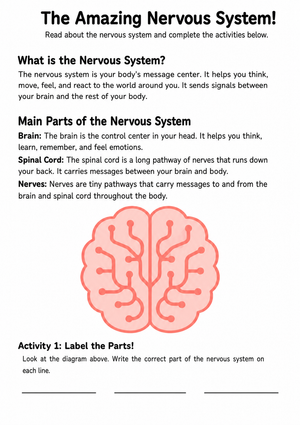
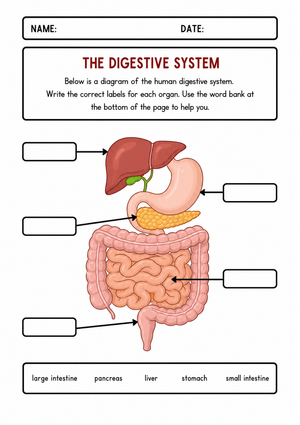
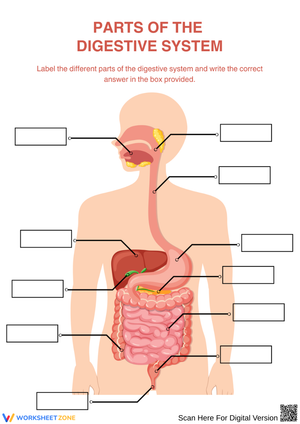
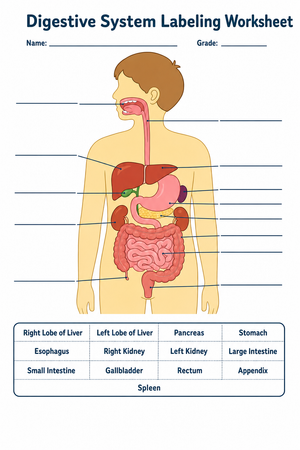
The digestive system worksheet follows food from the mouth through each structure in sequence: esophagus, stomach, small intestine, large intestine. Students mark where mechanical digestion happens versus where chemical digestion begins, and they annotate the role of the liver and pancreas as accessory organs. The nervous system worksheet covers the cerebrum, cerebellum, and brain stem, then asks students to distinguish between sensory and motor pathways and trace a simple reflex arc from stimulus to response.
Mistakes Students Make That These Worksheets Help You Catch
The most persistent error across all six systems is confusing structure with function. Students can correctly draw and label the heart but write that its job is "to hold blood." Every worksheet in the set addresses this directly by asking students to complete sentence frames like "The [organ] allows the body to ____," which forces functional thinking rather than identification alone.
Within the circulatory system, a consistent misconception is the assumption that arteries always carry oxygen-rich blood and veins always carry oxygen-poor blood. That shortcut breaks down at the pulmonary circuit — the pulmonary artery carries deoxygenated blood to the lungs, and the pulmonary vein returns oxygenated blood to the heart. Fourth graders who have memorized the simplified rule get tripped up here every time. One worksheet asks students to color-code vessels by oxygen level rather than by vessel type, which surfaces the confusion before it shows up on an assessment.
In the nervous system material, students frequently write that the cerebellum controls thinking. They have absorbed the prefix "cerebr-" and apply it broadly. Having students match specific brain regions to their functions — rather than just labeling a diagram — corrects this faster than reteaching from the beginning.
Building These Worksheets Into a Multi-Week Science Unit
The set works best distributed one system at a time across a three- to four-week unit. A reliable structure: introduce each system on Monday with a brief whole-class discussion to surface prior knowledge, assign the corresponding worksheet on Tuesday or Wednesday as independent practice, then revisit it Thursday with partners checking each other's labels and written responses. By Friday, the vocabulary has had three exposures — enough for most fourth graders to use the terms accurately in conversation.
The pulse measurement task embedded in the circulatory worksheet — students record resting heart rate, perform thirty seconds of jumping jacks, then immediately record again — takes about eight minutes and generates data students reference for the rest of the unit. When they reach the respiratory system worksheet, they already have a felt experience of why breathing rate and heart rate change together. That connection carries more explanatory weight than any diagram alone.
For teachers building interactive science notebooks, each worksheet fits naturally as a base layer: students complete the labeling and written sections, then mount the diagram in their notebook and add margin annotations in their own words. Teachers who assemble unit portfolios sometimes have students collect all six completed worksheets at the end, stapled together in system order, so they can trace connections — the arteries from the circulatory worksheet reappearing in the respiratory one, the nervous system coordinating the muscular system's voluntary movements.
Standard Alignment
These worksheets align with NGSS LS1.A: Structure and Function, which at the fourth-grade level expects students to understand that organisms have internal structures serving functions that support survival, growth, and reproduction. The key instructional shift LS1.A demands is moving students from identification — naming the femur — toward explanation — describing how the femur's density and shape allow it to bear the body's weight. Each worksheet pushes toward the explanatory level with short written-response items alongside the labeling tasks.
Many states place the human body systems unit in late third or early fourth grade, positioning it to connect with nutrition and health units that often follow. Teachers who use the 4th grade human body systems printable worksheets resources alongside a nutrition unit find the digestive and circulatory system worksheets carry double duty — they serve both the science standard and health curriculum goals, particularly around how the body converts food into usable energy.
Adjusting the Worksheets for a Range of Learners
For students who need more support, the labeling tasks become more accessible when the word bank is printed on a separate card students keep at their desk rather than embedded in the worksheet itself. Removing the hunt-and-match pressure lets those students focus on placement and function. On the written-response items, providing a sentence starter — "The role of the _____ is to..." — brings in students who freeze when faced with a blank line, without reducing the intellectual demand of the question.
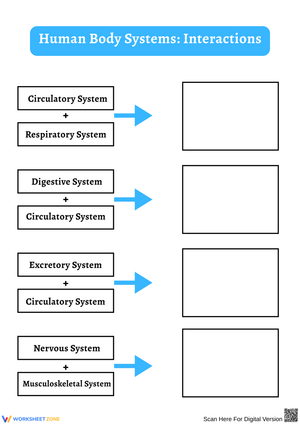
Students who move quickly through the core tasks benefit from cross-system connection questions added verbally or on a sticky note: "How does the respiratory system depend on the circulatory system to do its job?" or "If the nervous system were damaged, which other system would be most immediately affected and why?" These questions require integrative thinking that goes beyond any one worksheet but draw directly on the content already practiced. No separate materials needed — just a harder question and a few minutes at the end of the period.
Frequently Asked Questions
Which body systems does the set cover?
The set covers six systems: skeletal, muscular, circulatory, respiratory, digestive, and nervous. This matches the scope of most fourth-grade life science units aligned to NGSS LS1.A. Some district curricula include the excretory system at this grade as well — if yours does, the nervous system worksheet's reflex arc content pairs naturally with excretory content because both involve involuntary processes the brain stem coordinates.
Can students complete these worksheets independently, or do they need direct instruction first?
Most worksheets need a brief introduction — five to ten minutes of whole-class instruction or a short reading passage to establish vocabulary. The labeling tasks are accessible as independent practice after that initial exposure, but the written-response items work better after students have had at least one discussion about the system's function. Sending a labeling worksheet home without any prior instruction produces guessing rather than learning for most fourth graders.
How do these worksheets work for English language learners?
The diagram-based labeling tasks are among the most accessible activity formats for ELL students because they separate vocabulary recognition from writing production — students can demonstrate understanding by placing the correct term without constructing a full sentence. The 4th grade human body systems printable worksheets set benefits ELL students particularly in the digestive and circulatory activities, where the visual path of food or blood gives abstract vocabulary a concrete referent. For the written-response sections, pairing ELL students with a bilingual glossary of key terms helps without reducing the cognitive demand of the task.
Are these appropriate for third grade or fifth grade as well?
The content and vocabulary level targets fourth grade. Third graders typically study simpler organism structures — external features, basic needs — rather than internal systems, so these worksheets introduce concepts ahead of most third-grade curricula. Fifth graders who need a review of body systems find the 4th grade human body systems printable worksheets materials useful as a foundational reset before moving into more complex life science content like cells and ecosystems, though they are not an instructional stretch at that grade level.












 Interactive Worksheet Maker
 Quiz Maker
 Word Search Maker
 Crossword Puzzle Maker
 Word Scramble Generator
 Sentence Scramble Generator
 Handwriting Worksheet Generator
 Name Tracing Generator
 Fill In The Blank Generator