These ecosystem printable worksheets for 4th grade give teachers a focused set of practice tools covering the relationships students need to understand before fifth-grade life science deepens the same concepts. Each worksheet targets one skill — labeling, sorting, reading diagrams, or writing cause-and-effect explanations — so students build toward a complete picture of how living things interact with each other and with their environment.
The Specific Skills Targeted
The set moves through the core concepts that appear most often in fourth-grade science units on living systems:
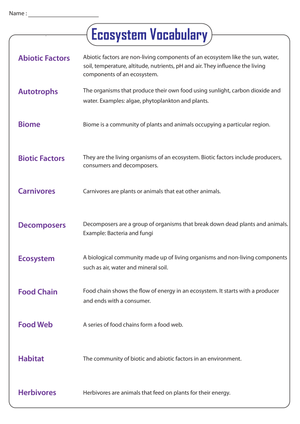
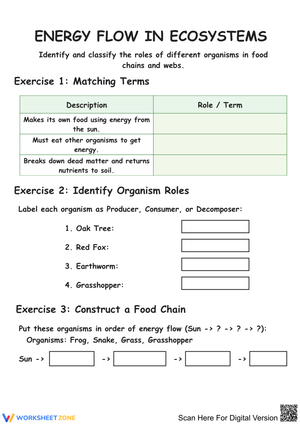
- Vocabulary work: Students match and define terms including ecosystem, habitat, producer, consumer, decomposer, and organism. One worksheet pairs each term with a visual example rather than a written definition, which reaches students who struggle to decode dense text.
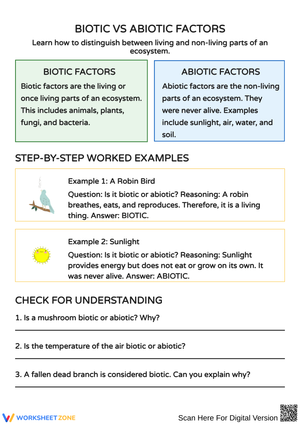
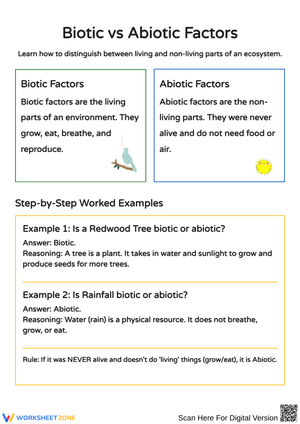
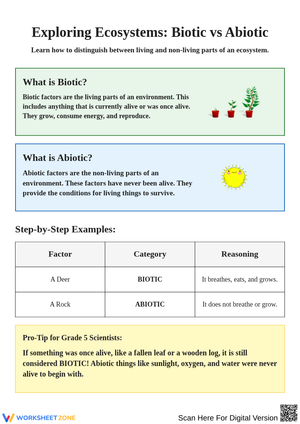
- Biotic and abiotic classification: Students examine a scene — a pond, a forest floor, a grassland — and sort its elements into living and nonliving categories. This is harder than it looks, and the sorting format surfaces confusion faster than a matching task does.
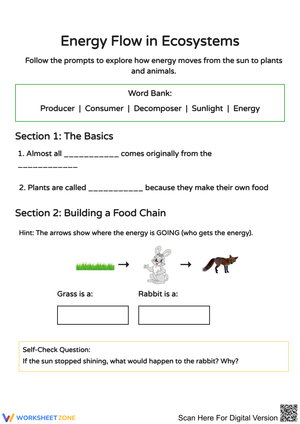
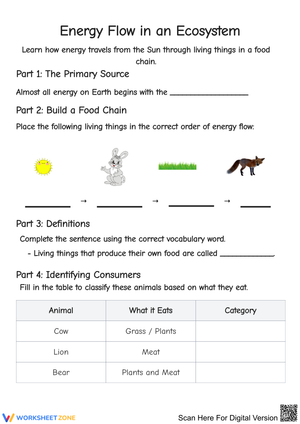
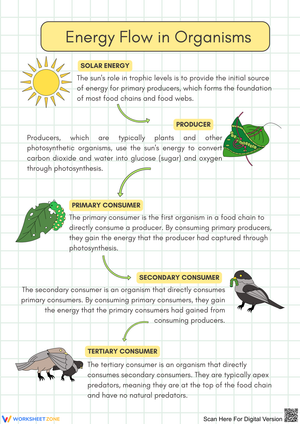
- Food chain sequencing: Students arrange organisms to show the path of energy, place arrows in the correct direction, and name the producer and each level of consumer.
- Food web reading: Students trace feeding relationships through a multi-organism diagram and answer questions about what shifts when one species is removed.
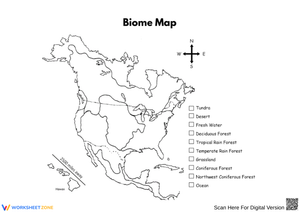
- Habitat matching: Students connect animals and plants to the environments that meet their needs — forest, desert, ocean, freshwater pond, or grassland — and explain one reason for each match.
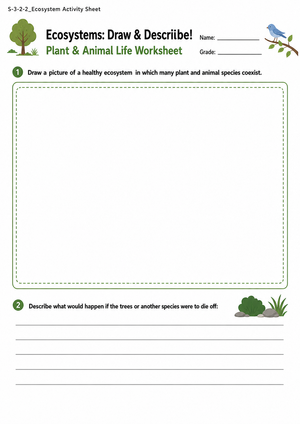
- Short written response: Students describe what would happen to an ecosystem if its producers disappeared or if a drought reduced a water source, using evidence from a diagram or passage to support their answer.
Frequent Student Errors Worth Watching For
When students work through ecosystem printable worksheets for 4th grade, two errors on food chain tasks come up reliably enough to address directly. First, students draw arrows pointing from predator to prey — thinking the arrow means "eats" — when the arrow should point from prey to predator to show the direction energy travels. A student will write "Fox → Rabbit" with complete confidence. Second, many students mark soil as abiotic without hesitation, not yet aware that soil contains living decomposers and bacteria that make it partially biotic. Both errors show up clearly in labeling and sorting tasks, which is exactly why those formats belong in the set.
A third pattern worth anticipating: fourth graders frequently use habitat and ecosystem as interchangeable terms. Habitat describes where an organism lives; ecosystem describes the full set of living and nonliving components and their interactions in an area. Students who write "the ecosystem of a fish is the ocean" are collapsing the two ideas into one. The vocabulary worksheet targets this distinction directly, but expect to revisit it in discussion after students complete the task — one round of written practice rarely settles it.
How to Build These Worksheets Into Your Lesson Plans
The most consistent use pattern for this set is pairing each worksheet with a brief second pass the following day. On day one, students complete the worksheet independently. On day two, they return to the same worksheet and explain one answer to a partner — out loud, pointing to the diagram or passage they used as evidence. That second conversation often reveals stronger reasoning than the written answer did, and it costs only five to eight minutes of class time without requiring new materials.
Beyond that, the set divides naturally by lesson phase. The vocabulary and sorting worksheets work well as warm-ups before introducing a new concept. The food chain and food web worksheets fit better as partner tasks during guided instruction, when students can talk through their reasoning before writing. The short-response worksheets — especially the cause-and-effect scenarios about ecosystem change — are strong exit tickets after a discussion or read-aloud. Each worksheet is self-contained enough to assign for homework or leave with a substitute without additional explanation.
Standard Alignment
NGSS clusters most formal ecosystem content at fifth grade under 5-LS2-1, which asks students to develop a model describing how matter moves among plants, animals, decomposers, and the environment. Many state frameworks, however, introduce food chains, habitats, and biotic/abiotic factors at fourth grade as direct preparation for that standard. These worksheets sit at that instructional entry point — building the vocabulary, classification habits, and diagram-reading skills students need before encountering the full systems-level thinking 5-LS2-1 demands. If your state framework explicitly places ecosystem basics at Grade 4, the set maps directly onto those objectives. If you follow NGSS strictly, these worksheets function as high-quality preview instruction for the fifth-grade life science progression.
Differentiating the Set for a Range of Learners
The simplest adjustment with these worksheets is changing the output, not the science content. A student working below grade level and a student working above grade level can both examine the same pond ecosystem diagram — one circles and labels, the other writes a paragraph explaining how energy moves through three organisms in that diagram. The science concept is identical; the demand on language production is not.
For students who need more support, the picture-based sorting worksheets are the natural starting point. Word banks on the vocabulary worksheets reduce the reading barrier without removing the science thinking. For students ready for a real challenge, the cause-and-effect scenarios gain significant complexity when you ask them to predict two or three downstream effects of a single environmental change — for example, what happens to a grassland ecosystem when a drought reduces the grass supply, affecting both the insects that feed on it and the birds that depend on those insects. That chain of reasoning is genuinely fourth-grade hard, and most students who breeze through standard food chain tasks will slow down on it.
Standard Alignment
Frequently Asked Questions
Do these worksheets fit small-group science rotations?
Yes. Each worksheet is self-contained and completable in roughly ten to fifteen minutes, which fits a standard rotation block. The sorting and labeling worksheets run smoothly without teacher support at the station; the short-response worksheets benefit from a brief model or anchor chart posted nearby.
What reading level do the passages use?
The reading passages are written for mid-to-late fourth grade. Students working significantly below grade level benefit from starting with the picture-based worksheets first. The ecosystem printable worksheets for 4th grade that rely on diagrams rather than passages give those students access to the same science concepts with a lower text demand.
Can these worksheets be used for science test review?
The food web, biotic/abiotic classification, and cause-and-effect response worksheets are strong review tools because they require students to apply vocabulary rather than recall it in isolation. Teachers preparing students for a district or state science assessment will find the short-response format especially useful — students practice explaining relationships in writing, which is what most assessments ask them to do.
How should I sequence the worksheets across a unit?
Start with vocabulary and habitat matching at the beginning of a unit, move to producers, consumers, decomposers, and food chains in the middle, and close with food webs and ecosystem change scenarios at the end. That order moves from recognition-level tasks to application and prediction, which matches how most fourth-grade science units build conceptual depth. The ecosystem printable worksheets for 4th grade in this set are ordered to support that progression, though teachers can rearrange them to fit their own pacing.
Are answer keys provided?
Yes. Each worksheet includes an answer key. For the short-response items, the key provides sample answers that work as a benchmark rather than the only acceptable response — student wording will vary, and the samples are meant as a guide for scoring, not a script.












 Interactive Worksheet Maker
 Quiz Maker
 Word Search Maker
 Crossword Puzzle Maker
 Word Scramble Generator
 Sentence Scramble Generator
 Handwriting Worksheet Generator
 Name Tracing Generator
 Fill In The Blank Generator