




























Views
Downloads

Printable Integumentary System Worksheet | Grade 4 Science

Paste this activity's link or code into your existing LMS (Google Classroom, Canvas, Teams, Schoology, Moodle, etc.).
Students can open and work on the activity right away, with no student login required.
You'll still be able to track student progress and results from your teacher account.
This Grade 4 science worksheet helps students identify and explain the parts and functions of the integumentary system. By labeling diagrams and answering targeted questions, learners will understand how skin, hair, nails, and glands work together to protect the human body and support overall survival.
At a Glance
- Grade: 4 · Subject: Science
- Standard:
4-LS1-1— Explain how internal and external structures support survival.- Skill Focus: Integumentary system anatomy and functions
- Format: 2 pages · 10 problems · Answer key included · PDF
- Best For: Independent practice or science centers
- Time: 15–20 minutes
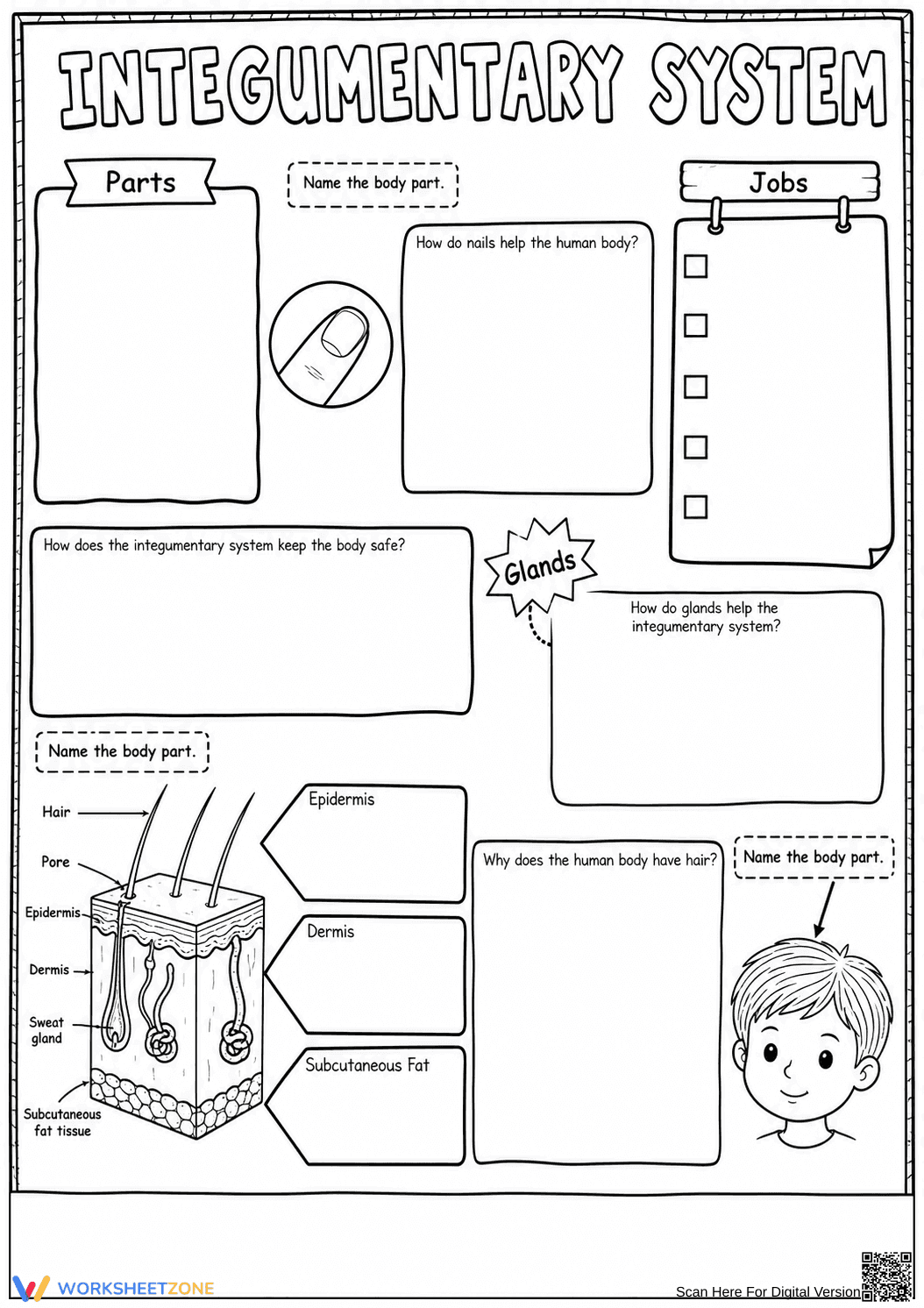
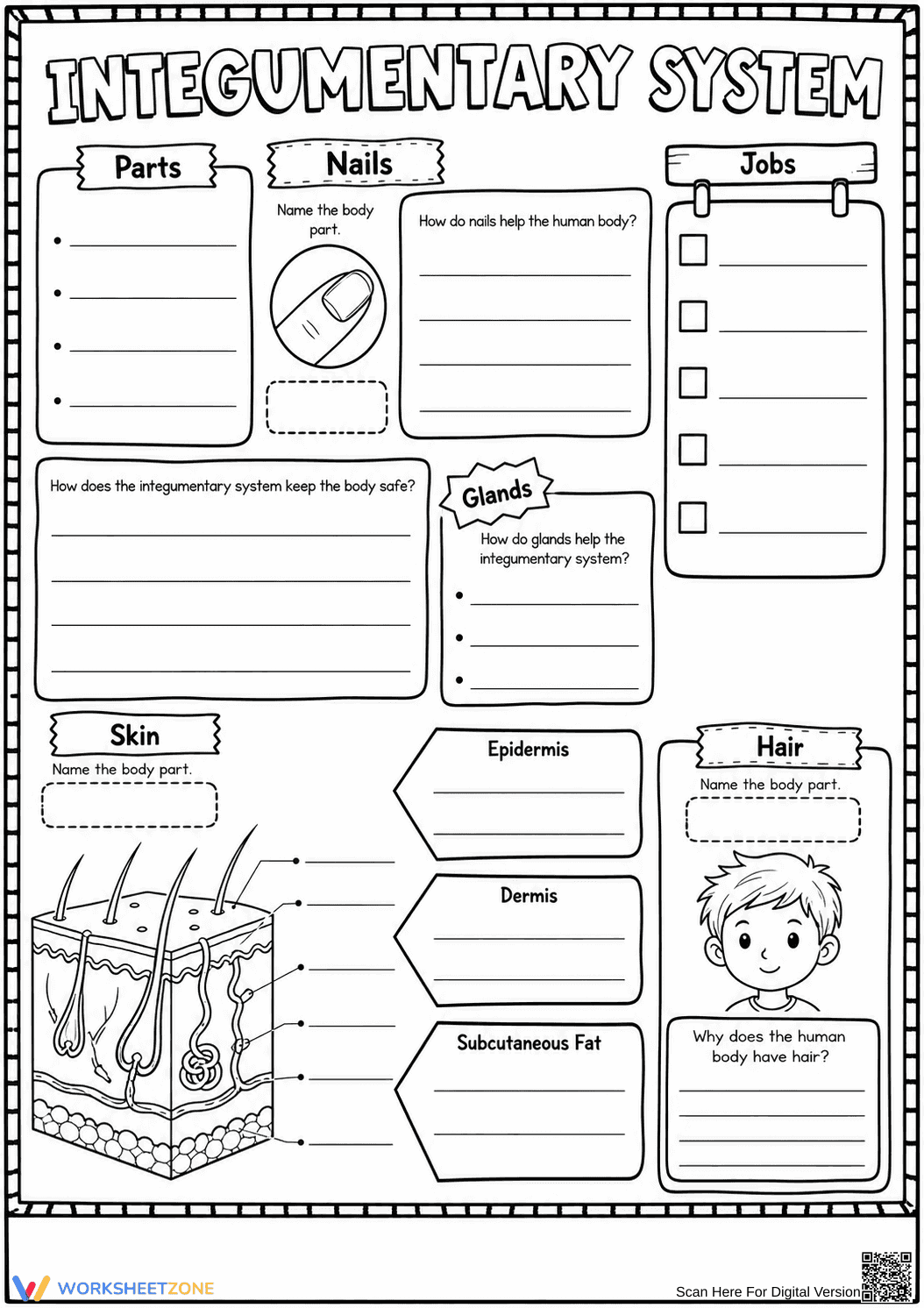
This resource features a visual graphic organizer layout that breaks down biological concepts. Students will label a detailed cross-section diagram of the skin, including the epidermis, dermis, and subcutaneous fat. The worksheet includes dedicated spaces for listing the parts and jobs of the integumentary system, alongside short-answer prompts about the protective roles of hair, nails, and sweat glands. A complete answer key is provided.
- Print (1 minute): Simply download the PDF and print the desired number of copies. The black-and-white design is optimized for clear, ink-saving reproduction.
- Distribute (1 minute): Hand out the worksheets as a standalone assignment or alongside a textbook reading. The clear instructions mean students can begin immediately.
- Review (3 minutes): Use the included answer key to quickly check student responses or project it on the board for a whole-class review session.
Total teacher prep time is under two minutes, making this ideal for sub plans.
Aligned to primary standard 4-LS1-1: Construct an argument that plants and animals have internal and external structures that function to support survival, growth, behavior, and reproduction. This activity specifically targets the external structures of the human body and their protective functions. Both standard codes can be copied directly into lesson plans, IEP goals, or district curriculum mapping tools.
Deploy this worksheet during a human body systems unit as a guided notes page while introducing the integumentary system. Alternatively, assign it as an independent review task. For formative assessment, observe how students answer the short-response questions about how the system keeps the body safe; this reveals their grasp of the system's overarching purpose. Expect completion to take 15 to 20 minutes.
This resource is designed for upper elementary students, specifically in fourth grade, who are exploring human anatomy and life science. The visual nature of the diagram and the structured response boxes provide excellent scaffolding for visual learners and students who benefit from graphic organizers. It pairs perfectly with an introductory reading passage on human body systems or a hands-on demonstration of how skin acts as a barrier.
Effectively teaching the integumentary system requires moving beyond simple vocabulary memorization to understanding functional relationships. This worksheet aligns with standard 4-LS1-1, challenging students to explain how internal and external structures support survival. According to a ScienceDirect TpT Analysis, graphic organizers and labeled diagrams significantly improve retention of complex biological systems in elementary learners by reducing cognitive load and visually mapping part-to-whole relationships. By requiring students to both label anatomical features like the epidermis and articulate the protective functions of glands and hair, this resource bridges the gap between rote identification and conceptual understanding. The structured format ensures that learners can systematically process how these external structures defend the human body, providing a solid foundation for more advanced life science curricula in middle school.


