


























Views
Downloads

Essential Nervous System Worksheet | Grade 4-5 Science
Paste this activity's link or code into your existing LMS (Google Classroom, Canvas, Teams, Schoology, Moodle, etc.).
Students can open and work on the activity right away, with no student login required.
You'll still be able to track student progress and results from your teacher account.
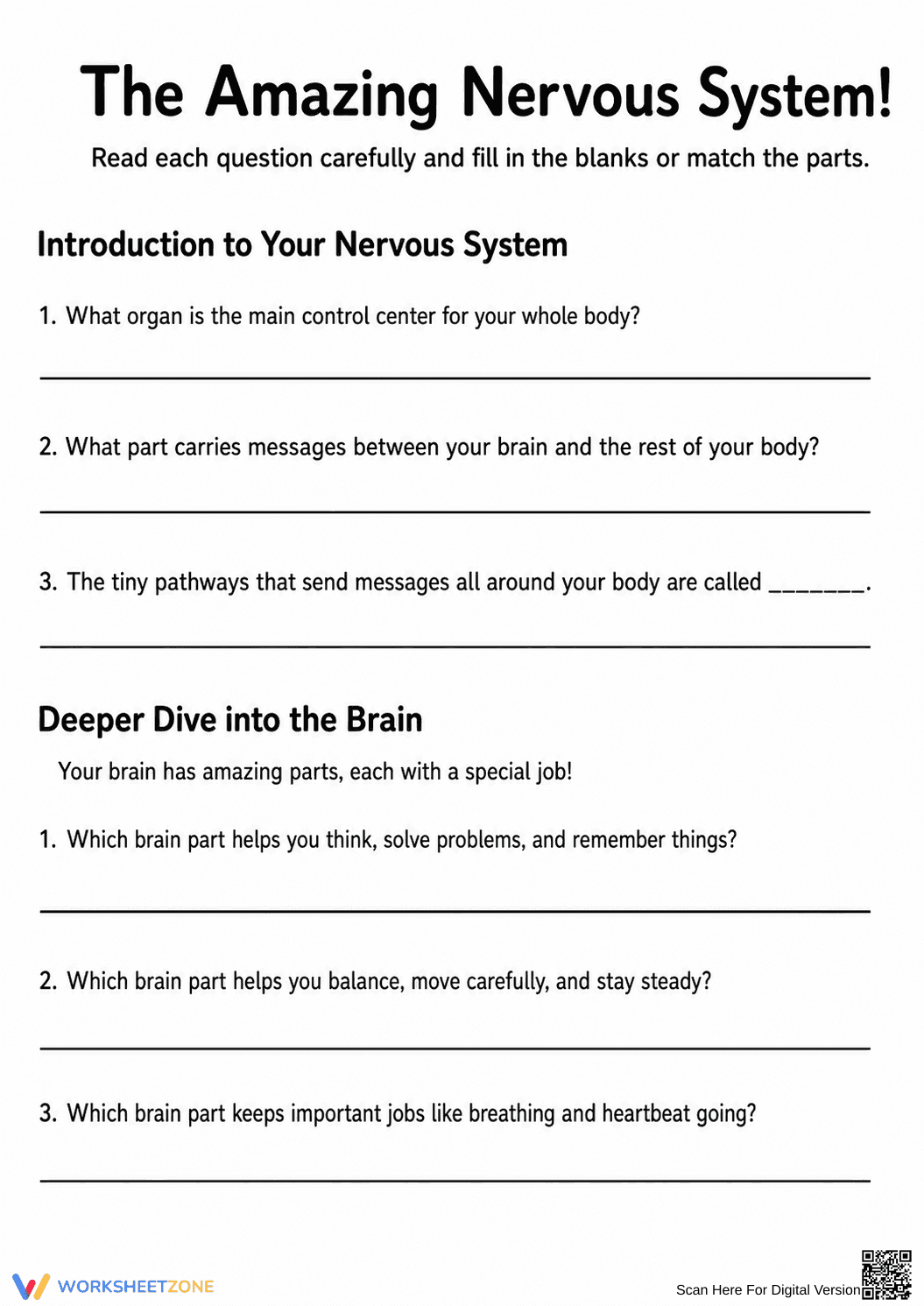
Students will master the fundamentals of human biology with this comprehensive nervous system resource. By engaging with structured questions about the brain, spinal cord, and peripheral nerves, learners develop a clear mental model of how the body processes information. This activity ensures students can distinguish between the cerebrum, cerebellum, and brainstem while understanding the critical role of sensory and motor pathways.
At a Glance
- Grade: 4 · Subject: Science
- Standard:
4-LS1-2— Describe how animals receive, process, and respond to information through the brain- Skill Focus: Nervous system anatomy and brain functions
- Format: 2 pages · 14 problems · Answer key included · PDF
- Best For: Independent practice or formative assessment
- Time: 20–30 minutes
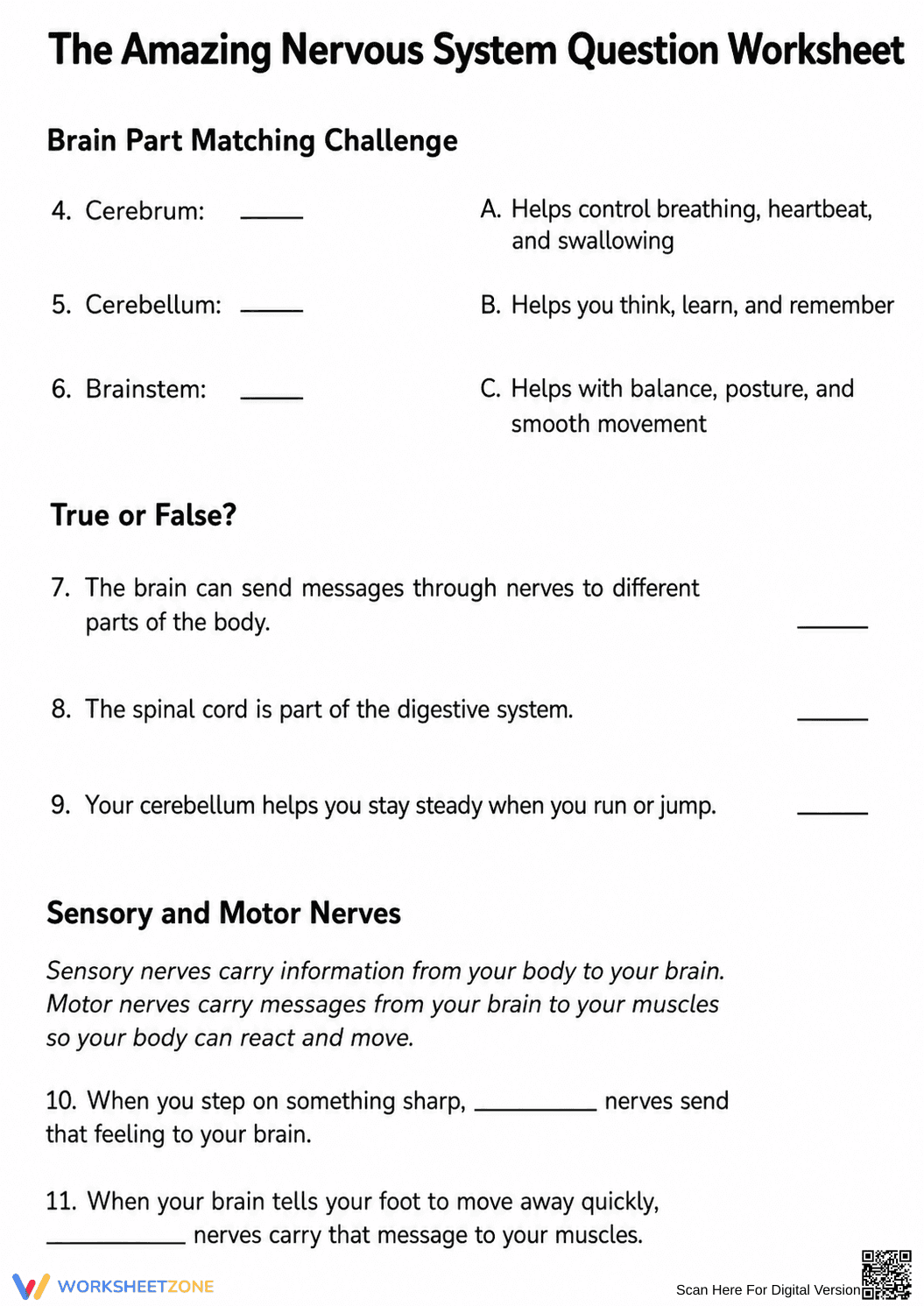
This two-page resource features 14 distinct tasks designed to reinforce life science vocabulary. The first page introduces the central nervous system with open-ended questions and a focused look at brain anatomy. The second page challenges students with a brain part matching activity, a true-or-false section to clear up common misconceptions, and a fill-in-the-blank exercise regarding sensory and motor nerve functions.
The zero-prep workflow is designed for maximum efficiency in busy classrooms. Teachers can print the double-sided PDF in less than 30 seconds. Distribution takes approximately 1 minute, and because the tasks are self-explanatory, students can begin working immediately without lengthy verbal instructions. Reviewing the 14 answers as a whole class takes roughly 5 minutes, making this an ideal sub plan or quick check for understanding.
This worksheet is primarily aligned with `4-LS1-2`, which requires students to use a model to describe how animals receive different types of information through their senses, process that information in their brain, and respond accordingly. It also supports middle school introductory concepts for MS-LS1-8. Both standard codes can be copied directly into lesson plans, IEP goals, or district curriculum mapping tools.
Use this worksheet as a mid-unit check after introducing the major organs of the body. It works exceptionally well as a formative assessment; observe students during the "Brain Part Matching Challenge" to see if they can differentiate between involuntary functions and conscious thought. Expected completion time is 20 to 30 minutes depending on prior knowledge and reading level.
This resource is tailored for students in Grades 3 through 5 who are exploring human body systems. It provides enough scaffolding for struggling readers while maintaining the technical vocabulary necessary for advanced learners. Pair this worksheet with a 3D brain model or a short video clip on nerve impulses to provide a multi-sensory learning experience for your science block.
The study of the nervous system at the elementary level is a cornerstone of biological literacy, as outlined in the NGSS framework. According to research from Fisher & Frey (2014) on the gradual release of responsibility, structured worksheets that move from simple recall to functional application—such as matching brain parts to their specific physiological roles—help solidify the instructional model. By requiring students to explain how sensory nerves carry information to the brain (Standard 4-LS1-2), this resource addresses the cognitive demand for evidence-based explanations in science. Data from NAEP science assessments suggests that students who can articulate the relationship between organ systems and bodily functions perform significantly better on complex life science evaluations. This worksheet provides the necessary repetition and vocabulary reinforcement to bridge the gap between basic identification and conceptual mastery of human anatomy.


