




























Views
Downloads

Essential Voluntary and Involuntary Muscles Worksheet

Paste this activity's link or code into your existing LMS (Google Classroom, Canvas, Teams, Schoology, Moodle, etc.).
Students can open and work on the activity right away, with no student login required.
You'll still be able to track student progress and results from your teacher account.
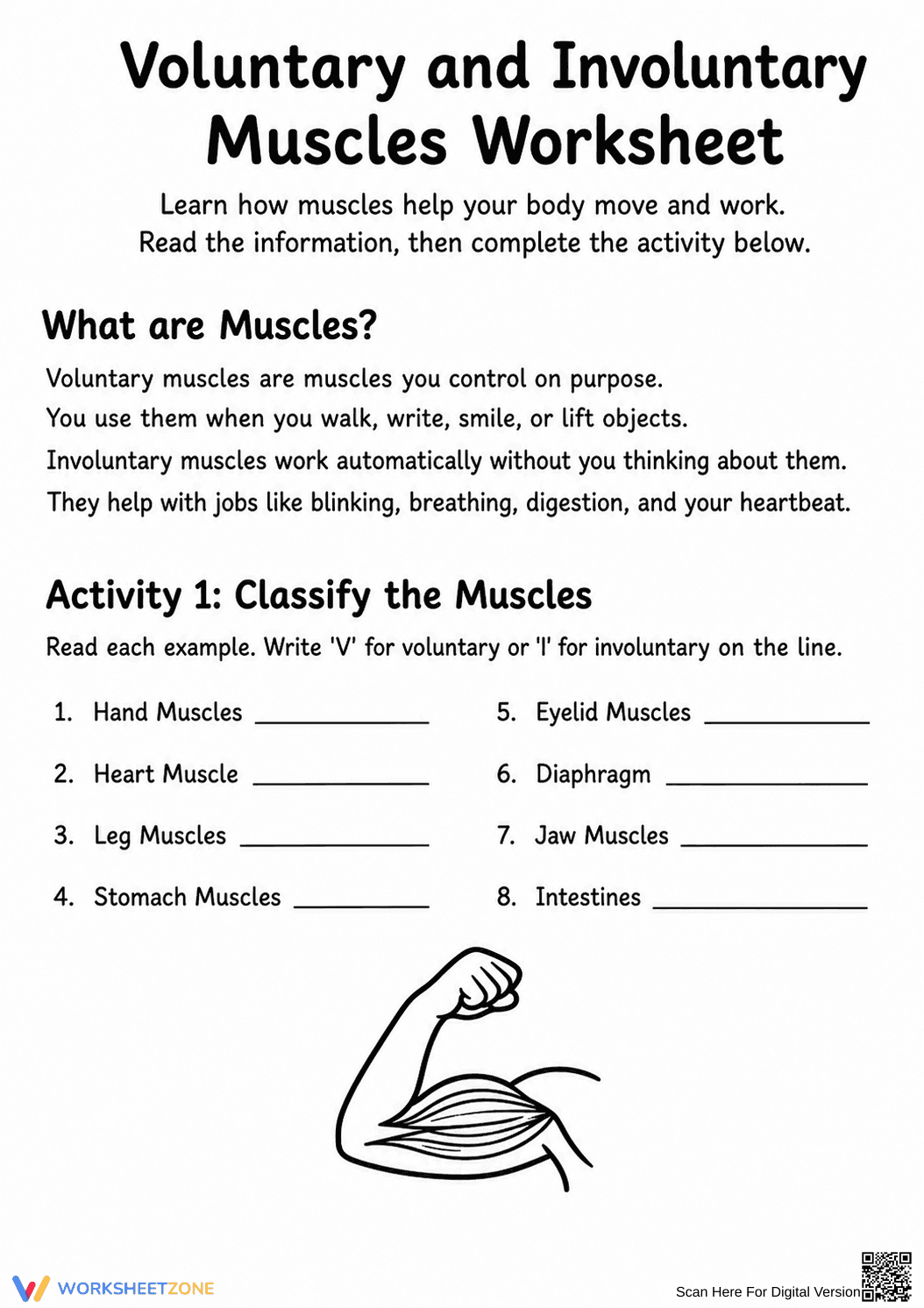
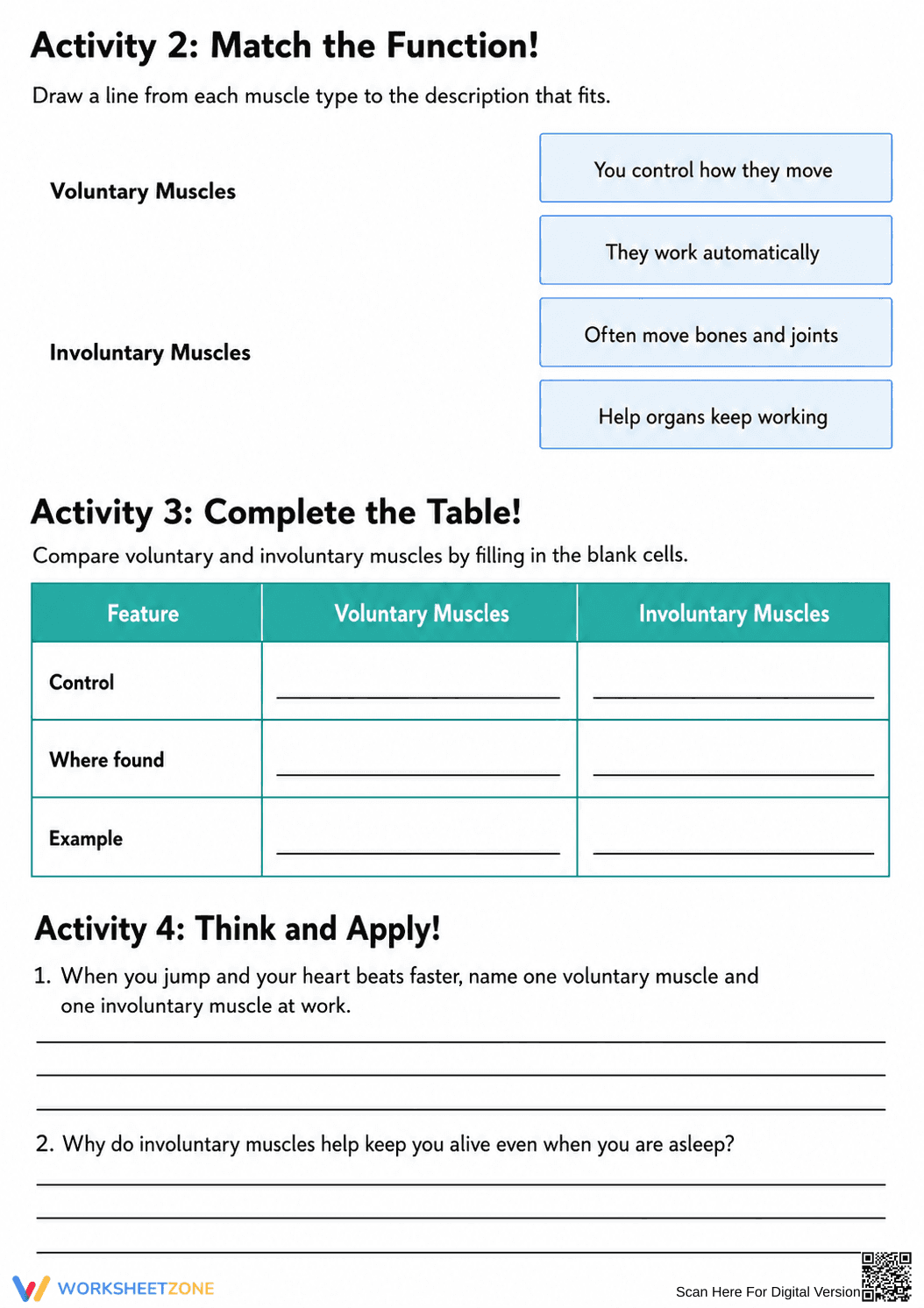
This Grade 4 science worksheet helps students master the distinction between voluntary and involuntary muscles through structured reading and four interactive activities. Students will identify how the body manages conscious movements versus automatic functions like heartbeats, ensuring a clear understanding of human anatomy and physiology.
At a Glance
- Grade: 4 · Subject: Science
- Standard:
4-LS1-1— Identify internal structures that function to support survival and growth- Skill Focus: Muscular system classification
- Format: 2 pages · 20 problems · Answer key included · PDF
- Best For: Human body systems unit introduction
- Time: 25–35 minutes
The resource features a concise reading passage followed by four distinct tasks: an 8-item classification list, a functional matching exercise, a comparison table for deep analysis, and two critical thinking application questions. The 2-page PDF includes a clear layout and a complete answer key for rapid grading and immediate student feedback.
Teachers can implement this lesson in three simple steps. First, print the 2-page PDF (30 seconds). Second, distribute to students for independent or partner work (1 minute). Third, review the answers using the included key to provide immediate feedback (5 minutes). This efficient workflow makes it an ideal sub plan or supplemental activity for busy science blocks.
This worksheet aligns with `4-LS1-1`, requiring students to construct an argument that plants and animals have internal and external structures that function to support survival, growth, behavior, and reproduction. It specifically addresses how the muscular system supports these life functions through both conscious and automatic actions. Both standard codes can be copied directly into lesson plans, IEP goals, or district curriculum mapping tools.
Use this as a mid-unit check for understanding after introducing the human body. During the activity, observe if students can correctly categorize the diaphragm and heart, which often challenge young learners. It typically takes 30 minutes to complete, making it perfect for a standard science block or as a formative assessment before a unit test.
This resource is designed for 3rd through 5th-grade students exploring biology. It provides enough scaffolding for English Language Learners through the introductory text and works well when paired with a 3D anatomical model or a video demonstration of muscle contraction. It is also suitable for homeschool environments focusing on life sciences.
According to the RAND AIRS 2024 report, structured science worksheets that combine informational text with multi-modal tasks—such as the classification and matching found here—significantly improve retention of complex biological concepts in upper elementary students. By targeting standard 4-LS1-1, this resource ensures students understand the functional differences between voluntary and involuntary muscle groups. Research from Fisher & Frey (2014) emphasizes that the gradual release of responsibility, moving from guided reading to independent application questions, is essential for mastering scientific literacy. This 2-page printable provides 20 specific data points for formative assessment, allowing educators to track student progress toward mastery of human body systems. The inclusion of a comparison table encourages higher-order thinking by requiring students to synthesize information rather than simply memorizing definitions, leading to better long-term conceptual outcomes.


