




























Views
Downloads
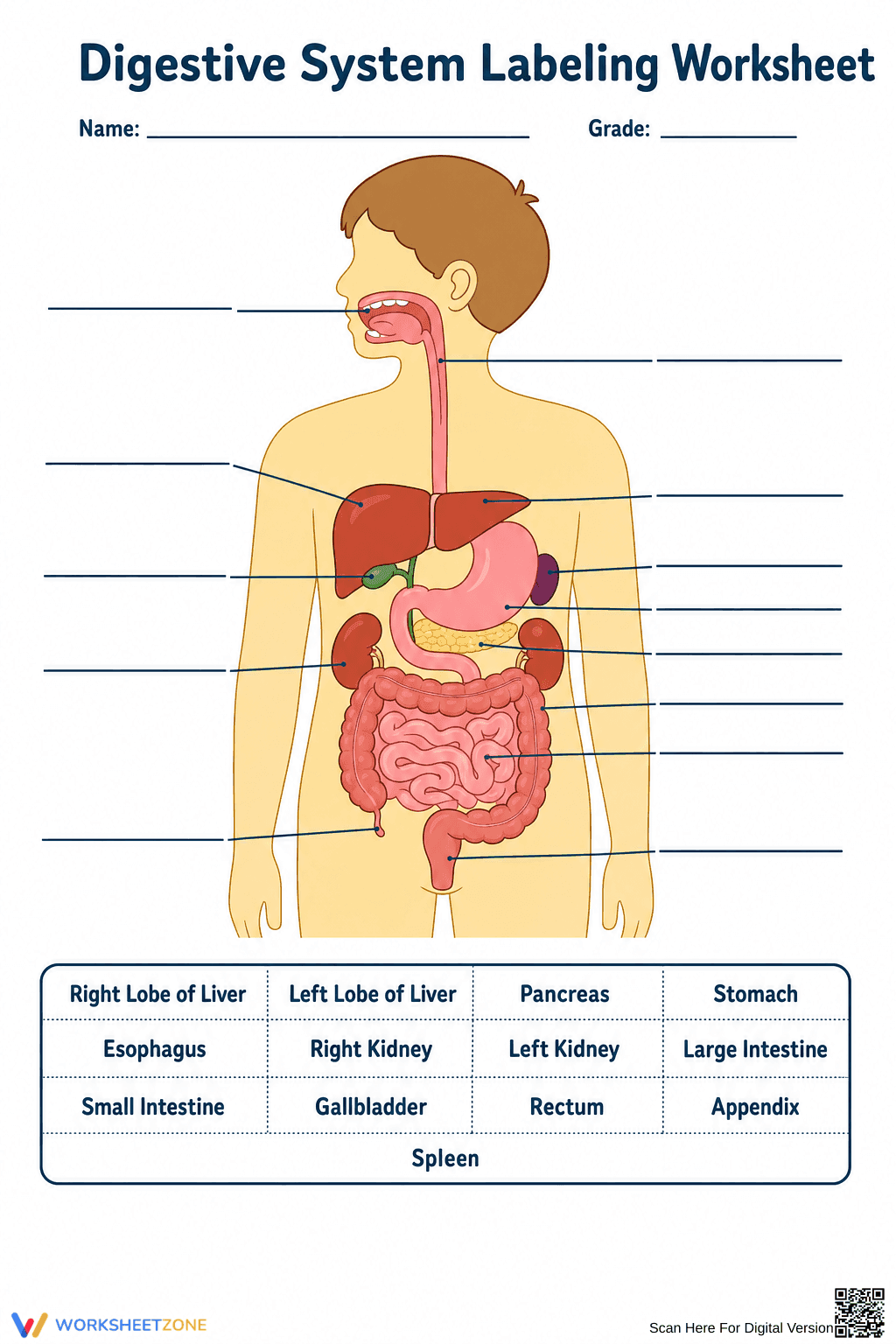

Grade 4 Digestive System — Printable No-Prep Worksheet

Paste this activity's link or code into your existing LMS (Google Classroom, Canvas, Teams, Schoology, Moodle, etc.).
Students can open and work on the activity right away, with no student login required.
You'll still be able to track student progress and results from your teacher account.
This Grade 4 science worksheet provides students with a clear, engaging diagram to identify and label the internal structures of the human digestive system. By matching 13 specific organs from the provided word bank to their correct anatomical locations, students build foundational knowledge of how internal subsystems function to support survival and digestion.
At a Glance
- Grade: 4 · Subject: Science
- Standard:
4-LS1-1— Identify internal structures that support survival and growth- Skill Focus: Labeling digestive system organs
- Format: 1 page · 13 problems · Answer key included · PDF
- Best For: Independent practice or review
- Time: 10–15 minutes
Inside this single-page resource, educators will find a high-quality, full-color anatomical diagram of the human body focusing on the digestive tract and associated organs. The worksheet features 13 distinct labeling lines pointing to key structures, including the stomach, intestines, liver, pancreas, and kidneys. A comprehensive word bank is positioned at the bottom of the page to scaffold student learning and ensure accurate spelling. A complete answer key is also provided for rapid grading.
This resource is designed for a smooth, zero-prep classroom experience. Print the PDF copies for your roster in under one minute. Distribute the worksheets along with pencils or colored markers, which takes another minute. Review the instructions and the word bank with the class in two minutes before letting them work independently. The total teacher preparation time is less than two minutes, making this an excellent, reliable option for emergency sub plans or quick formative assessments.
This worksheet is directly aligned with 4-LS1-1, requiring students to construct an argument that plants and animals have internal and external structures that function to support survival, growth, behavior, and reproduction. By identifying the specific organs of the digestive system, students gather evidence of these internal structures. Both standard codes can be copied directly into lesson plans, IEP goals, or district curriculum mapping tools.
This labeling activity works perfectly as an independent practice assignment immediately following direct instruction on human body systems. Teachers can also use it as a formative assessment tool; observe students as they work to see if they confuse the small and large intestines or the liver and stomach, which indicates a need for targeted reteaching. The expected completion time ranges from 10 to 15 minutes, making it an ideal warm-up or exit ticket.
This resource is primarily designed for fourth-grade science students, though it serves as an excellent review for fifth and sixth graders studying human biology. The inclusion of a word bank provides built-in differentiation for English Language Learners and students needing vocabulary support. It pairs naturally with an introductory reading passage on digestion or a 3D anatomical model demonstration.
Aligning instructional materials with 4-LS1-1 ensures students can accurately identify internal structures that support survival and growth. According to a recent ScienceDirect TpT Analysis, incorporating visual diagrams with targeted word banks significantly improves vocabulary retention and spatial understanding of anatomical systems in elementary science education. By connecting the visual representation of the digestive system to specific anatomical terminology, educators facilitate deeper cognitive mapping. This structured visual approach not only reinforces immediate lesson objectives but also builds the foundational scientific literacy required for more complex biological studies in middle school and beyond. When students actively engage in labeling exercises, they transition from passive observers to active participants in their own learning process, solidifying their grasp of how individual organs contribute to the broader function of the human body.


