




























Views
Downloads
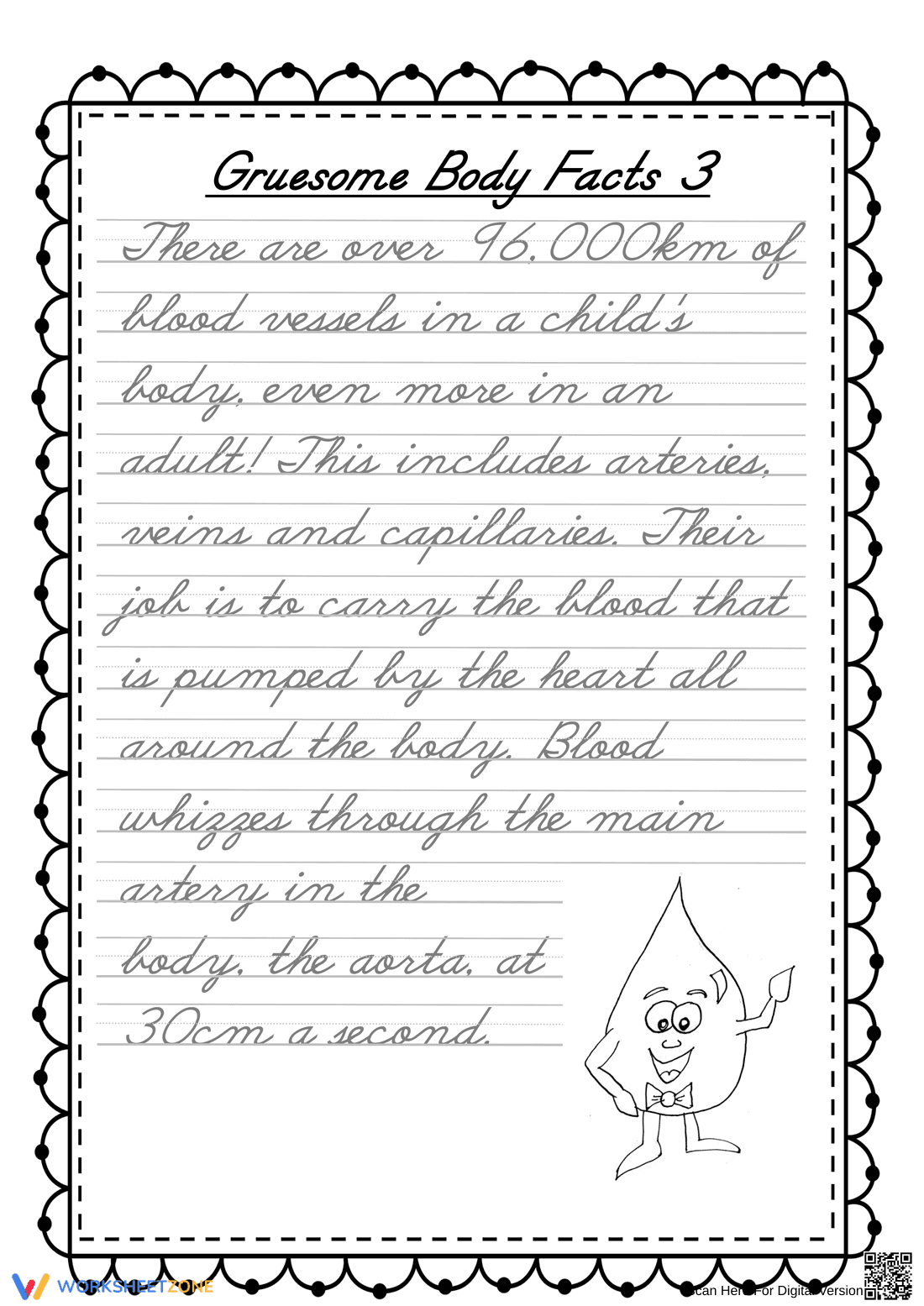

Blood Vessels Cursive Handwriting | Essential Grade 3-4

Paste this activity's link or code into your existing LMS (Google Classroom, Canvas, Teams, Schoology, Moodle, etc.).
Students can open and work on the activity right away, with no student login required.
You'll still be able to track student progress and results from your teacher account.
This Grade 3 and 4 science-themed handwriting worksheet helps students master cursive fluency while learning about the human circulatory system. By copying a paragraph about blood vessel length and speed, learners improve letter formation and spacing. This resource provides a meaningful context for penmanship practice, ensuring students remain engaged with interesting biological facts.
At a Glance
- Grade: 3-4 · Subject: Science & Handwriting
- Standard:
CCSS.ELA-LITERACY.L.3.1.j— Write legibly in cursive, focusing on letter connections and spacing- Skill Focus: Cursive penmanship and circulatory system facts
- Format: 1 page · 1 paragraph · Answer key included · PDF
- Best For: Morning work or science cross-curricular practice
- Time: 15–20 minutes
What's Inside
This single-page PDF features a "Gruesome Body Fact" about the 96,000km of blood vessels in the human body. The worksheet includes a clear cursive model for students to trace or copy onto lined paper. It utilizes a standard D'nealian-style cursive font, ensuring that letter connections are anatomically correct for developing writers. A small illustration of a blood drop adds a visual element to the page, making the task more approachable for young learners.
Zero-Prep Workflow
- Print: Select the single-page PDF and print enough copies for your class (30 seconds).
- Distribute: Hand out the sheets as students enter the classroom or transition to science block (1 minute).
- Review: Briefly discuss the cursive connections and the scientific facts as a whole group (5 minutes).
Total teacher preparation time is under 2 minutes, making it an ideal sub plan or bell-ringer activity.
Standards Alignment
The primary standard addressed is `CCSS.ELA-LITERACY.L.3.1.j`, which requires students to write legibly in cursive. Additionally, it supports NGSS `4-LS1-1` by introducing internal structures that support survival and growth. Both standard codes can be copied directly into lesson plans, IEP goals, or district curriculum mapping tools.
How to Use It
Use this worksheet during the independent practice phase of a handwriting lesson or as a cross-curricular reinforcement during a biology unit. For a formative assessment, observe students' grip and the fluidity of their letter connections as they work. Expected completion time ranges from 15 to 20 minutes depending on the student's fine motor proficiency and familiarity with cursive script.
Who It's For
This resource is perfect for third and fourth-grade students who have moved beyond individual letter formation and are ready for paragraph-level cursive practice. It is particularly effective for students who find traditional handwriting drills boring, as the "gruesome" facts provide high-interest motivation. Pair this with a diagram of the human heart or a circulatory system anchor chart for a complete lesson.
According to the RAND AIRS 2024 report, integrating content-area knowledge with foundational literacy skills significantly increases student engagement and retention. This worksheet targets CCSS.ELA-LITERACY.L.3.1.j by requiring students to produce legible cursive text within a scientific context. Research from Fisher & Frey (2014) emphasizes that cross-curricular writing tasks, such as copying facts about blood vessels, help solidify vocabulary while refining fine motor control. By focusing on the 96,000km of vessels and the 30cm-per-second speed of blood in the aorta, students process complex informational text while practicing penmanship. This dual-purpose approach ensures that instructional time is maximized, providing 15 to 20 minutes of focused practice that meets both ELA and Science requirements. The use of high-interest "gruesome" facts serves as a cognitive hook, which NAEP studies suggest can improve the quality of student work in foundational writing tasks.


