




























Views
Downloads

Printable Muscular System Diagram | Grade 5 Science

Paste this activity's link or code into your existing LMS (Google Classroom, Canvas, Teams, Schoology, Moodle, etc.).
Students can open and work on the activity right away, with no student login required.
You'll still be able to track student progress and results from your teacher account.
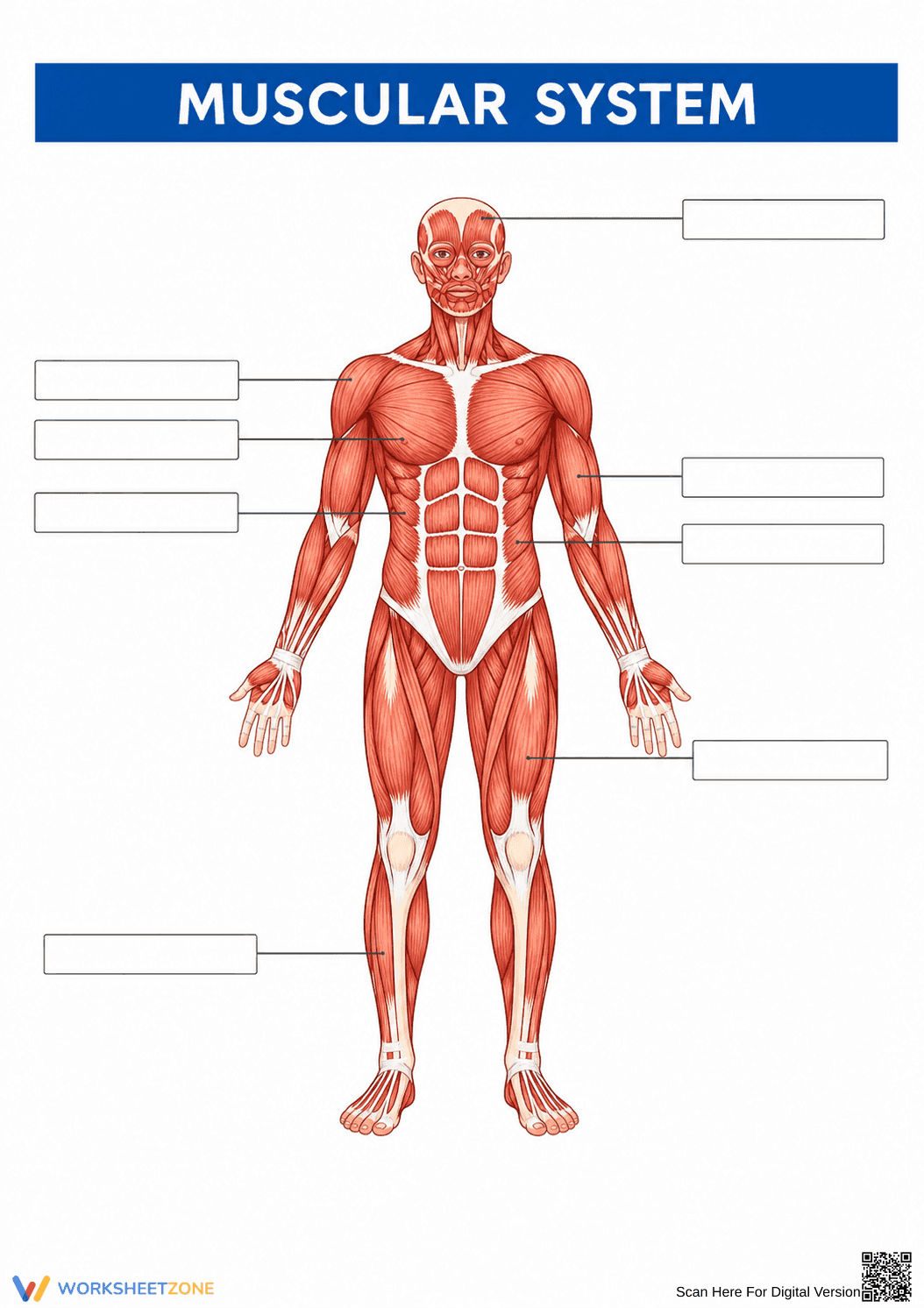
This human anatomy worksheet helps students identify and label the major muscle groups of the muscular system. By completing the diagram, learners build a foundational understanding of how internal structures support movement and survival, reinforcing key life science concepts through direct visual association.
At a Glance
- Grade: 4–6 · Subject: Science
- Standard:
4-LS1-1— Identify internal structures that support survival and movement- Skill Focus: Labeling the muscular system
- Format: 1 page · 8 problems · Answer key included · PDF
- Best For: Independent practice or review
- Time: 10–15 minutes
This single-page resource features a high-quality, full-body illustration of the human muscular system. Students are tasked with filling in eight blank text boxes connected by pointer lines to specific major muscle groups, such as the pectorals, abdominals, quadriceps, and biceps. A complete answer key is provided to ensure accurate self-correction or rapid teacher grading.
Zero-Prep Workflow
- Print (1 minute): Download the PDF and print a class set. The clear, high-contrast diagram ensures excellent photocopy quality.
- Distribute (1 minute): Hand out the worksheet as a standalone assignment or alongside a biology textbook or anatomy reference guide.
- Review (3 minutes): Display the answer key on your smartboard for quick, whole-class review.
Total teacher preparation time is under two minutes, making this an ideal emergency sub plan or immediate warm-up activity.
Standards Alignment
This activity aligns with 4-LS1-1: Construct an argument that plants and animals have internal and external structures that function to support survival, growth, behavior, and reproduction. By mapping the muscular system, students visualize the specific internal structures responsible for human movement and stability. Both standard codes can be copied directly into lesson plans, IEP goals, or district curriculum mapping tools.
How to Use It
Deploy this diagram during the middle of a human body systems unit after introducing the major muscle groups. It serves as an excellent formative assessment; as students work, circulate the room and observe whether they can distinguish between arm muscles (biceps) and leg muscles (quadriceps/calves) without checking their reference materials. Alternatively, use it as a pre-assessment to gauge prior anatomical knowledge before direct instruction. Expected completion time is 10 to 15 minutes.
Who It's For
This resource is designed for upper elementary and middle school students in Grades 4 through 6 studying life science or health. For students needing extra support, provide a word bank on the board containing the eight target muscle names. It pairs perfectly with an introductory direct instruction lesson on the musculoskeletal system or a reading passage about how muscles contract to create movement.
Integrating visual diagrams into life science instruction significantly enhances student retention of anatomical vocabulary and spatial relationships. According to a ScienceDirect TpT Analysis, spatial learning tools like labeled diagrams reduce cognitive load, allowing learners to process complex biological systems more efficiently than text alone. When students practice identifying internal structures that support survival and movement, aligned with 4-LS1-1, they transition from rote memorization to deeper structural comprehension. This worksheet provides the exact visual scaffolding required to build that foundational knowledge effectively. By physically writing the anatomical terms next to the corresponding physical features, students engage multiple learning modalities, solidifying their grasp of the muscular system. This targeted, repetition-based practice ensures that young learners can confidently discuss how internal structures function together to facilitate human movement, stability, and overall physical health in their daily lives.


