




























Views
Downloads

Muscular System Graphic Organizer | Grade 5 Essential

Paste this activity's link or code into your existing LMS (Google Classroom, Canvas, Teams, Schoology, Moodle, etc.).
Students can open and work on the activity right away, with no student login required.
You'll still be able to track student progress and results from your teacher account.
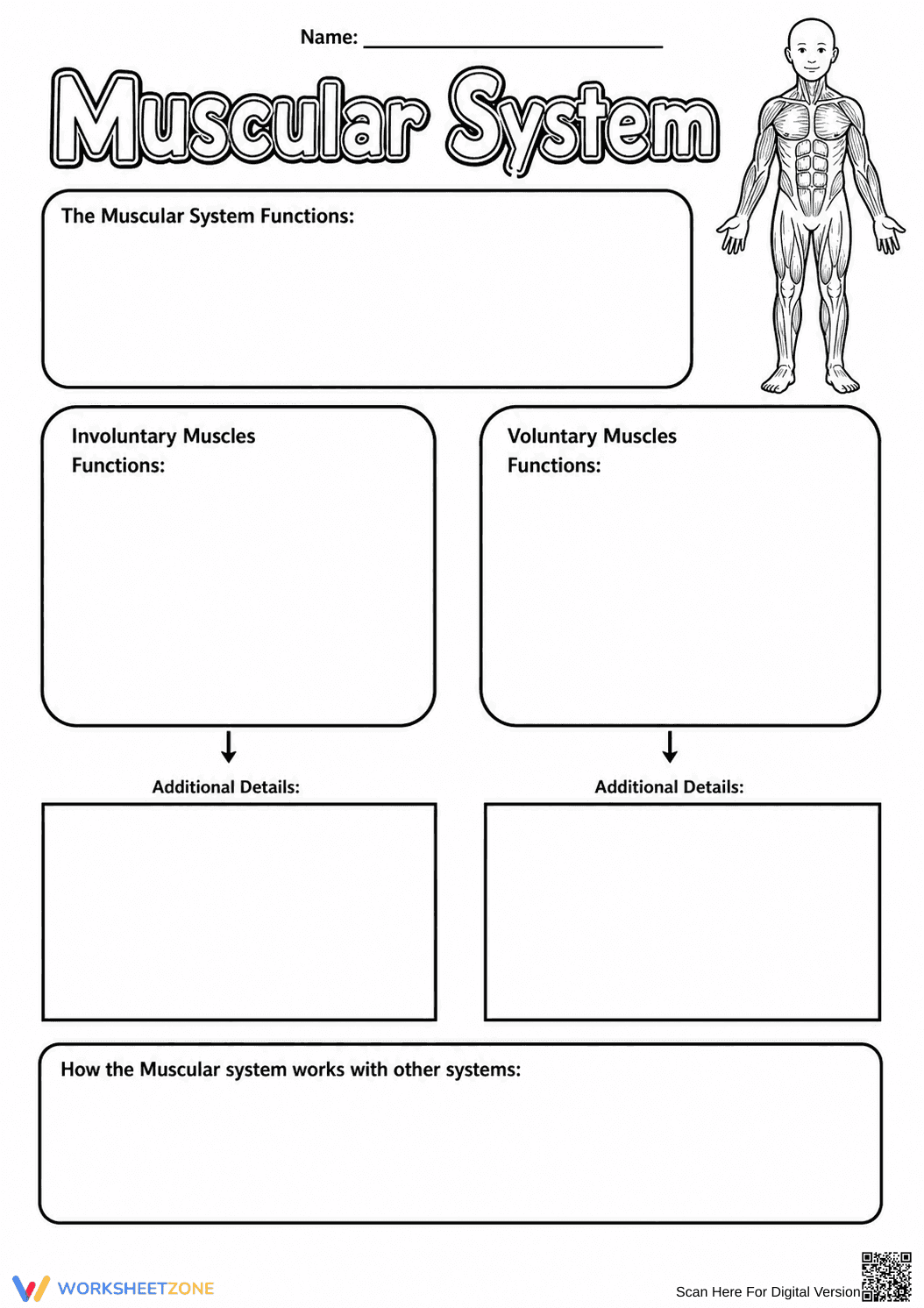
This Muscular System Graphic Organizer provides a structured framework for students to synthesize their knowledge of human anatomy. By categorizing muscle types and explaining physiological interactions, learners develop a comprehensive mental model of how the body moves. It transforms passive reading into active processing, ensuring students grasp the critical distinction between voluntary and involuntary control before moving to more complex biological systems.
At a Glance
- Grade: 5 · Subject: Science
- Standard:
4-LS1-1— Construct an argument that animals have internal structures that support survival and movement- Skill Focus: Muscular system classification and function
- Format: 1 page · 6 tasks · Answer key included · PDF
- Best For: Guided note-taking and formative assessment
- Time: 20–30 minutes
This single-page PDF features a clean, high-contrast layout designed for maximum readability in the classroom. It includes a detailed anatomical diagram of the human muscular system to provide immediate visual context for the learner. The organizer is divided into six logical zones: a primary box for general functions, dual tracks for involuntary and voluntary muscle details, and a concluding section for cross-system interactions. A comprehensive answer key is provided to streamline the grading process for busy educators.
The zero-prep workflow is designed for immediate classroom implementation. Simply print the required copies, distribute them during direct instruction or as a follow-up to a textbook reading session, and use the included answer key for a quick whole-class review or individual check-ins. This resource is an ideal "grab-and-go" option for unexpected sub plans or last-minute lesson adjustments.
This resource aligns with 4-LS1-1, focusing on how internal structures like muscles function to support the survival and movement of organisms. It also supports middle school standards by introducing how the muscular system interacts with the skeletal and nervous systems to coordinate complex body functions. Both standard codes can be copied directly into lesson plans, IEP goals, or district curriculum mapping tools to ensure compliance with state frameworks.
Use this organizer as a "during-reading" tool to help students filter information from a science text. As they encounter facts about cardiac, smooth, or skeletal muscles, they can immediately categorize them into the voluntary or involuntary sections. For formative assessment, collect the completed sheets to identify if students can correctly distinguish between muscle types. Expected completion time is approximately 25 minutes when paired with a short video or reading passage.
This worksheet is tailored for upper elementary and middle school students, particularly those in grades 4, 5, and 6. It is highly effective for visual learners and students who require graphic scaffolding to organize complex biological concepts. It pairs naturally with a skeletal system diagram or a hands-on lab activity involving muscle contraction models to provide a holistic view of the musculoskeletal system and its role in human health.
According to the RAND AIRS 2024 report, graphic organizers significantly improve the retention of complex scientific terminology by reducing cognitive load. This 4-LS1-1 aligned resource targets the specific skill of identifying internal structures and their roles in organism survival. By requiring students to articulate the relationship between voluntary and involuntary muscles, the worksheet moves beyond rote memorization toward conceptual mastery. Research from Fisher & Frey (2014) emphasizes that structured note-taking supports the gradual release of responsibility, allowing students to transition from teacher-led instruction to independent synthesis.


