


























Views
Downloads

Homeostasis Worksheet: Essential Grade 4-5 Science Guide
Paste this activity's link or code into your existing LMS (Google Classroom, Canvas, Teams, Schoology, Moodle, etc.).
Students can open and work on the activity right away, with no student login required.
You'll still be able to track student progress and results from your teacher account.
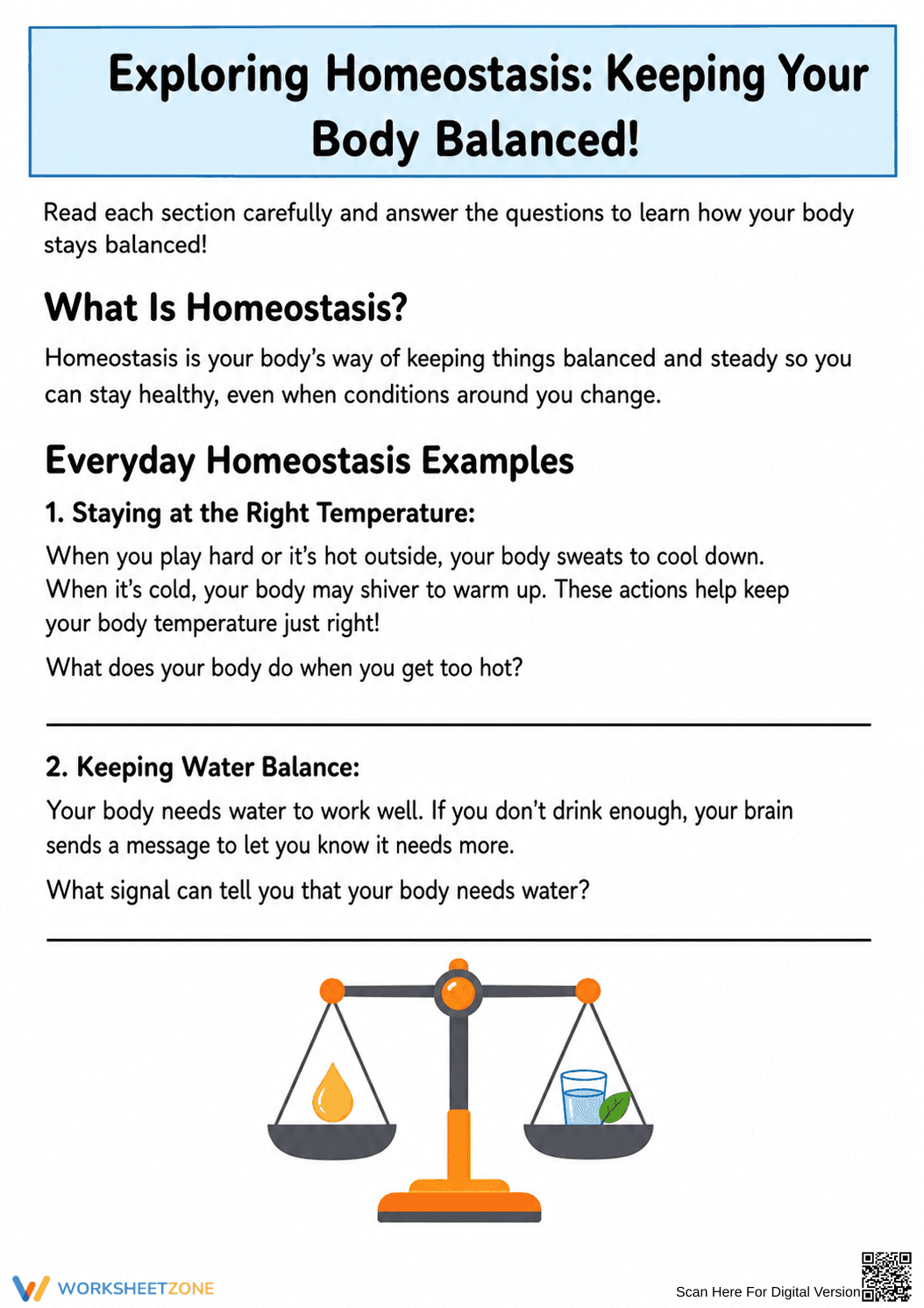
This Grade 4-5 science worksheet introduces students to the fundamental concept of homeostasis through engaging reading passages and practical examples. By exploring how the human body regulates temperature, water, and energy, learners develop a concrete understanding of biological balance. It provides a clear pathway for students to connect internal physiological processes to external environmental changes.
At a Glance
- Grade: 4 · Subject: Science
- Standard:
4-LS1-1— Construct an argument that animals have internal structures that support survival and growth- Skill Focus: Homeostasis and Body Regulation
- Format: 2 pages · 8 problems · Answer key included · PDF
- Best For: Introductory lessons or independent sub plans
- Time: 20–30 minutes
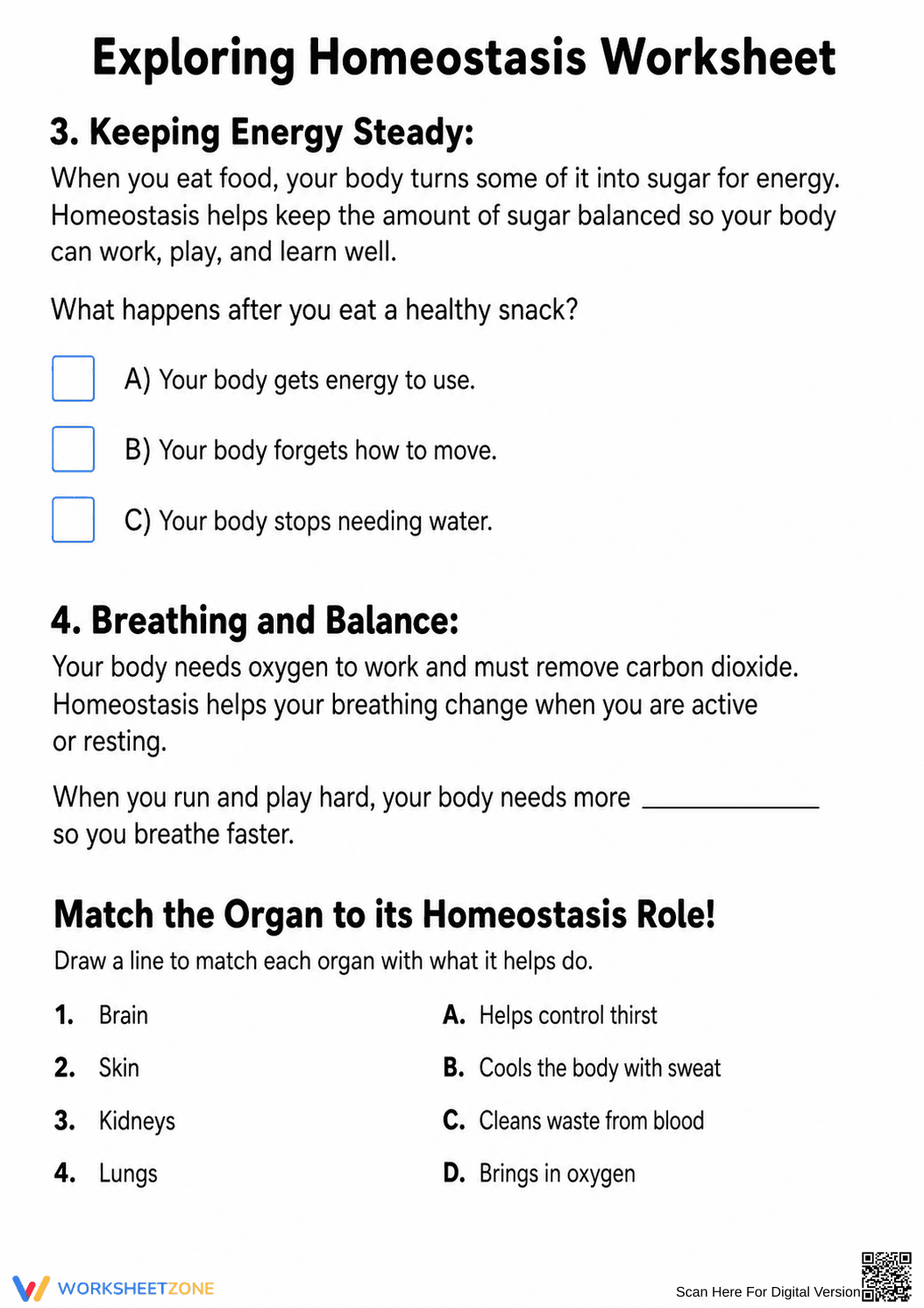
This 2-page PDF features four distinct reading sections covering temperature regulation, water balance, energy maintenance, and respiratory equilibrium. The layout includes short-answer reflection questions, a multiple-choice check for understanding, a fill-in-the-blank prompt, and a final matching activity that connects organs like the brain and kidneys to their specific homeostatic roles. A full answer key is provided for quick grading.
Zero-Prep Workflow
- Print: Select the 2-page PDF and print enough copies for your class in 30 seconds.
- Distribute: Hand out the worksheets as a warm-up or part of a guided reading session.
- Review: Use the included answer key to facilitate a 5-minute whole-class discussion on how the body stays balanced.
Total teacher preparation time is under 2 minutes, making this an ideal resource for busy mornings or emergency sub folders.
Standards Alignment
The primary focus is `4-LS1-1`, which requires students to understand how internal structures function to support survival. Homeostasis is the mechanism by which these structures maintain the steady state necessary for life. This resource also supports CCSS.ELA-LITERACY.RI.4.1 by requiring students to refer to details in a text when explaining what the text says explicitly. Both standard codes can be copied directly into lesson plans, IEP goals, or district curriculum mapping tools.
How to Use It
Use this worksheet during the "Explain" phase of a 5E instructional model to provide formal definitions and examples after an initial inquiry activity. It also serves as an effective formative assessment tool; observe if students can correctly match the organ to its function in the final section to gauge their grasp of system interactions. Expected completion time is 20 to 30 minutes.
Who It's For
This resource is designed for upper elementary students in Grades 3 through 5, particularly those beginning a unit on the human body. It is scaffolded with clear headings and visual aids, making it accessible for English Language Learners. Pair this with a digital thermometer demonstration or a hydration anchor chart for a comprehensive lesson.
This homeostasis worksheet aligns with the 4-LS1-1 standard, focusing on the plain-English skill of identifying how internal body structures maintain balance for survival. According to the RAND AIRS 2024 report, high-quality science literacy materials that integrate reading comprehension with core disciplinary ideas significantly improve student retention of complex biological concepts. By utilizing 8 targeted tasks—including matching and evidence-based short answers—this resource mirrors the rigorous expectations found in modern state assessments. Research from Fisher & Frey (2014) emphasizes that gradual release through informational text helps students transition from basic recall to conceptual application. This 2-page PDF provides the necessary scaffolding to ensure that Grade 4 and 5 learners can articulate the relationship between environmental stimuli and physiological responses, such as sweating or shivering, within a structured 30-minute instructional window.


