




























Views
Downloads
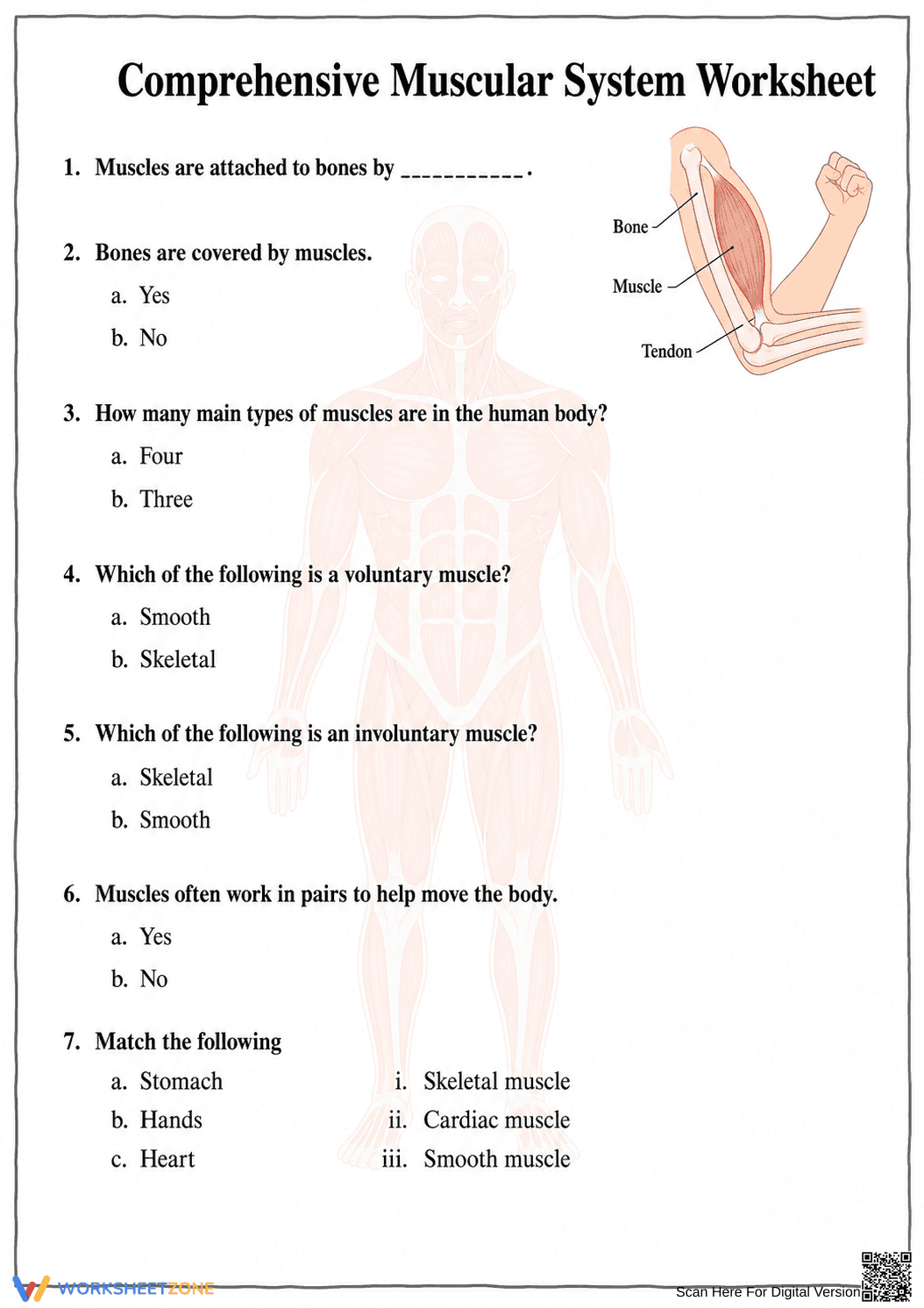

Grade 4 Muscular System — Printable No-Prep Worksheet

Paste this activity's link or code into your existing LMS (Google Classroom, Canvas, Teams, Schoology, Moodle, etc.).
Students can open and work on the activity right away, with no student login required.
You'll still be able to track student progress and results from your teacher account.
This Grade 4 science worksheet helps students identify and classify different types of muscles within the human body. By completing targeted questions on voluntary and involuntary muscles, students build a foundational understanding of how internal structures support movement and survival.
At a Glance
- Grade: 4 · Subject: Science
- Standard:
4-LS1-1— Identify internal structures that support survival and behavior- Skill Focus: Muscular System Anatomy
- Format: 1 page · 7 problems · Answer key included · PDF
- Best For: Independent practice or review
- Time: 10–15 minutes
This single-page resource features seven distinct tasks designed to assess comprehension of the muscular system. It includes a fill-in-the-blank question on tendons, multiple-choice and true/false questions covering voluntary versus involuntary muscles, and a matching section connecting specific body parts to skeletal, cardiac, and smooth muscle types. A complete answer key is provided for quick grading.
Designed for immediate classroom use, this worksheet requires zero teacher setup. Print (1 min): Generate copies directly from the PDF. Distribute (1 min): Hand out to students as a standalone activity. Review (3 mins): Use the included key to check answers together. Total prep time is under two minutes, making it an excellent option for emergency sub plans or quick formative assessments.
This activity aligns with 4-LS1-1, requiring students to construct an argument that animals have internal and external structures that function to support survival, growth, behavior, and reproduction. By categorizing muscle types and their functions, learners directly address this core life science concept. Both standard codes can be copied directly into lesson plans, IEP goals, or district curriculum mapping tools.
Deploy this worksheet immediately following direct instruction on the human body to reinforce new vocabulary. Alternatively, use it as a brief morning work assignment to activate prior knowledge before a comprehensive review of body systems. As students complete the matching section, teachers can quickly observe whether they grasp the distinction between cardiac, smooth, and skeletal muscles. Expect completion to take 10 to 15 minutes.
This resource is ideal for upper elementary students in grades 4 through 6 who are studying human anatomy. The straightforward question formats provide built-in scaffolding for diverse learners, including those who benefit from clear, multiple-choice options. It pairs perfectly with an introductory lesson or anchor chart on the human body systems.
Understanding internal structures like the muscular system is critical for mastering 4-LS1-1, where students identify internal structures that support survival and behavior. According to the RAND AIRS 2024 report, providing students with structured, vocabulary-rich practice materials significantly improves their retention of complex scientific concepts. Worksheets that combine visual diagrams with varied question types—such as matching and multiple-choice—help solidify foundational knowledge before moving on to more advanced biological processes. When educators integrate these targeted, low-stakes assessments into their regular instructional routines, they create essential opportunities for formative feedback. This specific practice ensures that learners can confidently articulate how different muscle groups, including cardiac and smooth muscles, function together to facilitate movement and sustain life. Consistent exposure to these core anatomical concepts builds the scientific literacy required for future STEM success.


