


























Views
Downloads
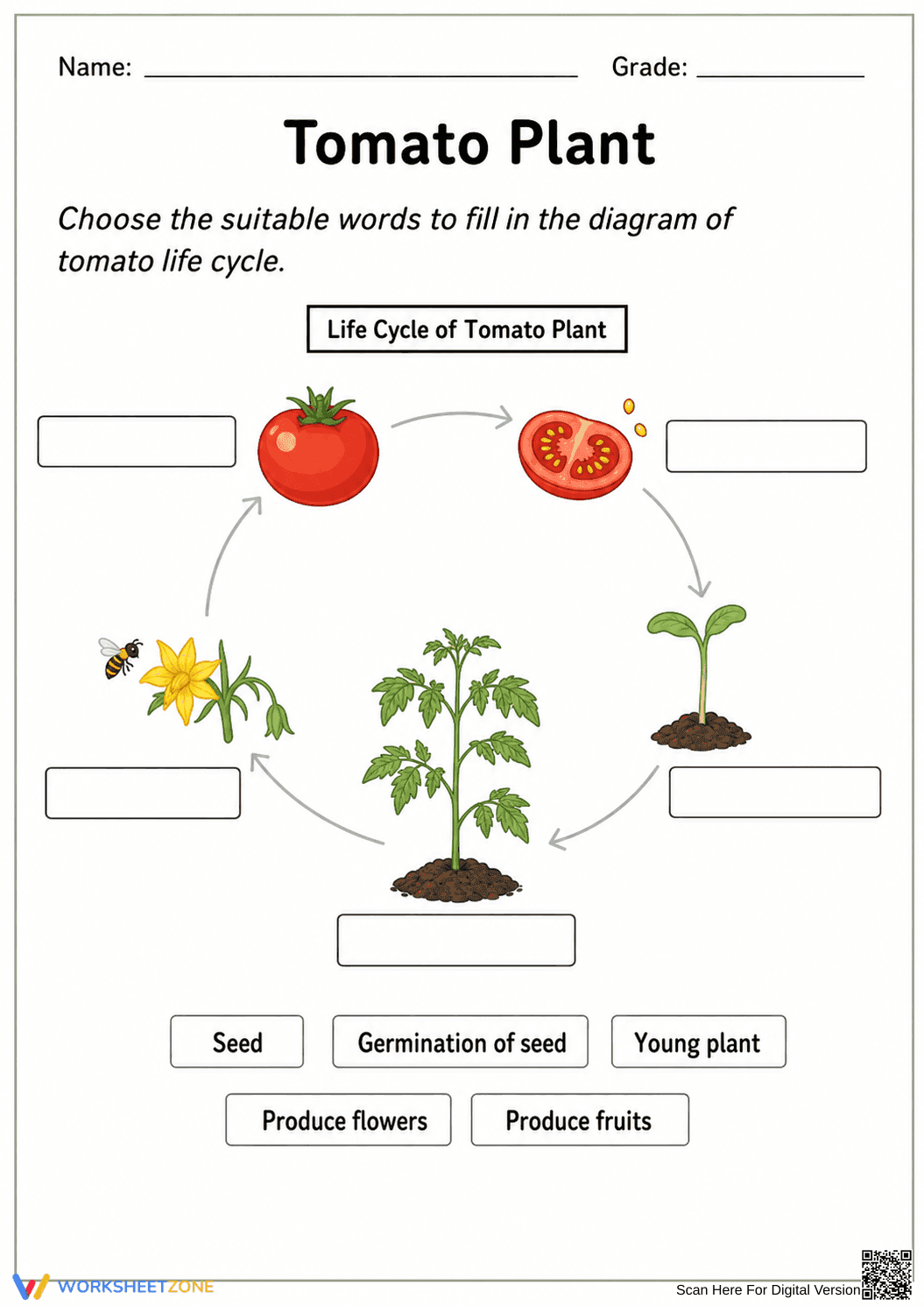

Grade 3 Tomato Life Cycle — Printable No-Prep Worksheet
Paste this activity's link or code into your existing LMS (Google Classroom, Canvas, Teams, Schoology, Moodle, etc.).
Students can open and work on the activity right away, with no student login required.
You'll still be able to track student progress and results from your teacher account.
This Grade 3 science worksheet helps students master the stages of a plant's life cycle by labeling a clear, engaging diagram. By matching key vocabulary terms to visual representations of a tomato plant's growth, students develop a concrete understanding of how organisms grow, reproduce, and change over time.
At a Glance
- Grade: 3 · Subject: Science
- Standard:
3-LS1-1— Develop models to describe organism life cycles- Skill Focus: Labeling plant life cycle stages
- Format: 1 page · 5 problems · Answer key included · PDF
- Best For: Independent practice or science centers
- Time: 10–15 minutes
Inside this single-page resource, educators will find a beautifully illustrated diagram of a tomato plant's life cycle. The worksheet features five distinct labeling tasks corresponding to the major stages of growth. A convenient word bank is provided at the bottom of the page, offering built-in scaffolding for developing readers. The download also includes a complete answer key for quick grading.
This resource is designed for a zero-prep workflow.
- Print (1 minute): Download the PDF and print.
- Distribute (1 minute): Hand out the worksheets. The clear instructions and word bank let students begin immediately.
- Review (3 minutes): Use the answer key to quickly check work or project it for self-correction.
With teacher prep time under two minutes, this is perfect for sub plans.
This worksheet is directly aligned to the Next Generation Science Standards, specifically focusing on 3-LS1-1: Develop models to describe that organisms have unique and diverse life cycles but all have in common birth, growth, reproduction, and death. By completing the diagram, students are actively modeling the growth sequence of a specific organism. Both standard codes can be copied directly into lesson plans, IEP goals, or district curriculum mapping tools.
This versatile worksheet can be deployed during various instructional moments. Use it as an independent practice activity immediately following direct instruction on plant biology, allowing students to apply their new vocabulary. Alternatively, it serves as an excellent formative assessment tool at the end of a life cycles unit. While students work, teachers can observe which individuals struggle to differentiate between the "germination" and "young plant" stages, providing targeted intervention. Expected completion time ranges from 10 to 15 minutes.
This resource is primarily designed for third-grade science students, though it is easily adaptable for second or fourth graders reviewing basic biology concepts. The inclusion of a word bank provides essential differentiation for English Language Learners and students requiring vocabulary support. For a comprehensive lesson, pair this diagram activity with a hands-on seed planting lab or an informational text about agricultural life cycles.
Mastering scientific vocabulary through visual models is a critical component of early elementary science education. When students engage with the 3-LS1-1 standard to develop models to describe organism life cycles, they build foundational knowledge required for more complex biological concepts in later grades. According to a 2024 report by EdReports, integrating visual diagrams with targeted word banks significantly improves vocabulary retention and conceptual understanding in elementary science curricula. This structured approach allows young learners to connect abstract terms like "germination" to concrete visual evidence. By systematically practicing these labeling skills, students not only meet specific grade-level expectations but also develop stronger overall scientific literacy. Utilizing targeted, standards-aligned materials ensures that instructional time is maximized, providing students with the exact scaffolds they need to succeed in understanding the natural world.


