


























Views
Downloads
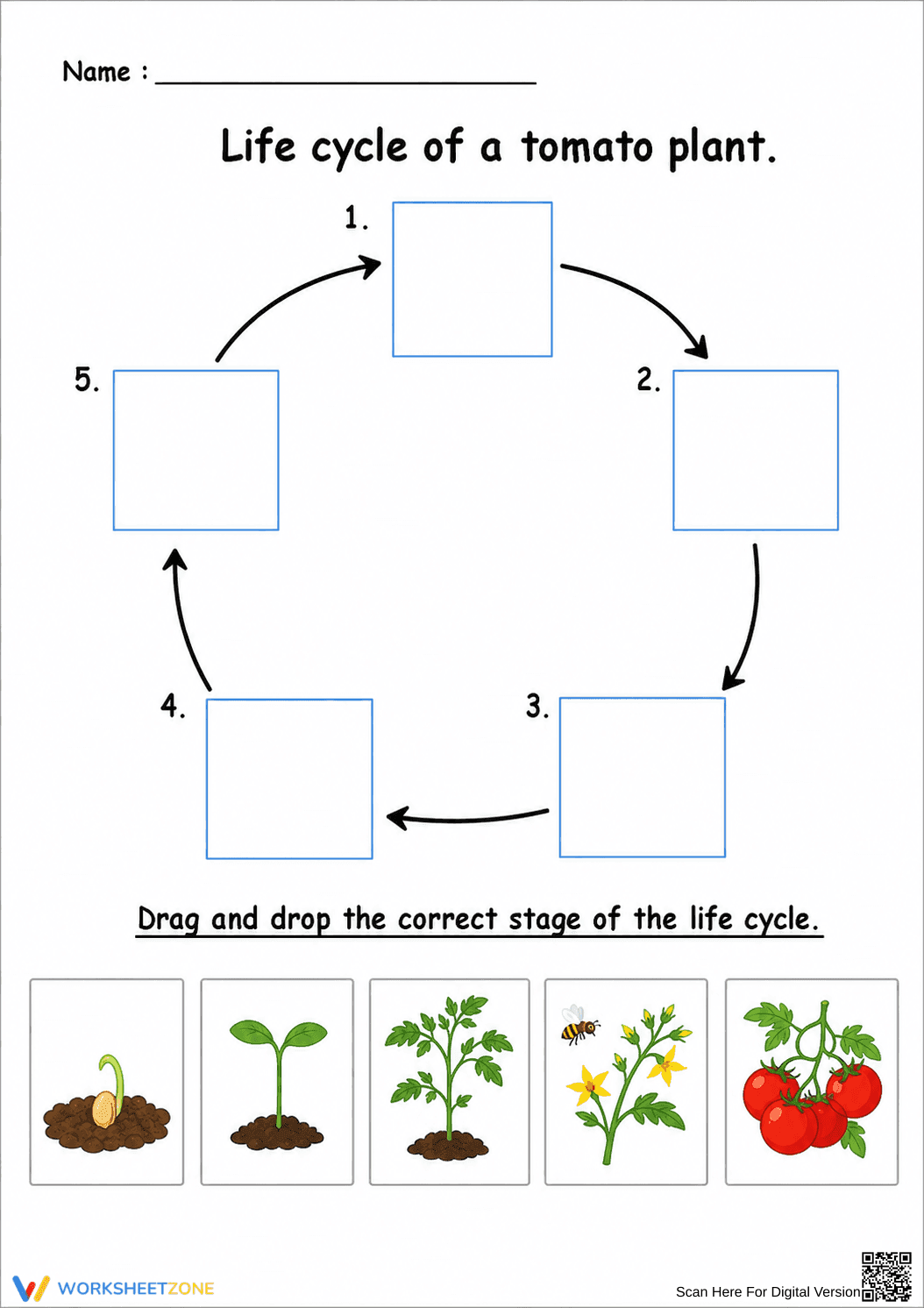

Grade 3 Tomato Life Cycle — Printable No-Prep Worksheet
Paste this activity's link or code into your existing LMS (Google Classroom, Canvas, Teams, Schoology, Moodle, etc.).
Students can open and work on the activity right away, with no student login required.
You'll still be able to track student progress and results from your teacher account.
This Grade 3 science worksheet helps students master the stages of plant growth by sequencing the life cycle of a tomato plant. By analyzing visual models and placing them in the correct chronological order, learners build a foundational understanding of how living organisms grow, reproduce, and develop over time.
At a Glance
- Grade: 3 · Subject: Science
- Standard:
3-LS1-1— Develop models to describe organism life cycles- Skill Focus: Sequencing plant life cycles
- Format: 1 page · 5 problems · Answer key included · PDF
- Best For: Independent practice or science centers
- Time: 10–15 minutes
This single-page resource features a clear, circular diagram with five blank stages connected by directional arrows. At the bottom, students find five illustrations representing the tomato plant's phases: a sprouting seed, seedling, growing plant, flowering plant, and mature plant bearing fruit. Students place these images into the correct sequence. A complete answer key is provided.
Designed for maximum efficiency, this zero-prep resource requires minimal teacher setup:
- Print (1 minute): Print the PDF worksheet and answer key.
- Distribute (1 minute): Hand out the worksheets during your science block.
- Review (3 minutes): Use the answer key to quickly check sequences.
Because the instructions are highly visual and self-explanatory, this activity is an excellent addition to any emergency sub plan.
This worksheet is directly aligned to the Next Generation Science Standard 3-LS1-1: Develop models to describe that organisms have unique and diverse life cycles but all have in common birth, growth, reproduction, and death. By organizing the visual model of the tomato plant, students demonstrate their comprehension of these universal biological stages. Both standard codes can be copied directly into lesson plans, IEP goals, or district curriculum mapping tools.
Use it as independent practice following a direct instruction lesson on plant biology. Alternatively, it serves as an effective formative assessment tool. Teachers can observe whether students correctly identify the flowering stage as a precursor to the fruiting stage. Expected completion time is 10 to 15 minutes.
This worksheet is primarily designed for third-grade science students, though it is easily adaptable for second-grade learners exploring basic plant life cycles. The heavy reliance on visual cues makes it particularly supportive for English Language Learners and students who benefit from non-verbal demonstrations of knowledge. For a comprehensive lesson, pair this activity with a hands-on seed planting lab or a read-aloud book about garden ecosystems.
Understanding biological progression is a critical component of early elementary science education. This resource supports standard 3-LS1-1 by requiring students to develop models to describe organism life cycles. According to a 2024 report by EdReports, instructional materials that integrate visual modeling with sequential logic significantly improve student retention of complex biological processes. When learners actively manipulate visual representations—such as ordering the stages from seed to mature fruit—they build stronger cognitive frameworks for understanding how living things grow, reproduce, and eventually die. This foundational knowledge is essential for later, more advanced studies in genetics and ecosystem dynamics. By providing a clear, structured opportunity to practice this skill, educators can ensure their students are meeting key scientific benchmarks while developing essential analytical abilities.


