


























Views
Downloads

Tomato Plant Life Cycle Worksheet | Essential Grade 3
Paste this activity's link or code into your existing LMS (Google Classroom, Canvas, Teams, Schoology, Moodle, etc.).
Students can open and work on the activity right away, with no student login required.
You'll still be able to track student progress and results from your teacher account.
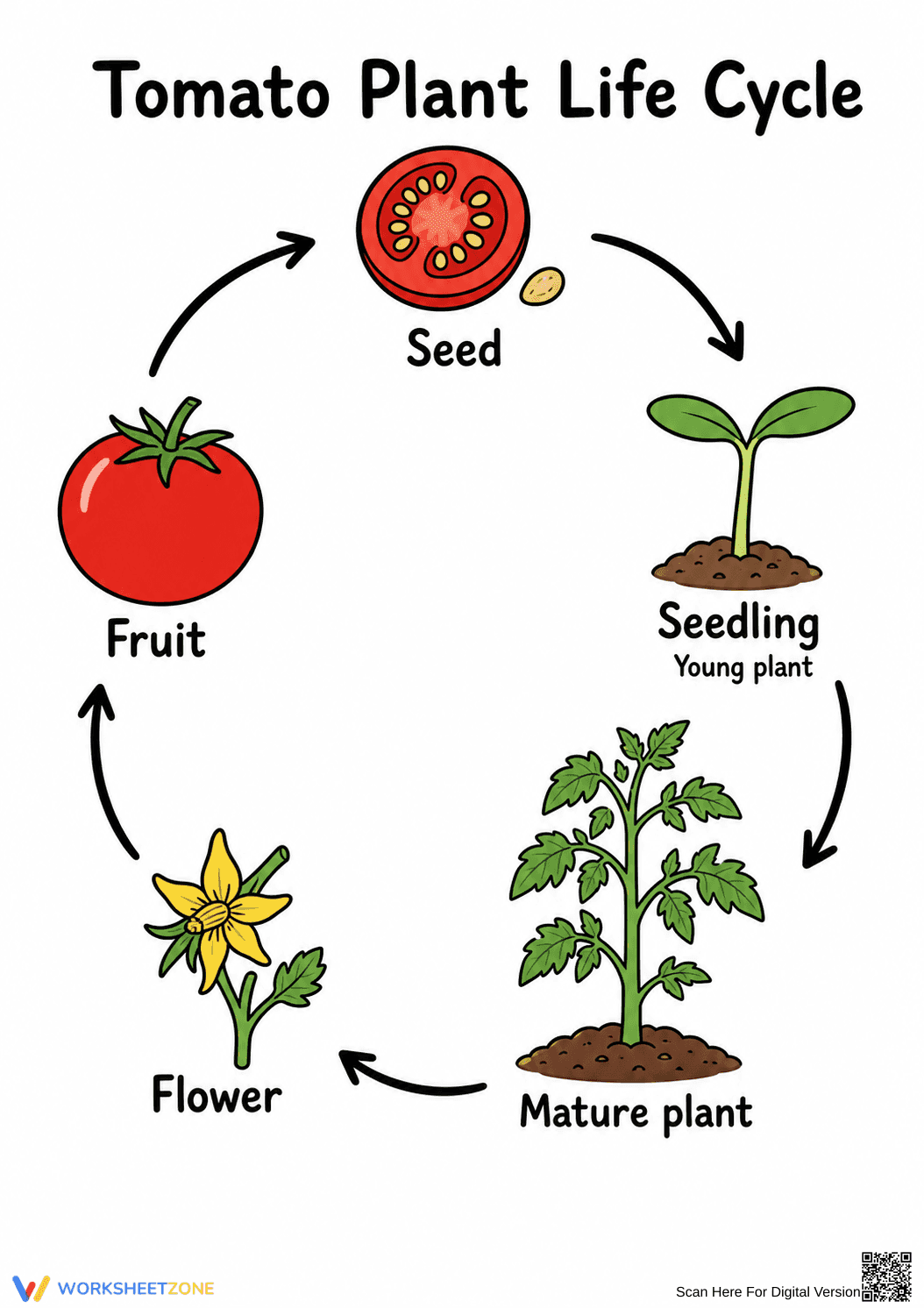
This Grade 3 science resource provides a clear, visual model of the tomato plant life cycle to help students understand biological growth patterns. By identifying the five distinct stages from seed to fruit, learners develop a foundational understanding of how flowering plants reproduce and sustain their species over time.
At a Glance
- Grade: 3 · Subject: Science
- Standard:
3-LS1-1— Develop models to describe that organisms have unique and diverse life cycles- Skill Focus: Plant Life Cycle Identification
- Format: 1 page · 5 stages · Reference Diagram · PDF
- Best For: Visual learners and science center activities
- Time: 10–15 minutes
What's Inside: This single-page PDF features a high-resolution circular diagram illustrating the five primary stages of a tomato plant: the seed, the seedling (young plant), the mature plant, the flower, and the final fruit. Each stage is accompanied by a clear, bold label and a detailed illustration. The cyclical arrows emphasize the continuous nature of plant reproduction, making it an ideal anchor chart or student reference sheet.
The zero-prep design allows for immediate classroom integration. First, print the single-page PDF (30 seconds). Second, distribute the sheet as a visual guide during your direct instruction on botany (1 minute). Third, have students use the diagram to cross-reference their own observations if growing classroom plants (5 minutes). Total teacher preparation time is under 2 minutes, making this an excellent choice for emergency sub plans or quick science warm-ups.
Standards Alignment: This worksheet aligns directly with `3-LS1-1`: "Develop models to describe that organisms have unique and diverse life cycles but all have in common birth, growth, reproduction, and death." It specifically addresses the growth and reproduction phases of a common angiosperm. This standard code can be copied directly into lesson plans, IEP goals, or district curriculum mapping tools.
How to Use It: Use this as a formative assessment tool during a unit on life science. Ask students to cover the labels and name the stages based on the illustrations alone. Alternatively, use it as a reference by having students color the diagram as they observe these specific stages in a real tomato plant grown in the classroom. Completion typically takes 10 to 15 minutes depending on the depth of discussion.
Who It's For: This resource is designed for Grade 3 elementary students but is accessible for Grade 2 learners or as a review for Grade 4. It is particularly effective for English Language Learners (ELLs) due to the high visual-to-text ratio. Pair this with a hands-on seed-planting activity or a reading passage about photosynthesis to create a comprehensive science lesson.
According to the RAND AIRS 2024 report on elementary science instruction, visual models are critical for developing conceptual frameworks in young learners. This worksheet utilizes the 3-LS1-1 standard to bridge the gap between abstract biological concepts and observable natural phenomena. By focusing on the tomato plant, a familiar organism, students can more easily internalize the stages of birth, growth, and reproduction. Research from Fisher & Frey (2014) suggests that clear, labeled diagrams serve as essential scaffolds that support vocabulary acquisition and scientific literacy. This printable resource provides a structured entry point for students to engage with complex life science standards without the cognitive load of dense text. It ensures that 100% of students, regardless of reading level, can access the core curriculum and demonstrate an understanding of the cyclical nature of life in the plant kingdom.


