


























Views
Downloads

Essential Tomato Plant Life Cycle Worksheet | Grade 3
Paste this activity's link or code into your existing LMS (Google Classroom, Canvas, Teams, Schoology, Moodle, etc.).
Students can open and work on the activity right away, with no student login required.
You'll still be able to track student progress and results from your teacher account.
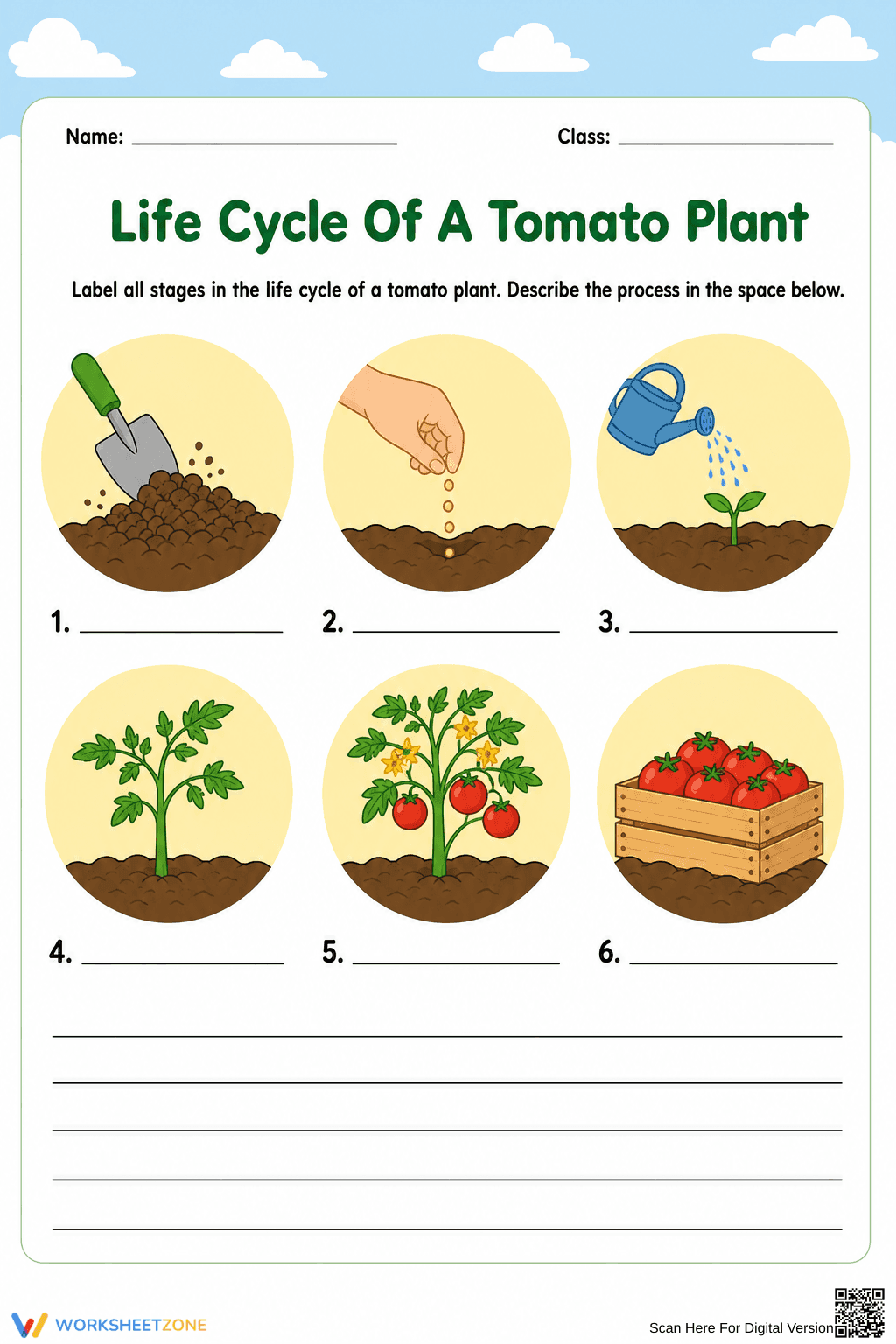
This life science worksheet helps students visualize and articulate the biological progression of a tomato plant. By identifying specific growth phases from seed to harvest, learners develop a concrete understanding of how organisms change over time. It provides a structured framework for students to demonstrate their knowledge of plant biology and developmental stages through both visual identification and descriptive writing.
At a Glance
- Grade: 3 · Subject: Science
- Standard:
3-LS1-1— Develop models to describe that organisms have unique and diverse life cycles- Skill Focus: Plant Life Cycle Sequencing
- Format: 1 page · 7 tasks · Answer key included · PDF
- Best For: Formative assessment or science center activity
- Time: 15–20 minutes
The worksheet features six high-quality illustrations representing the chronological stages of a tomato plant's development. Below the visual sequence, students find six numbered lines for labeling and a dedicated section of primary-ruled lines for a written summary. The layout is clean and intuitive, ensuring students can focus on the scientific content without being overwhelmed by complex formatting or unnecessary visual clutter.
This resource is designed for immediate classroom implementation. Teachers can print the single-page PDF in less than a minute. Distribution takes seconds, and because the instructions are self-explanatory, students can begin working immediately. Reviewing the completed work is efficient using the included answer key, making this an ideal choice for emergency sub plans or quick lesson transitions where teacher prep time must be kept under 2 minutes.
Aligned to `3-LS1-1`, this activity requires students to develop models to describe that organisms have unique and diverse life cycles but all have in common birth, growth, reproduction, and death. It also supports ELA standards for writing informative texts by requiring a written description of the biological process. Both standard codes can be copied directly into lesson plans, IEP goals, or district curriculum mapping tools to ensure compliance with state frameworks.
Use this worksheet as a mid-unit check for understanding after a lesson on germination and pollination. It works exceptionally well as a formative assessment; observe if students correctly sequence the watering and sprout phase before the flowering phase. Expect students to complete the labeling and short-response writing within a 20-minute instructional block, providing a clear snapshot of their current mastery levels.
This resource is tailored for elementary students in grades 2 through 4 who are exploring life sciences. It is particularly effective for visual learners and English Language Learners who benefit from the clear pictorial cues provided for each stage. Pair this worksheet with a live classroom planting project or a non-fiction text about agriculture to create a comprehensive learning experience that bridges theory and practice.
According to the RAND AIRS 2024 report on science instructional materials, high-quality visual models are essential for helping elementary students internalize complex biological sequences. This worksheet addresses the 3-LS1-1 standard by providing a scaffolded environment where students move from simple identification to descriptive synthesis. Research from Fisher & Frey (2014) emphasizes that the gradual release of responsibility is most effective when students have opportunities to apply vocabulary in context, such as labeling specific stages of a plant's life cycle. By requiring both a label and a written description, this resource ensures that students are not merely memorizing steps but are constructing a mental model of growth and reproduction. This dual-modality approach is a proven method for increasing retention of scientific concepts in the early grades, providing teachers with a reliable tool for measuring student mastery of NGSS-aligned curriculum goals.


