


























Views
Downloads

Printable Plant Life Cycle Worksheet | Grade 2 Science
Paste this activity's link or code into your existing LMS (Google Classroom, Canvas, Teams, Schoology, Moodle, etc.).
Students can open and work on the activity right away, with no student login required.
You'll still be able to track student progress and results from your teacher account.
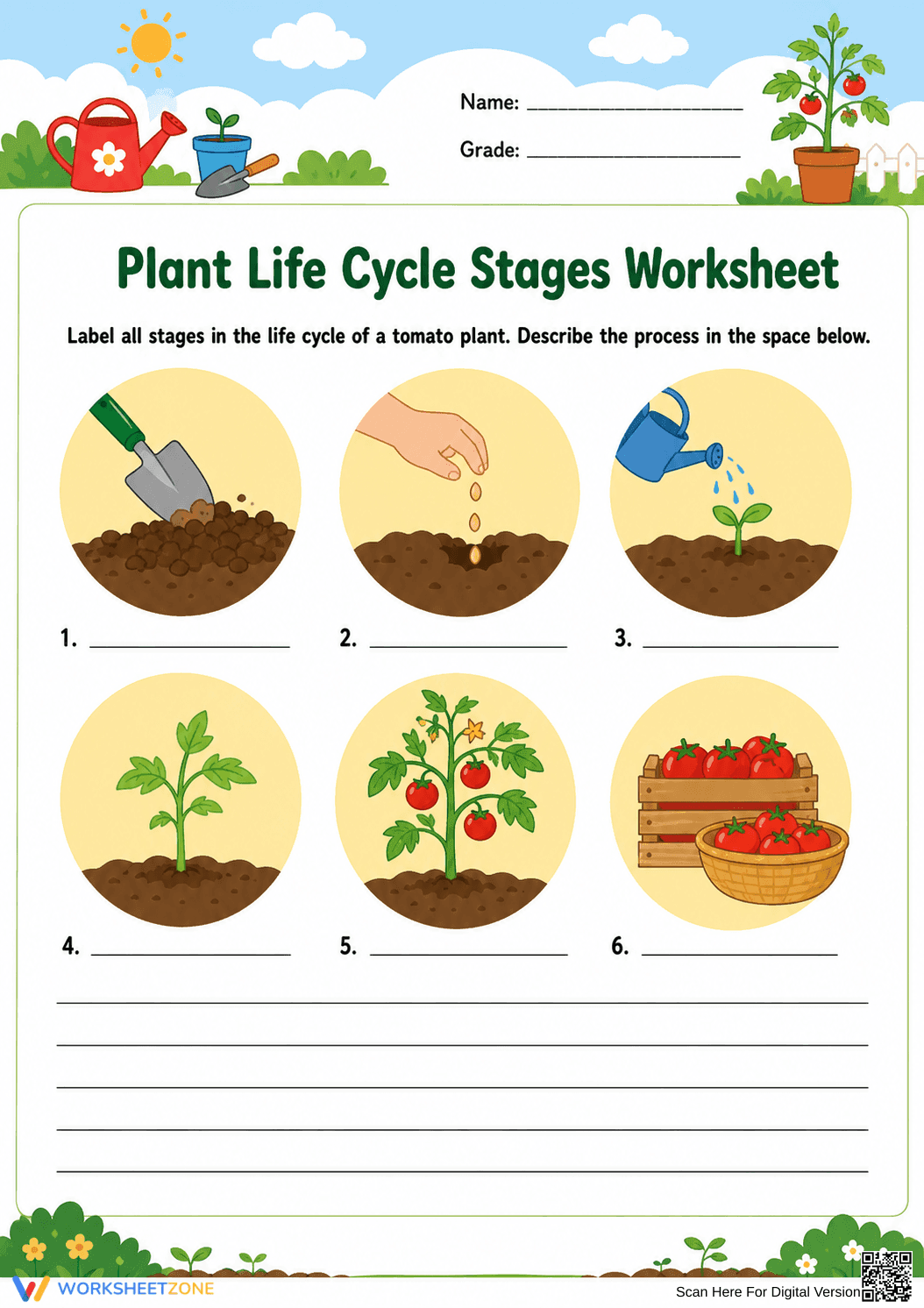
This Grade 2 science and writing worksheet helps students master plant life cycles while practicing informative writing. By labeling a tomato plant's growth stages and writing a descriptive summary, learners solidify biological sequencing and scientific vocabulary.
At a Glance
- Grade: 2 · Subject: Science
- Standard:
CCSS.ELA-LITERACY.W.2.2— Write informative texts to explain a scientific process- Skill Focus: Sequencing and Informative Writing
- Format: 1 page · 7 problems · Answer key included · PDF
- Best For: Independent practice and science centers
- Time: 15–20 minutes
This single-page resource features six sequential illustrations of a tomato plant's life cycle, from planting seeds to harvesting fruit. Students write the correct label for each visual stage. Below the illustrations, a lined section provides space for students to synthesize their observations into a written description of the plant's development. A standard answer key is included.
Zero-Prep Workflow
This worksheet requires absolutely no teacher setup.
- Print (1 min): Simply print the PDF. The illustrations print clearly in grayscale.
- Distribute (1 min): Hand out during a science block or literacy center.
- Review (3 min): Use the answer key to check labels, then review paragraphs for accurate sequencing.
With prep time under two minutes, this is ideal for busy afternoons or a substitute teacher's sub plan.
Standards Alignment
Aligned to CCSS.ELA-LITERACY.W.2.2, requiring students to write informative texts that introduce a topic, use facts, and provide a conclusion. By describing the plant's growth, students apply this standard to a scientific context. Both standard codes can be copied directly into lesson plans, IEP goals, or district curriculum mapping tools.
How to Use It
Use this as independent practice after direct instruction on plant biology. It also serves as a formative assessment at the end of a life cycles unit. While students work, observe their paragraphs to ensure they use transition words (first, next, finally) to connect stages. Expected completion time is 15 to 20 minutes.
Who It's For
Designed for second-grade students, this is easily adapted for first or third graders. The visual scaffolds make it accessible for English Language Learners. Pair this worksheet with a read-aloud book about gardens or a seed planting activity to connect illustrations to real-world biology.
Integrating writing into science instruction significantly boosts both literacy development and long-term content retention. When students actively engage with CCSS.ELA-LITERACY.W.2.2 to write informative texts to explain a scientific process, they move far beyond simple rote memorization and begin to deeply internalize the underlying biological concepts. According to a recent ScienceDirect TpT Analysis, cross-curricular worksheets that intentionally combine visual sequencing with descriptive writing tasks dramatically improve student recall of scientific vocabulary by providing multiple, overlapping modalities for learning. By requiring young learners to first accurately label the visual stages of a tomato plant's growth and then synthesize those individual steps into a cohesive, well-structured paragraph, this resource effectively bridges the critical gap between visual observation and written articulation. This dual-layered instructional approach ensures that early elementary students not only recognize the biological sequence but can also communicate it clearly, laying a strong, evidence-based foundation for their future STEM and literacy success.


