


























Views
Downloads

Printable Tomato Life Cycle Worksheet | Grade 3 Science
Paste this activity's link or code into your existing LMS (Google Classroom, Canvas, Teams, Schoology, Moodle, etc.).
Students can open and work on the activity right away, with no student login required.
You'll still be able to track student progress and results from your teacher account.
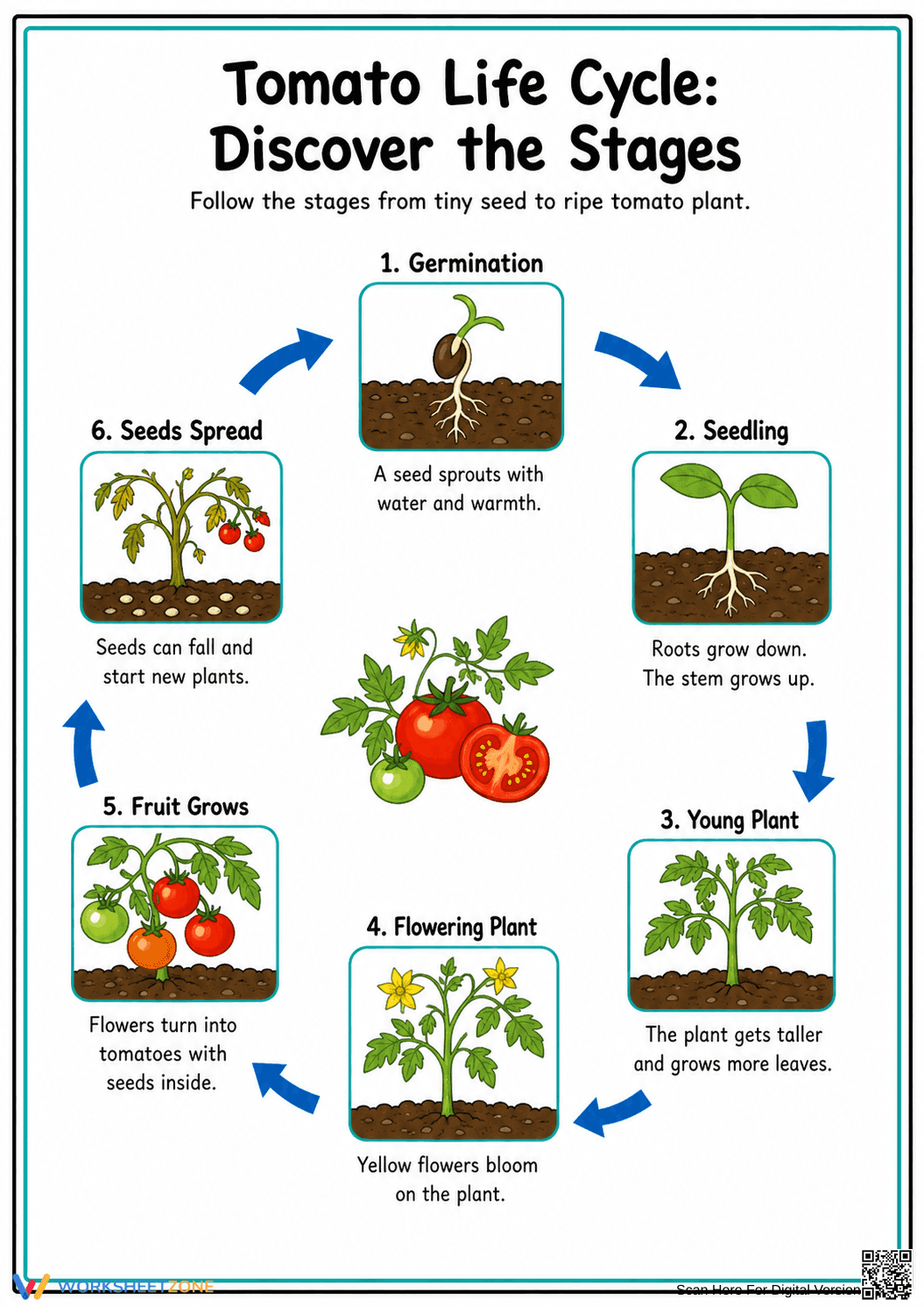
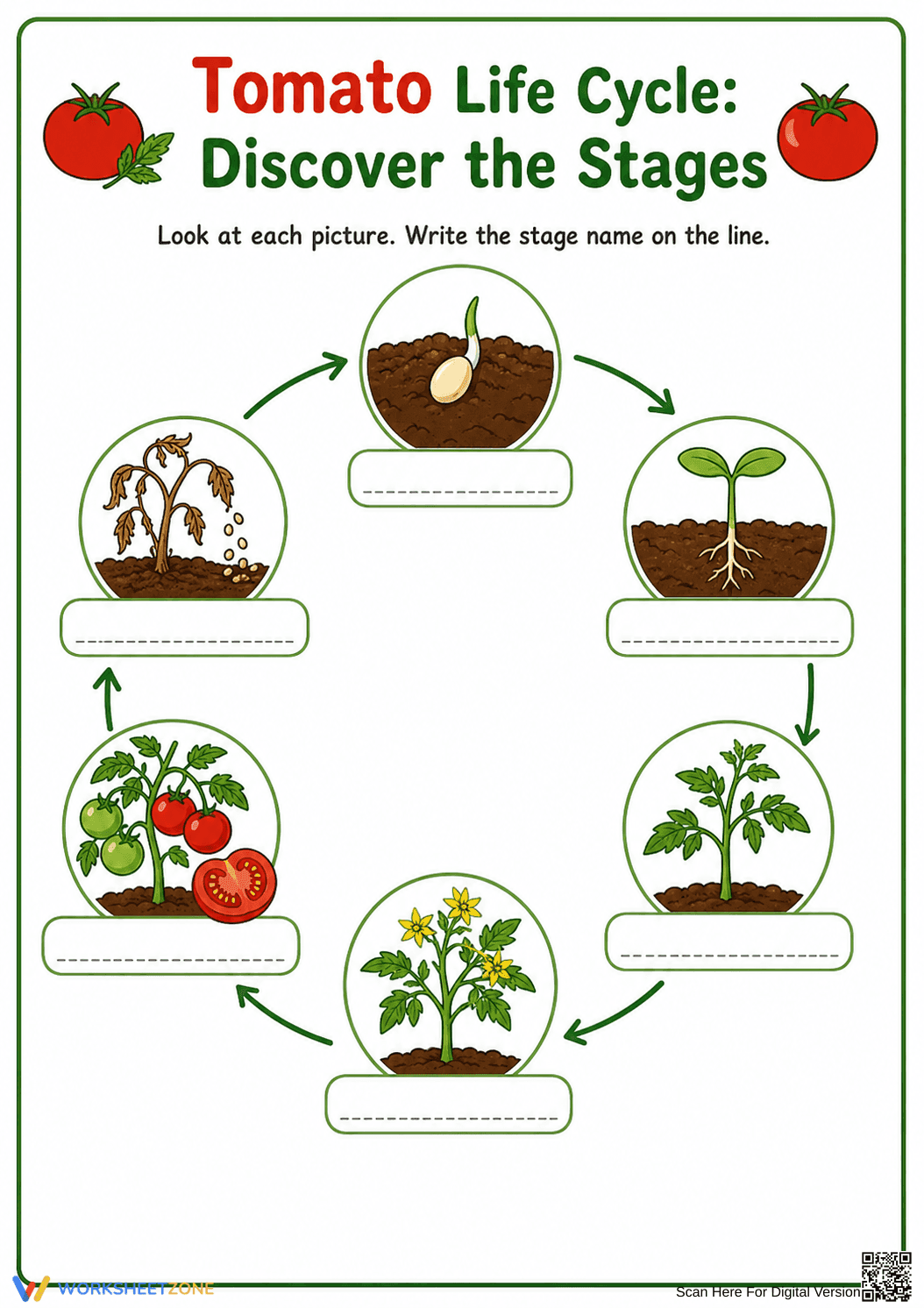
This Grade 3 science worksheet helps students master plant life cycles by identifying and sequencing the developmental stages of a tomato plant. By analyzing a clear visual model, learners will successfully label each phase from germination to seed dispersal, building foundational botany skills and scientific vocabulary.
At a Glance
- Grade: 3 · Subject: Science
- Standard:
3-LS1-1— Develop models to describe organism life cycles- Skill Focus: Plant Life Cycles
- Format: 2 pages · 6 problems · Answer key included · PDF
- Best For: Independent practice and review
- Time: 15–20 minutes
This resource includes a two-page PDF designed for immediate classroom use. The first page serves as a full-color reference poster, detailing the six stages of a tomato plant's growth with illustrations and short descriptive sentences. The second page features a fill-in-the-blank diagram where students recall and write the correct stage names, using the first page as a built-in answer key or study guide.
- Print (1 minute): Simply print the two-page PDF. The reference sheet and activity page are perfectly formatted for standard letter paper.
- Distribute (1 minute): Hand out the reference poster for a quick class review, then provide the blank diagram for independent work.
- Review (1 minute): Students can self-correct using the reference page, keeping total teacher prep time under two minutes.
This self-contained format makes it an excellent, reliable option for emergency substitute plans.
This activity is directly aligned to 3-LS1-1: Develop models to describe that organisms have unique and diverse life cycles but all have in common birth, growth, reproduction, and death. By mapping the tomato's journey from seed to fruit and back to seed, students visually grasp this continuous biological loop. Both standard codes can be copied directly into lesson plans, IEP goals, or district curriculum mapping tools.
Deploy this worksheet immediately after direct instruction on plant biology to reinforce new vocabulary. Alternatively, use it as a quiet morning work assignment where students read the reference poster and complete the diagram independently. As a formative assessment tip, observe whether students can correctly sequence the "Flowering Plant" stage before the "Fruit Grows" stage, as this often confuses early learners. Expected completion time is 15 to 20 minutes.
This resource is primarily designed for third-grade science students, though its clear visuals make it highly accessible for second graders or English Language Learners needing vocabulary support. For differentiation, allow struggling readers to keep the reference poster on their desks while completing the diagram, while advanced students can attempt it from memory. Pair this activity with a hands-on seed-planting lab to solidify the concepts.
Understanding biological sequences is a critical component of early elementary science education. When students engage with materials aligned to 3-LS1-1, they develop models to describe organism life cycles, moving beyond rote memorization to grasp the continuous nature of birth, growth, reproduction, and death. According to a 2024 report by EdReports, providing students with clear, sequential visual models significantly improves their ability to retain complex scientific processes and apply that knowledge to other living organisms. This tomato plant activity supports that pedagogical framework by combining explicit visual aids with active recall tasks. By requiring learners to accurately label the specific stages of development—from germination to seed dispersal—educators can ensure foundational botany concepts are firmly established before introducing more complex ecological systems in later grades. This structured approach builds lasting scientific literacy.


