


























Views
Downloads

Printable DNA to Protein Worksheet | Grade 10-12 Science
Paste this activity's link or code into your existing LMS (Google Classroom, Canvas, Teams, Schoology, Moodle, etc.).
Students can open and work on the activity right away, with no student login required.
You'll still be able to track student progress and results from your teacher account.
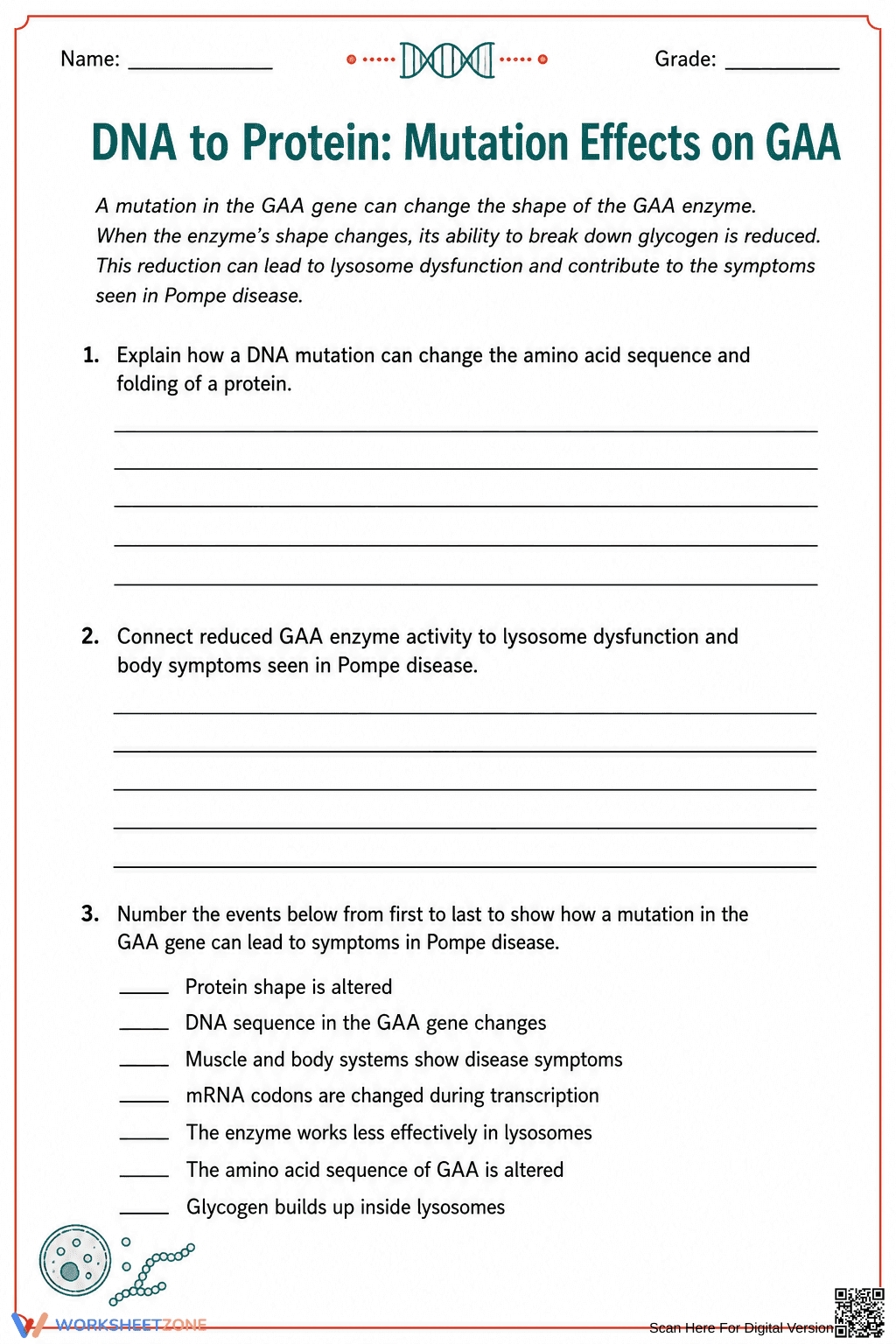
This high school biology worksheet bridges the gap between abstract molecular biology and real-world medical applications. Students analyze how DNA mutations in the GAA gene lead to structural changes in proteins, ultimately causing Pompe disease. It provides a clear framework for understanding the central dogma of biology through a clinical lens.
At a Glance
- Grade: 10-12 · Subject: Biology
- Standard:
HS-LS1-1— Explain how DNA determines protein structure- Skill Focus: Protein synthesis and mutation impact
- Format: 1 page · 3 tasks · Answer key included · PDF
- Best For: Formative assessment or homework
- Time: 20–30 minutes
The resource features a concise informational text regarding enzyme function and shape. It includes two open-ended explanation prompts requiring students to link lysosome function to systemic symptoms. The final task is a seven-step sequencing activity where learners order the biological events from initial gene mutation to the manifestation of genetic disease characteristics. A complete answer key is provided for accurate grading.
This resource is designed for immediate classroom implementation. Teachers can print the single-page PDF in under one minute. Distributing the assignment takes seconds, and because the tasks are self-contained with a provided text snippet, students can begin working immediately without extensive background lectures. Reviewing the sequencing task as a whole class takes approximately five minutes using the included answer key. Total teacher prep time is under two minutes, making it an ideal emergency sub plan.
Aligned primarily to HS-LS1-1, which requires students to construct an explanation based on evidence for how the structure of DNA determines the structure of proteins which carry out the essential functions of life. It also supports understanding of how inheritable genetic variations result from mutations. Both standard codes can be copied directly into lesson plans, IEP goals, or district curriculum mapping tools.
Use this worksheet as a mid-unit check for understanding after teaching transcription and translation. It serves as an excellent formative assessment to see if students can apply the structure-determines-function concept to a specific enzyme. As students work, observe their sequencing logic to identify misconceptions about the order of transcription and translation. Expect students to complete the analysis in 20 to 30 minutes during independent practice.
This is ideal for Grade 10-12 Biology students, including those in Honors or AP tracks who need to see the physiological consequences of molecular errors. The built-in text provides necessary scaffolding for on-level learners, while the open-ended prompts challenge advanced students to articulate complex biological cascades. It pairs naturally with a lecture on the central dogma or a case study on metabolic disorders.
The "From DNA to Protein" worksheet provides a rigorous application of the HS-LS1-1 standard, requiring students to synthesize knowledge of genetic coding and protein morphology to explain how DNA determines protein structure. By focusing on the acid alpha-glucosidase (GAA) protein, the resource moves beyond rote memorization of codons into the functional reality of human health. Research from EdReports 2024 emphasizes that high-quality science instruction must connect microscopic cellular processes to macroscopic observable phenomena to ensure long-term retention. This worksheet achieves that by tracing the path from a single nucleotide change to the systemic symptoms of Pompe disease. The sequencing task specifically targets cognitive load by breaking down complex biological cascades into logical, manageable steps. This structured approach supports diverse learners in mastering the relationship between genotype and phenotype, providing clear evidence of student mastery for secondary science educators.


