


























Views
Downloads
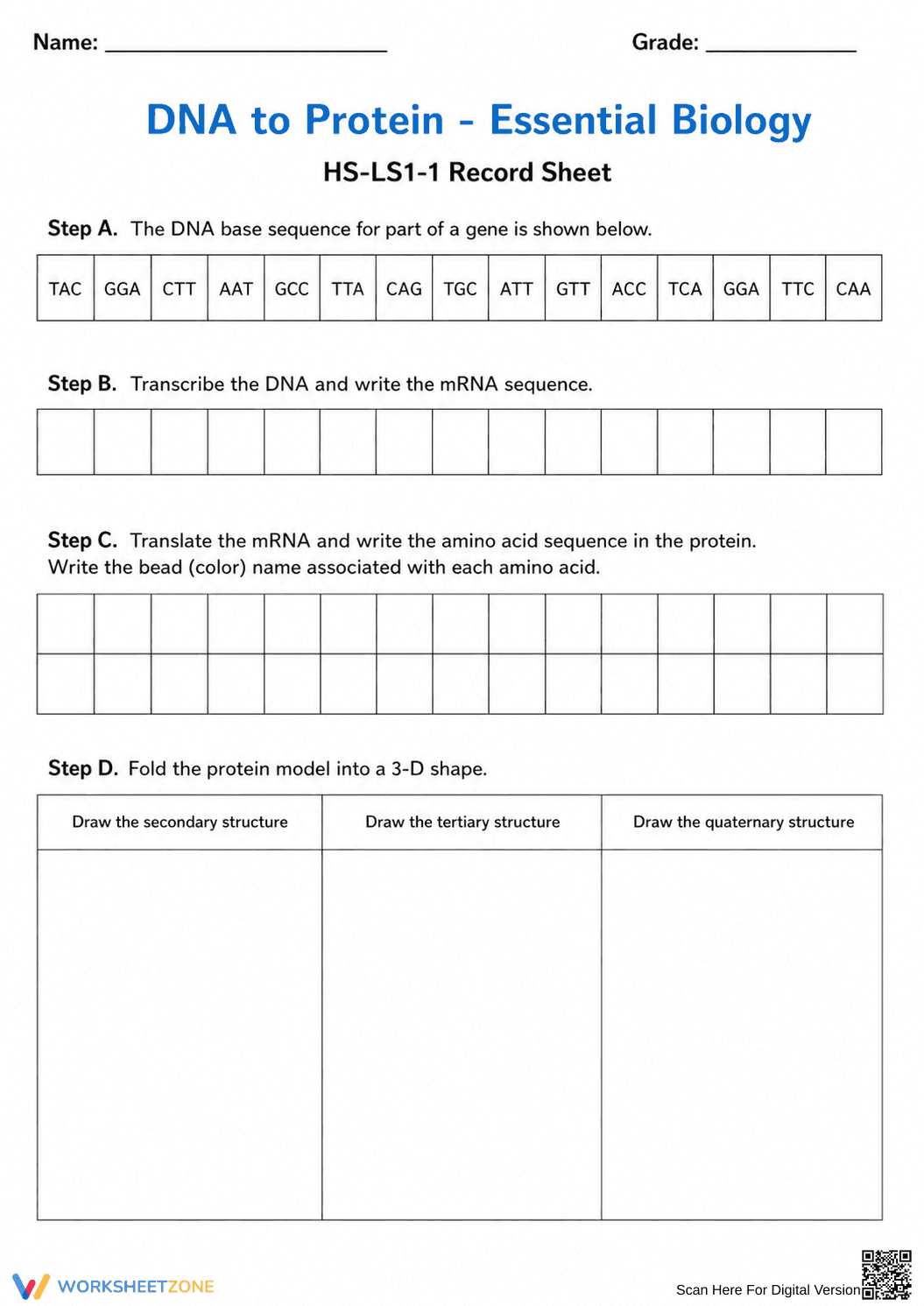

HS-LS1-1 Worksheet: DNA to Protein — Essential Biology
Paste this activity's link or code into your existing LMS (Google Classroom, Canvas, Teams, Schoology, Moodle, etc.).
Students can open and work on the activity right away, with no student login required.
You'll still be able to track student progress and results from your teacher account.
This Grade 9-10 biology worksheet provides a comprehensive record sheet for students to demonstrate mastery of the central dogma. By moving from DNA sequences to three-dimensional protein models, students visualize how genetic information dictates physical structure. This resource ensures students master transcription and translation mechanics while connecting these processes to higher-order protein folding and structural biology.
At a Glance
- Grade: 9-10 · Subject: Biology
- Standard:
HS-LS1-1— Construct an explanation for how DNA structure determines the structure of proteins- Skill Focus: Transcription, Translation, and Protein Folding
- Format: 1 page · 48 tasks · Answer key included · PDF
- Best For: Formative assessment of the central dogma
- Time: 25–35 minutes
The worksheet is organized into four distinct steps that mirror the biological reality of gene expression. It includes a 15-base DNA sequence for transcription, a dedicated grid for mRNA codon mapping, and a translation table that incorporates a color-coding system for amino acids. The final section provides structured space for students to illustrate complex levels of protein organization, including secondary, tertiary, and quaternary structures.
This resource serves as clear evidence of student mastery. Educators can evaluate performance across three tiers: Approaching (accurate base pairing in transcription), Meeting (correct translation and amino acid sequencing), and Exceeding (detailed differentiation between folding levels). These discrete tasks allow for precise data entry into gradebooks or IEP progress monitoring tools, identifying exactly where the student's conceptual understanding of molecular biology may require further support.
Aligned primarily to HS-LS1-1, the worksheet requires students to "construct an explanation based on evidence for how the structure of DNA determines the structure of proteins which carry out the essential functions of life." It also supports HS-LS1-2 by illustrating how these proteins contribute to hierarchical organization. Both standard codes can be copied directly into lesson plans, IEP goals, or district curriculum mapping tools.
Use this record sheet as a companion to a hands-on protein folding lab or as a standalone formative assessment. It is particularly effective when students use pipe cleaners or beads to model the physical folding described in Step D. Teachers should observe Step B closely to ensure students are correctly substituting Uracil for Thymine during the transcription phase.
This resource is designed for high school biology students, including those in Honors or AP tracks. It pairs naturally with a codon wheel or amino acid chart. For differentiated support, teachers might provide a word bank of protein folding terms or pre-fill the first three mRNA bases to scaffold the transcription process for struggling learners.
According to Fisher & Frey (2014), the gradual release of responsibility in complex biological concepts requires students to move from decoding sequences to visualizing three-dimensional structures. This worksheet facilitates that transition by requiring students to first perform the mechanical tasks of transcription and translation before engaging in the higher-order thinking required to illustrate secondary, tertiary, and quaternary protein structures. By mapping the HS-LS1-1 standard directly to a record sheet, educators can observe the exact point where a student might struggle—whether in the base-pairing rules of mRNA or the conceptual folding of the polypeptide chain. Research indicates that scaffolded modeling of the central dogma improves long-term retention of genetic expression mechanisms compared to passive reading. This resource serves as a critical bridge between abstract molecular biology and the physical reality of cellular function, providing the necessary evidence for mastery of protein synthesis and structural biology in high school settings.


