


























Views
Downloads

Grade 9 Mitosis vs Meiosis — Printable No-Prep Worksheet
Paste this activity's link or code into your existing LMS (Google Classroom, Canvas, Teams, Schoology, Moodle, etc.).
Students can open and work on the activity right away, with no student login required.
You'll still be able to track student progress and results from your teacher account.
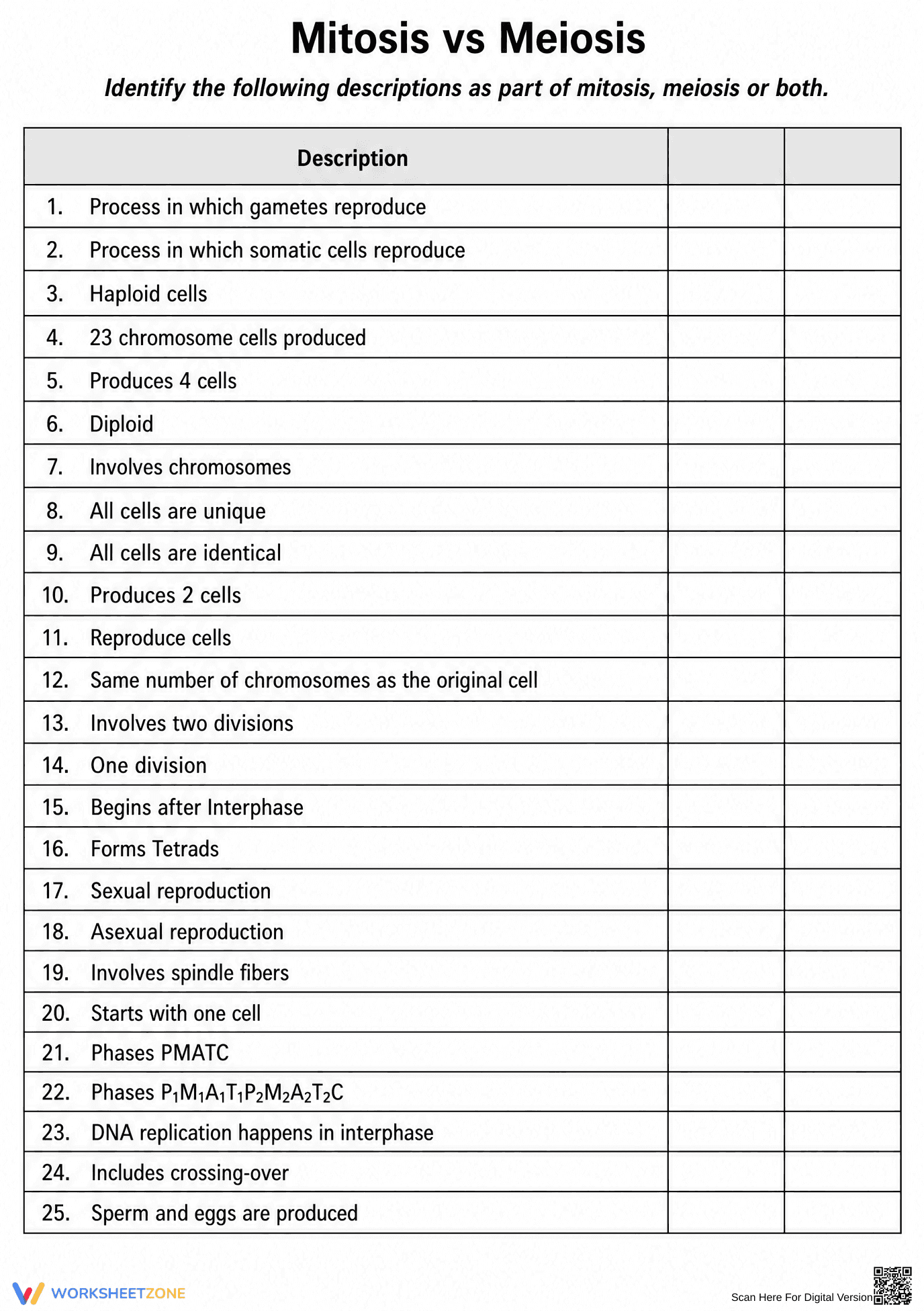
This high school biology worksheet provides students with targeted practice differentiating between mitosis and meiosis. By categorizing 25 specific cellular processes and characteristics, learners will solidify their understanding of cell division, reproduction, and genetic variation. This clear, straightforward activity ensures students can confidently distinguish between somatic and gamete cell cycles.
At a Glance
- Grade: 9 · Subject: Biology
- Standard:
HS-LS3-2— Differentiate between cellular division processes and genetic outcomes.- Skill Focus: Mitosis vs. Meiosis
- Format: 1 page · 25 problems · Answer key included · PDF
- Best For: Formative assessment or review
- Time: 15–20 minutes
Inside this single-page resource, educators will find a comprehensive classification table featuring 25 distinct descriptions of cell division. Students must evaluate statements regarding chromosome counts, reproduction types, and specific phases (such as crossing-over and tetrad formation) to determine if they apply to mitosis, meiosis, or both. A complete answer key is provided to ensure accurate grading and immediate student feedback.
This resource is designed for immediate classroom implementation with a streamlined workflow:
- Print (1 minute): Simply download the PDF and print a class set. No special formatting or cutting is required.
- Distribute (1 minute): Hand out the single-page table as a warm-up, exit ticket, or independent practice assignment.
- Review (3 minutes): Use the included answer key to quickly check student comprehension or facilitate a whole-class review session.
With under two minutes of total teacher prep time, this worksheet is an ideal, reliable option for emergency sub plans or last-minute review sessions.
This activity is aligned to HS-LS3-2, requiring students to make and defend claims based on evidence that inheritable genetic variations may result from new genetic combinations through meiosis. It also supports foundational knowledge for understanding cellular division and differentiation. Both standard codes can be copied directly into lesson plans, IEP goals, or district curriculum mapping tools.
Deploy this worksheet after direct instruction on cell division to assess initial comprehension. It serves perfectly as an independent practice activity where students can reference their notes to categorize each statement. Alternatively, use it as a collaborative review station before a unit exam. As students work, circulate the room and observe whether they correctly identify phase-specific vocabulary like "spindle fibers" or "haploid cells" to quickly gauge formative understanding. Expected completion time ranges from 15 to 20 minutes.
This resource is optimized for high school biology students in grades 9 through 12. It provides excellent reinforcement for general education classrooms and can be easily accommodated for students needing extra support by allowing them to use a comparison anchor chart. Pair this worksheet with a visual diagram of the cell cycle to maximize student retention and conceptual understanding.
Mastering the distinctions between cellular division processes is a critical component of high school life sciences. Aligned with HS-LS3-2, this resource helps students differentiate between cellular division processes and genetic outcomes by categorizing 25 specific traits of mitosis and meiosis. According to a ScienceDirect TpT Analysis, structured categorization tasks significantly reduce cognitive overload, allowing students to process complex biological vocabulary more efficiently. When learners actively sort characteristics like "diploid" versus "haploid" or "somatic" versus "gamete," they build stronger neural pathways for long-term retention. This targeted practice ensures that foundational genetics concepts are firmly established before moving on to more advanced topics like Punnett squares and heredity. By providing a clear, distraction-free format, educators can accurately measure student mastery and identify specific misconceptions early in the instructional cycle.


