


























Views
Downloads


Mitosis vs Meiosis Worksheet | Essential Grade 9-12 Biology
Paste this activity's link or code into your existing LMS (Google Classroom, Canvas, Teams, Schoology, Moodle, etc.).
Students can open and work on the activity right away, with no student login required.
You'll still be able to track student progress and results from your teacher account.
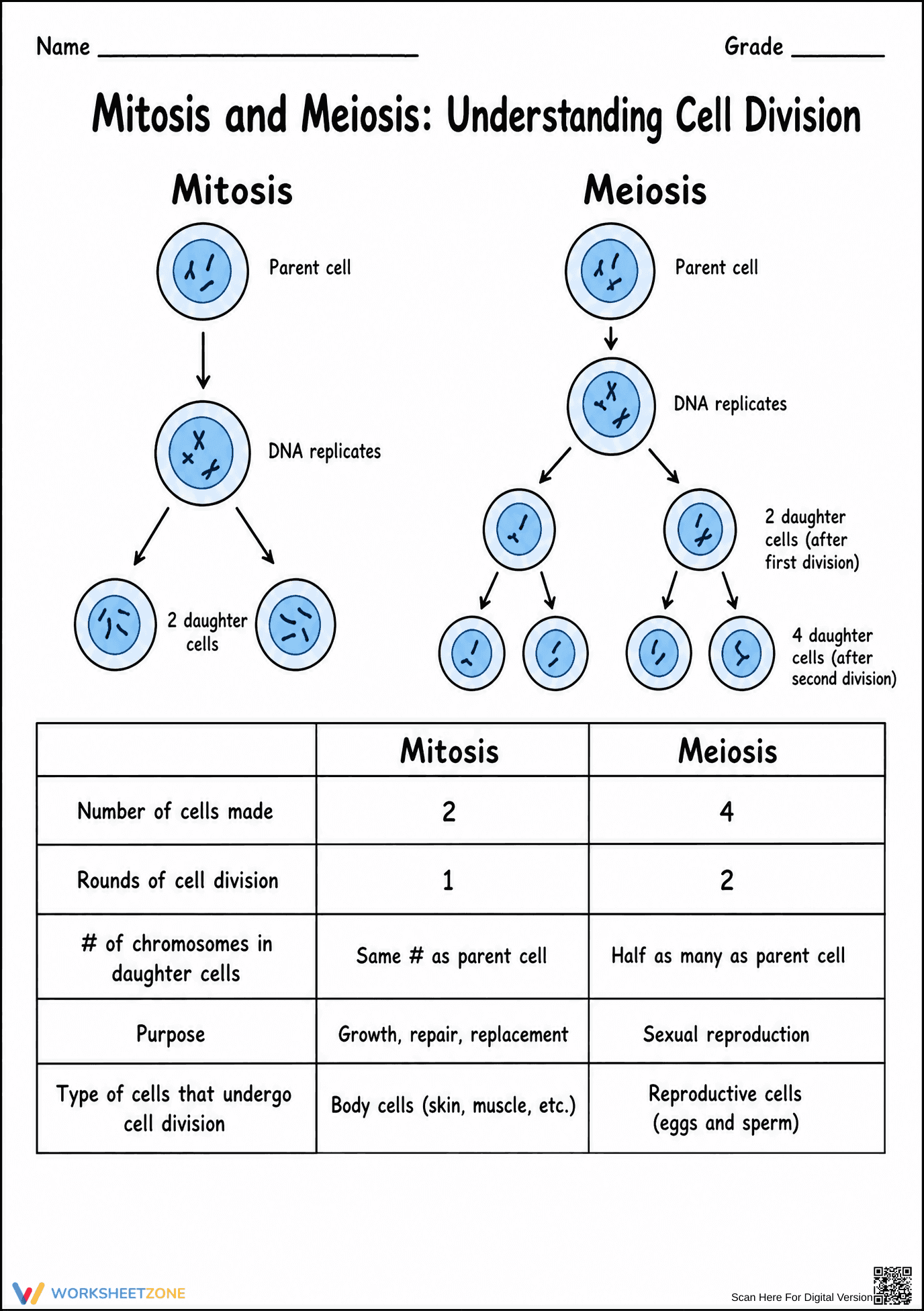
This high school biology worksheet provides a clear comparative analysis of mitosis and meiosis, helping students distinguish between somatic and reproductive cell division. By utilizing visual flowcharts and a comprehensive summary table, learners identify differences in chromosome counts, division rounds, and biological purposes. This resource ensures students master the fundamental mechanics of genetic continuity and variation.
At a Glance
At a Glance
- Grade: 9-12 · Subject: Biology
- Standard:
HS-LS1-4— Use models to illustrate the role of cellular division in complex organisms- Skill Focus: Comparing mitosis and meiosis
- Format: 2 pages · 12 problems · Answer key included · PDF
- Best For: High school biology unit review
- Time: 20–30 minutes
What's Inside
The first page features detailed diagrams of both division processes alongside a five-point comparison table covering cell types and chromosome numbers. The second page challenges students with five 'complete the diagram' exercises, requiring them to calculate daughter cell counts based on specific parent cell values. This 2-page layout includes a full answer key for efficient grading and immediate student feedback.
Zero-Prep Workflow
The zero-prep design allows for immediate implementation. First, print the 2-page PDF (30 seconds). Second, distribute the worksheets following a lecture (1 minute). Third, use the answer key for a rapid whole-class review (5 minutes). This streamlined workflow ensures instructional time remains focused on analysis, making it ideal for substitute folders.
Standards Alignment
The primary focus is `HS-LS1-4`, which requires students to use models to illustrate the role of cellular division. It also supports `HS-LS3-2` by demonstrating how meiosis leads to genetic variation. Both standard codes can be copied directly into lesson plans, IEP goals, or district curriculum mapping tools.
How to Use It
Assign this worksheet during the 'elaborate' phase of a 5E lesson cycle to reinforce the distinction between diploid and haploid outcomes. Teachers should observe students during the diagram completion phase on page two to check for mathematical errors in chromosome distribution. Completion typically takes 20 to 30 minutes depending on prior knowledge.
Who It's For
This resource is designed for Grade 9-12 biology students, including those in honors or AP tracks requiring a quick refresher. It pairs effectively with a cell cycle anchor chart or a microscope lab observing onion root tips. The structured table provides necessary support for English Language Learners and students with IEPs.
This educational resource aligns with the NGSS framework, specifically standard HS-LS1-4, by providing a structured visual model for comparing cellular division processes. According to Fisher & Frey (2014), the use of graphic organizers and comparative diagrams is a critical component of the gradual release of responsibility model, particularly when students are tasked with distinguishing between complex biological cycles like mitosis and meiosis. By requiring students to calculate chromosome counts across multiple generations of daughter cells, the worksheet moves beyond rote memorization and into the application of genetic principles. Research indicates that visual scaffolding helps high school learners internalize the distinction between somatic and germ cell production, which is foundational for understanding heredity and evolution. This 2-page document serves as a reliable formative assessment tool, allowing educators to identify misconceptions regarding DNA replication and cell ploidy levels before moving into advanced genetics units. The standard HS-LS1-4 remains a core benchmark for secondary science mastery.


