


























Views
Downloads

Grade 9 Mitosis vs. Meiosis — Printable No-Prep Worksheet
Paste this activity's link or code into your existing LMS (Google Classroom, Canvas, Teams, Schoology, Moodle, etc.).
Students can open and work on the activity right away, with no student login required.
You'll still be able to track student progress and results from your teacher account.
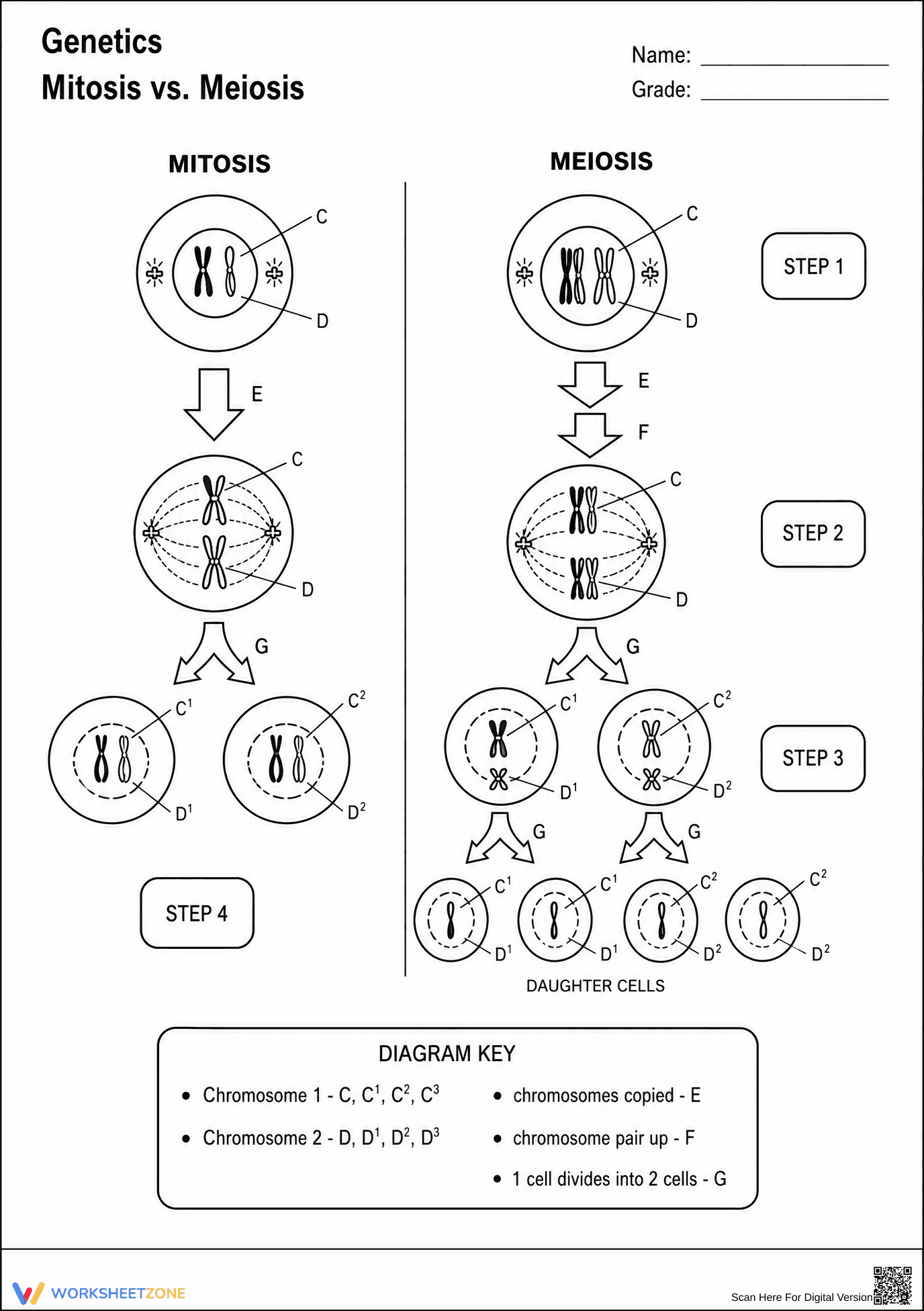
This Grade 9 biology worksheet provides students with a clear, side-by-side visual model comparing mitosis and meiosis. By analyzing the detailed diagrams, students will understand chromosome behavior during cell division, including copying, pairing, and separation. This resource simplifies complex genetic processes into an easy-to-follow visual format.
At a Glance
- Grade: 9 · Subject: Biology
- Standard:
HS-LS1-4— Use a model to illustrate cellular division.- Skill Focus: Comparing mitosis and meiosis
- Format: 1 page · 4 visual steps · Answer key included · PDF
- Best For: Visual reference and review
- Time: 15–20 minutes
Inside this resource, educators will find a single-page comprehensive diagram that maps out both forms of cell division side-by-side. The worksheet features four distinct visual steps, tracing a parent cell through the stages of division to produce either two identical daughter cells (mitosis) or four distinct daughter cells (meiosis). A built-in diagram key helps students decode chromosome states, such as when chromosomes are copied or paired up, providing a self-contained study tool.
This resource is designed for immediate classroom implementation with a streamlined zero-prep workflow.
- Print (1 minute): The single-page layout is optimized for standard black-and-white printing, ensuring all chromosome details remain crisp and legible.
- Distribute (1 minute): Hand out the diagram as a standalone reference sheet or attach it to a larger genetics packet.
- Review (3 minutes): Briefly walk through the diagram key with the class to ensure students understand the letter coding system.
With under two minutes of total teacher prep time, this visual guide is highly effective for last-minute lesson additions or as a reliable component of a biology sub plan.
This worksheet is directly aligned to HS-LS1-4, requiring students to use a model to illustrate the role of cellular division (mitosis) and differentiation in producing and maintaining complex organisms. It also supports foundational knowledge for understanding genetic variation through meiosis. Both standard codes can be copied directly into lesson plans, IEP goals, or district curriculum mapping tools.
Teachers can introduce this diagram during direct instruction as a visual anchor when explaining the phases of cell division. Have students color-code the chromosomes in both pathways to actively engage with the material. Alternatively, use it as a formative assessment tool by covering the labels and asking students to identify whether a specific step belongs to mitosis or meiosis based on chromosome behavior. The expected completion time for a guided review is 15 to 20 minutes.
This resource is primarily designed for high school biology students in grades 9 through 12 who are mastering genetics and cellular reproduction. The clear, step-by-step visual scaffolds make it particularly beneficial for visual learners and students requiring modified instructional materials. It pairs perfectly with hands-on modeling activities, such as using pipe cleaners to simulate chromosome separation, or alongside a direct instruction lesson on heredity.
Effectively teaching complex biological processes requires high-quality visual models that reduce cognitive load. This resource aligns with HS-LS1-4, helping students use a model to illustrate cellular division. According to a ScienceDirect TpT Analysis (2024), providing students with side-by-side comparative diagrams significantly improves their ability to distinguish between similar scientific processes, such as mitosis and meiosis. By breaking down cell division into discrete, labeled steps with a clear diagram key, this worksheet allows learners to independently trace chromosome behavior from parent to daughter cells. Visual scaffolds like this are essential for building long-term retention in genetics units, ensuring students can confidently transition from basic memorization to higher-order application of biological concepts.


