


























Views
Downloads
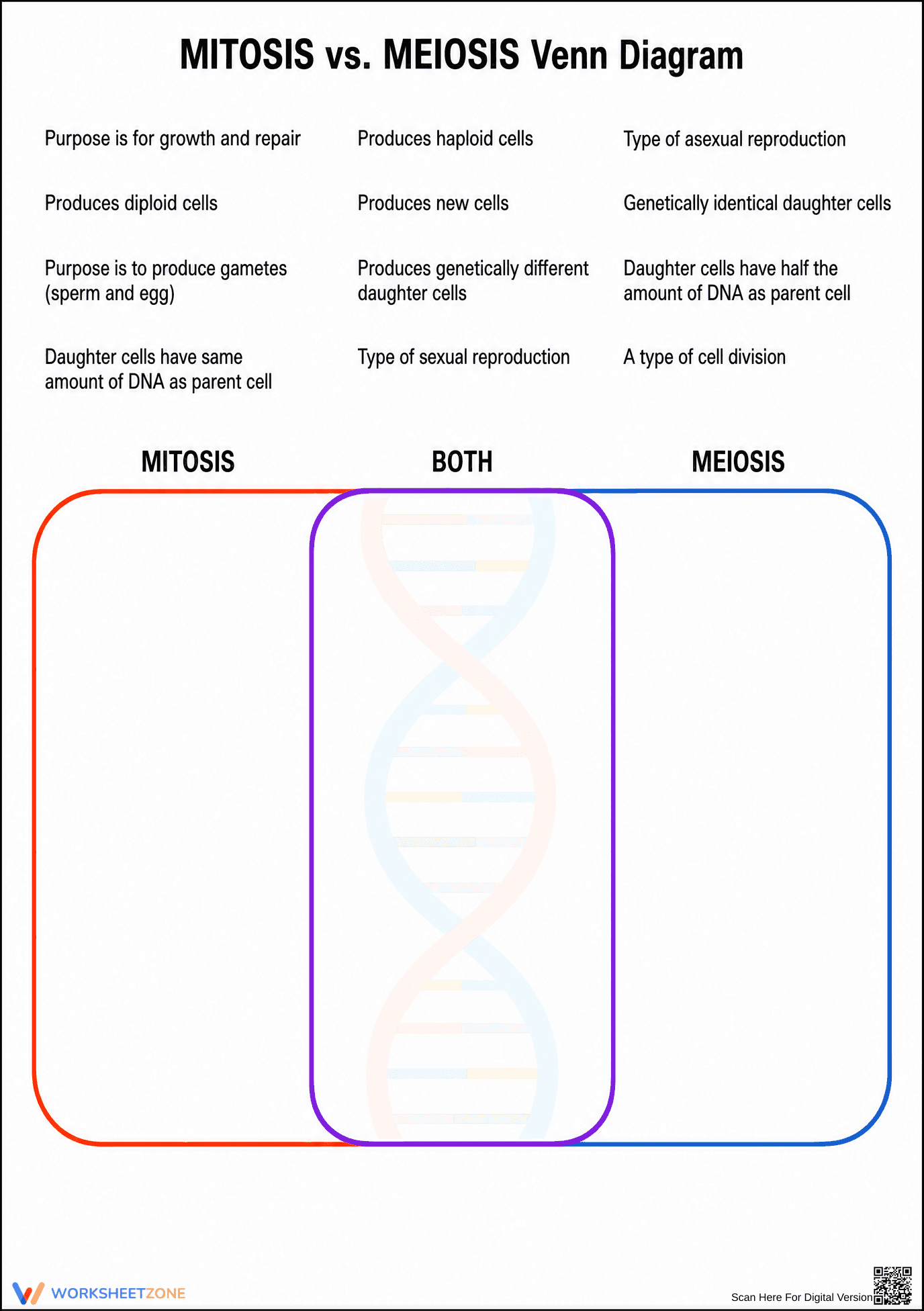

Printable Mitosis vs Meiosis Venn Diagram | Grade 9-12
Paste this activity's link or code into your existing LMS (Google Classroom, Canvas, Teams, Schoology, Moodle, etc.).
Students can open and work on the activity right away, with no student login required.
You'll still be able to track student progress and results from your teacher account.
This high school biology worksheet helps students visually compare and contrast the processes of mitosis and meiosis. By categorizing key characteristics into a Venn diagram, learners solidify their understanding of cell division, genetic variation, and reproduction types. The structured format ensures students can confidently distinguish between diploid and haploid cell production.
At a Glance
- Grade: 9-12 · Subject: Biology
- Standard:
HS-LS3-2— Compare asexual and sexual reproduction outcomes- Skill Focus: Comparing Mitosis and Meiosis
- Format: 1 page · 12 problems · Answer key included · PDF
- Best For: Independent practice and review
- Time: 15–20 minutes
This single-page resource features a clear, three-section Venn diagram labeled Mitosis, Both, and Meiosis. At the top, a word bank provides twelve characteristics, such as "Produces haploid cells" and "Purpose is for growth and repair." Students evaluate each statement and write it in the correct section. An answer key is included to make grading fast and accurate.
Designed for immediate classroom implementation, this zero-prep resource follows a simple workflow:
- Print (1 minute): The single-page layout is optimized for standard black-and-white printing, requiring no special formatting.
- Distribute (1 minute): Hand out the worksheet as a standalone assignment. The included word bank means students have all the information they need right on the page.
- Review (3 minutes): Use the provided answer key to quickly check student work or project it on the board for self-grading.
Total teacher prep time is under two minutes, making this an excellent option for emergency sub plans or quick formative assessments.
This worksheet aligns with HS-LS3-2: Make and defend a claim based on evidence that inheritable genetic variations may result from new genetic combinations through meiosis. By explicitly contrasting meiosis with mitosis, students build the foundational knowledge required to understand how sexual reproduction generates genetic diversity compared to asexual reproduction. Both standard codes can be copied directly into lesson plans, IEP goals, or district curriculum mapping tools.
Deploy this worksheet during the middle or end of a cell division unit. It serves perfectly as an independent practice activity after direct instruction on both processes. Alternatively, use it as a collaborative review station where pairs of students debate where each characteristic belongs. As a formative assessment tip, walk around the room and observe whether students correctly place "Produces genetically different daughter cells" versus "Genetically identical daughter cells"—this often reveals misconceptions about genetic variation. Expected completion time is 15 to 20 minutes.
This resource is designed for high school biology students, though it can easily be adapted for advanced middle school life science classes. The built-in word bank provides a natural scaffold for English Language Learners and students needing vocabulary support, as they do not have to generate the characteristics from memory. Pair this worksheet with a visual anchor chart showing the stages of cell division to provide additional context for struggling learners.
Mastering the distinctions between cellular processes requires structured comparative practice. Aligning with standard HS-LS3-2, this resource requires students to compare asexual and sexual reproduction outcomes by categorizing specific traits of mitosis and meiosis. According to Fisher & Frey (2014), utilizing graphic organizers like Venn diagrams significantly enhances students' ability to process complex scientific vocabulary and conceptual relationships. By moving beyond rote memorization and asking students to actively sort characteristics such as chromosome counts and reproductive purposes, educators facilitate deeper cognitive engagement. This targeted practice helps solidify the biological mechanisms responsible for genetic continuity and variation. Integrating this type of visual categorization into science curricula ensures learners build the robust foundational knowledge necessary for advanced genetics topics, ultimately supporting long-term retention and scientific literacy.


