


























Views
Downloads

Essential Meiosis & Cell Division Worksheet | Grades 9-12
Paste this activity's link or code into your existing LMS (Google Classroom, Canvas, Teams, Schoology, Moodle, etc.).
Students can open and work on the activity right away, with no student login required.
You'll still be able to track student progress and results from your teacher account.
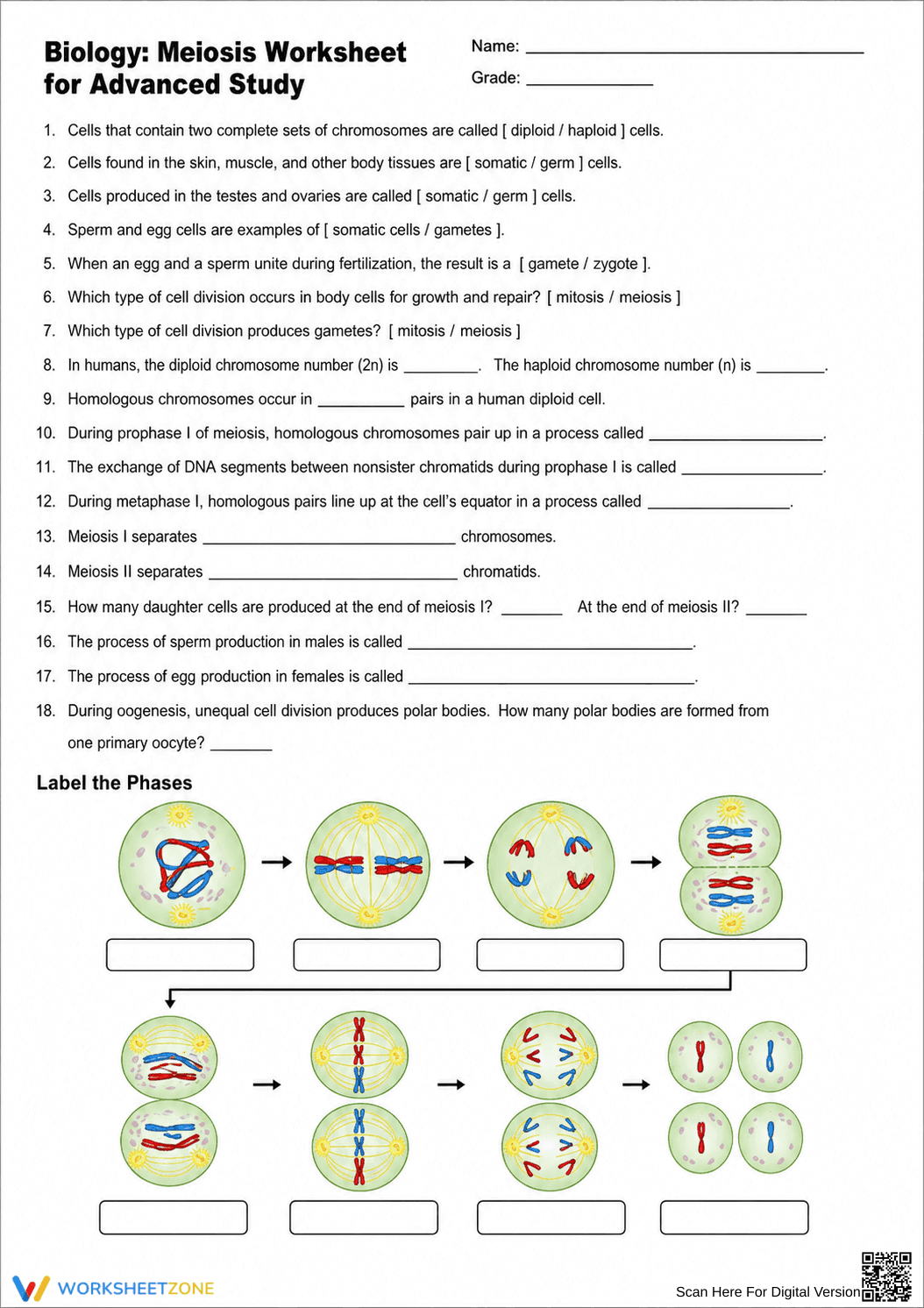
This high school biology worksheet provides a comprehensive review of meiosis, focusing on the transition from diploid to haploid cells. Students demonstrate mastery by identifying chromosome behavior and labeling specific cellular phases. It ensures learners understand how gametes form and how genetic variation is introduced during prophase I through crossing over and independent assortment.
At a Glance
- Grade: 9-12 · Subject: Biology
- Standard:
HS-LS3-2— Explain how meiosis results in inheritable genetic variation through new combinations- Skill Focus: Meiosis Phases & Chromosome Counts
- Format: 1 page · 26 tasks · Answer key included · PDF
- Best For: Independent practice or formative assessment
- Time: 25–35 minutes
The resource contains 18 structured fill-in-the-blank and multiple-choice questions that target vocabulary like zygote, somatic, and homologous pairs. Following the text-based section, a visual labeling task features 8 distinct cell diagrams. These diagrams require students to identify the specific stages of Meiosis I and Meiosis II, providing a multi-modal approach to complex biological concepts.
This worksheet is designed for a zero-prep classroom workflow. Teachers can print the single-page PDF in less than 1 minute. Distribution takes seconds, as the instructions are self-contained and require no additional lecture. Reviewing the 26 tasks using the provided answer key allows for a rapid 5-minute feedback loop at the end of the period, making it an ideal sub plan or exit ticket.
Aligned to `HS-LS3-2`, students must "Make and defend a claim based on evidence that inheritable genetic variations may result from: (1) new genetic combinations through meiosis." This worksheet provides the foundational evidence by requiring students to identify crossing over and the separation of chromatids. Both standard codes can be copied directly into lesson plans, IEP goals, or district curriculum mapping tools.
Use this as a mid-unit check for understanding after introducing the stages of cell division. It works effectively as a quiet independent activity while the teacher conducts small-group interventions. For formative assessment, observe student accuracy on questions 10 and 11 (crossing over) to gauge readiness for more complex genetics problems. Completion typically ranges from 25 to 35 minutes.
This resource is tailored for high school biology students, including those in Honors or AP tracks who need a refresher on chromosome math. It pairs naturally with a meiosis slide deck or a microscope lab observing lily anthers. The visual labeling section supports English Language Learners by providing clear pictorial cues for technical vocabulary.
According to the RAND AIRS 2024 analysis of secondary science curriculum, high-quality instructional materials must bridge the gap between abstract terminology and visual representation to ensure long-term retention of cellular processes. This worksheet addresses that need by pairing 18 conceptual questions with 8 visual identification tasks, directly supporting the HS-LS3-2 framework. Research from Fisher & Frey (2014) emphasizes that "check for understanding" tools are most effective when they require students to translate between text and diagrams, a core feature of this meiosis resource. By focusing on the specific mechanisms of haploid and diploid transitions, the worksheet provides the necessary scaffolding for students to later tackle complex inheritance patterns and genetic probability. This structured approach ensures that 9th through 12th-grade learners build a robust mental model of gametogenesis, which is essential for meeting national standards in life science and genetics.


