


























Views
Downloads
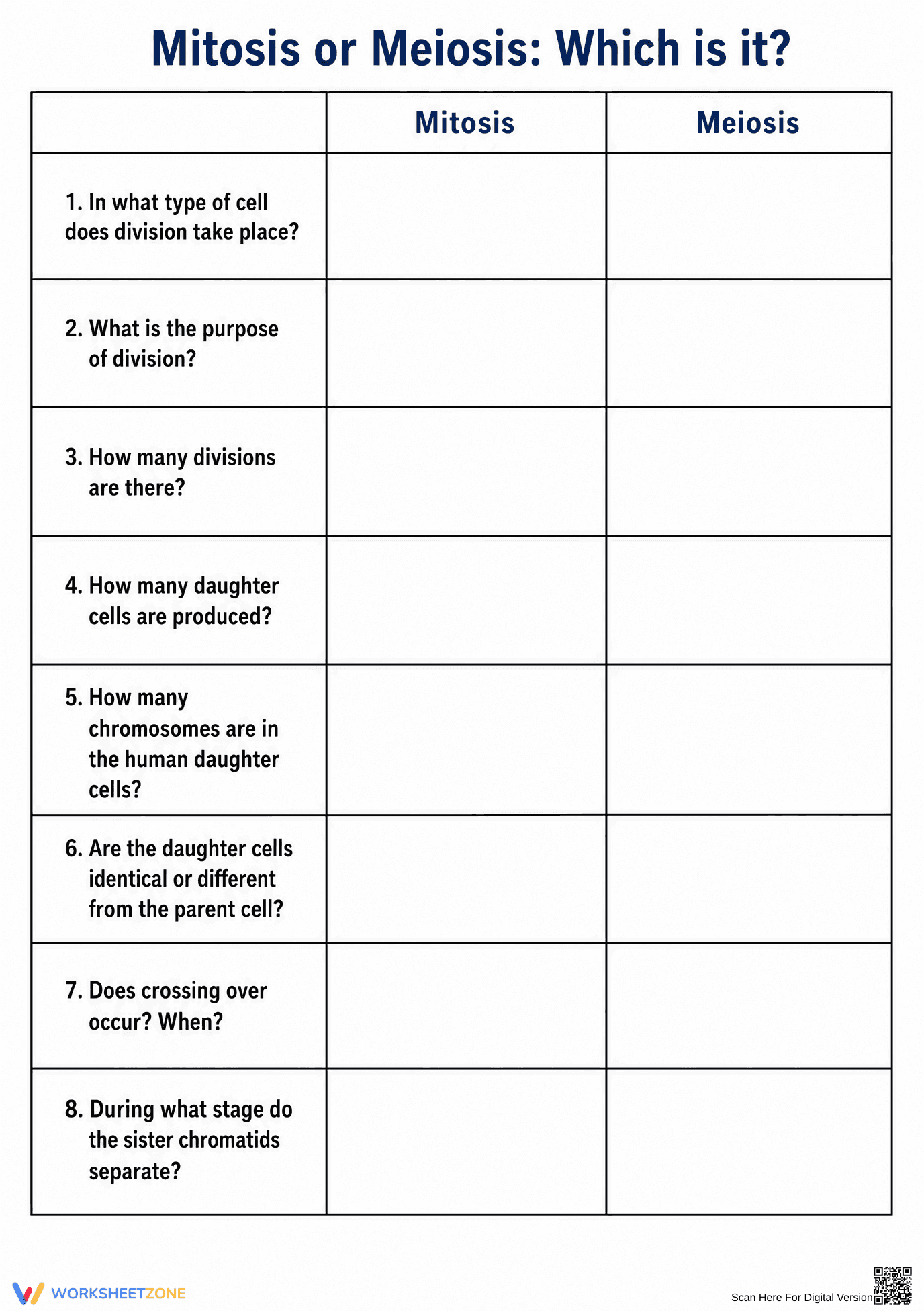

Mitosis vs Meiosis Comparison | Essential Biology Worksheet
Paste this activity's link or code into your existing LMS (Google Classroom, Canvas, Teams, Schoology, Moodle, etc.).
Students can open and work on the activity right away, with no student login required.
You'll still be able to track student progress and results from your teacher account.
This essential biology worksheet provides a structured framework for students to compare and contrast the two primary methods of cellular reproduction. By analyzing mitosis and meiosis side-by-side, learners identify critical differences in purpose, cell type, and genetic outcomes. This activity ensures students can distinguish between the production of identical somatic cells and the creation of unique gametes.
At a Glance
- Grade: 8-12 · Subject: Biology
- Standard:
HS-LS1-4— Use a model to illustrate the role of cellular division in organisms- Skill Focus: Comparative Cell Biology
- Format: 1 page · 8 tasks · Answer key included · PDF
- Best For: Mid-unit review and exam preparation
- Time: 15–20 minutes
The worksheet features a comprehensive 8-row comparison table designed for clarity and ease of use. Each row presents a targeted question that prompts students to recall specific details about both processes. The single-page PDF format is optimized for quick printing and includes a full answer key for efficient grading or self-assessment.
This resource is designed for a zero-prep classroom workflow. Teachers can print the single-page document in less than 30 seconds and distribute it immediately to students. The clear table structure allows for a 15-minute independent work session, followed by a 5-minute whole-class review. It serves as an ideal sub plan or a bell-ringer activity to activate prior knowledge before a lab.
Aligned to HS-LS1-4, this worksheet requires students to use a model to illustrate the role of cellular division and differentiation in maintaining complex organisms. It also supports HS-LS3-2 by highlighting how meiosis results in inheritable genetic variations. Both standard codes can be copied directly into lesson plans, IEP goals, or district curriculum mapping tools.
Use this worksheet as a formative assessment after introductory lectures on cell cycles. It is particularly effective when assigned as a partner activity, allowing students to debate the nuances of chromosome counts and chromatid separation. For a summative application, include the table as a section in a unit test to verify mastery of the fundamental differences between asexual and sexual reproduction pathways.
This resource is tailored for high school biology students in grades 9 through 12. It provides excellent support for English Language Learners (ELLs) by using a predictable table structure that minimizes linguistic complexity while maintaining rigorous scientific content. Pair this worksheet with a digital cell cycle animation for a multi-modal learning experience.
According to the RAND AIRS 2024 report on secondary science instruction, the use of structured comparative organizers significantly improves student retention of complex biological cycles like HS-LS1-4. This worksheet facilitates the high-level cognitive processing required to distinguish between somatic and germ cell division. By isolating eight specific variables—including chromosome count, crossing over, and sister chromatid separation—students move beyond rote memorization toward a conceptual understanding of genetic continuity and variation. Research indicates that visual tables reduce the extraneous cognitive load associated with dense scientific texts, allowing Grade 9-12 learners to focus on the mechanics of cellular reproduction. This resource provides the necessary scaffolding for students to articulate the differences between diploid and haploid outcomes, a foundational requirement for advanced genetics. Utilizing this evidence-based approach ensures that learners can accurately model the role of cellular division in producing and maintaining complex organisms as required by national science frameworks.


