


























Views
Downloads
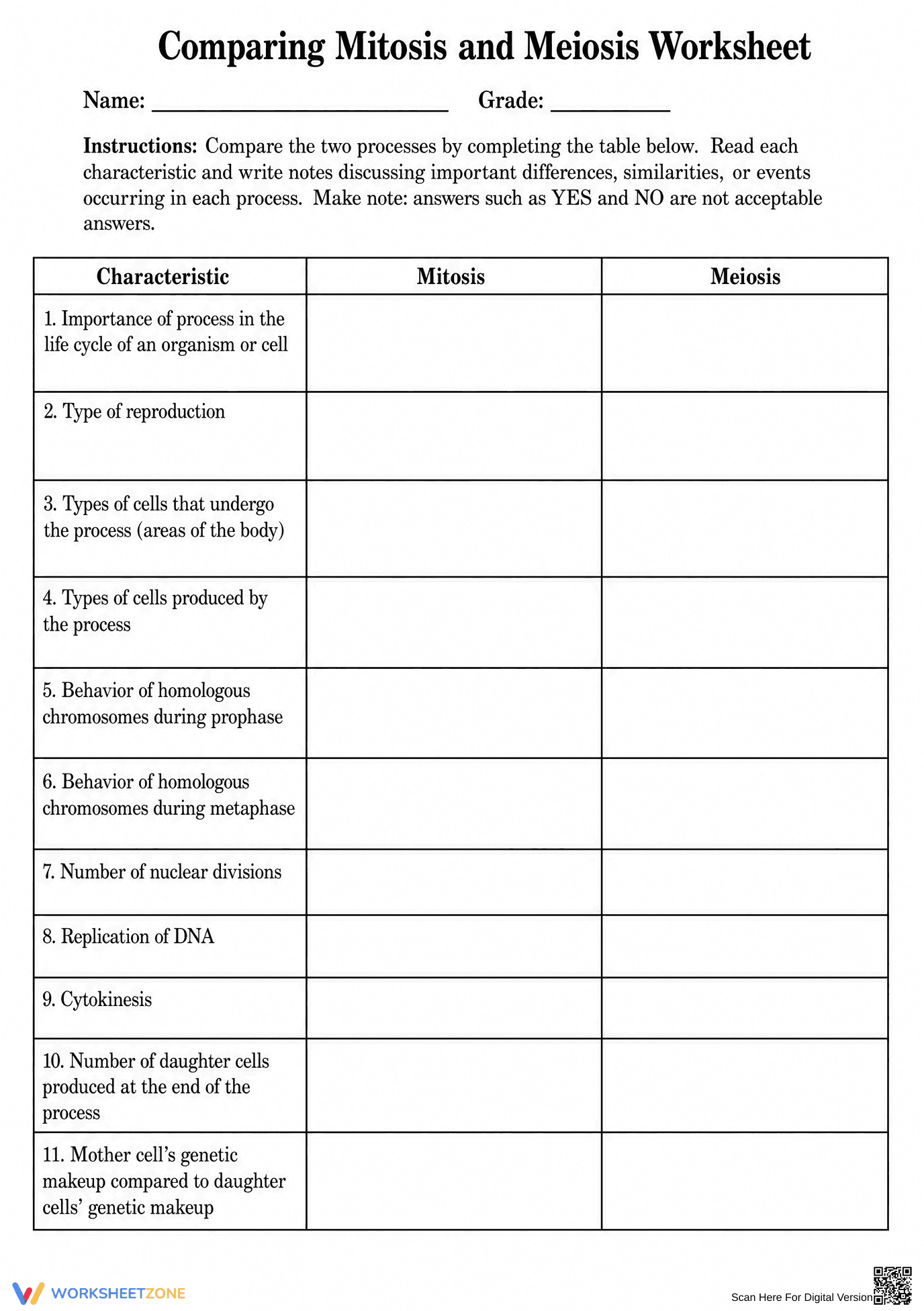

Essential Mitosis vs Meiosis Comparison Worksheet
Paste this activity's link or code into your existing LMS (Google Classroom, Canvas, Teams, Schoology, Moodle, etc.).
Students can open and work on the activity right away, with no student login required.
You'll still be able to track student progress and results from your teacher account.
This high school biology worksheet provides a structured framework for students to distinguish between mitosis and meiosis. By analyzing 11 distinct characteristics, learners identify how cells replicate for growth versus reproduction. This activity ensures students move beyond rote memorization to understand the functional consequences of different nuclear division types in eukaryotic organisms.
At a Glance
- Grade: 9-12 · Subject: Biology
- Standard:
HS-LS3-2— Explain how inheritable genetic variations result from new genetic combinations through meiosis.- Skill Focus: Comparative Analysis of Cell Division
- Format: 1 page · 11 problems · Answer key included · PDF
- Best For: Mid-unit formative assessment or review
- Time: 20–30 minutes
The resource consists of a comprehensive comparison matrix designed for clarity and depth. It features 11 specific rows targeting critical biological concepts, including homologous chromosome behavior, the number of nuclear divisions, and the genetic makeup of daughter cells. The layout provides ample space for detailed notes, discouraging simple binary responses and requiring students to articulate the logic behind each process. A full teacher answer key is provided to streamline grading and provide immediate feedback.
Skill Progression
- Guided Identification: Students begin by examining the basic purpose and location of each process within the body, establishing the biological context for division.
- Supported Analysis: Learners compare complex mechanical behaviors like DNA replication, prophase interactions, and cytokinesis across 6 specific technical rows.
- Independent Synthesis: Students evaluate the genetic outcomes of each division, explaining how meiosis creates variation while mitosis preserves identity in the final 3 tasks.
This gradual-release approach ensures mastery of complex cellular mechanics through a structured I Do, We Do, You Do instructional model.
Standards Alignment
This resource is primarily aligned with HS-LS3-2, which requires students to make and defend claims about how inheritable genetic variations result from meiosis. It also supports HS-LS1-4, focusing on the role of cellular division in producing and maintaining complex organisms. Both standard codes can be copied directly into lesson plans, IEP goals, or district curriculum mapping tools.
How to Use It
Use this worksheet as a summative review after lecturing on both processes but before a unit exam. It serves as an excellent active study guide where students must verify their notes against the table requirements. Alternatively, assign it as a collaborative partner activity during the instructional phase; observe students as they discuss row 11 regarding genetic makeup to gauge their understanding of diploid versus haploid outcomes. Completion typically takes 25 minutes.
Who It's For
This is designed for Grade 9-12 Biology students, including those in Honors or AP tracks who need a refresher on fundamental mechanics. It is particularly effective for visual learners who benefit from side-by-side data organization. Pair this worksheet with a microscopic slide lab or a 3D modeling activity to provide a multi-sensory learning experience for diverse classrooms.
The distinction between mitosis and meiosis is a cornerstone of biological literacy, yet it remains a frequent point of confusion for secondary students. According to research by Fisher & Frey (2014), the use of graphic organizers and comparison matrices significantly improves the retention of complex procedural knowledge by reducing cognitive load. This worksheet leverages that principle by isolating 11 variables, allowing students to focus on specific mechanical differences like homologous pairing and chromosome reduction. By aligning with the HS-LS3-2 standard, the activity ensures that students are not just identifying phases, but are understanding the broader implications of genetic recombination. This evidence-based approach to cell biology instruction facilitates the transition from basic recall to the higher-order thinking required for advanced genetics and evolutionary biology studies.


