


























Views
Downloads
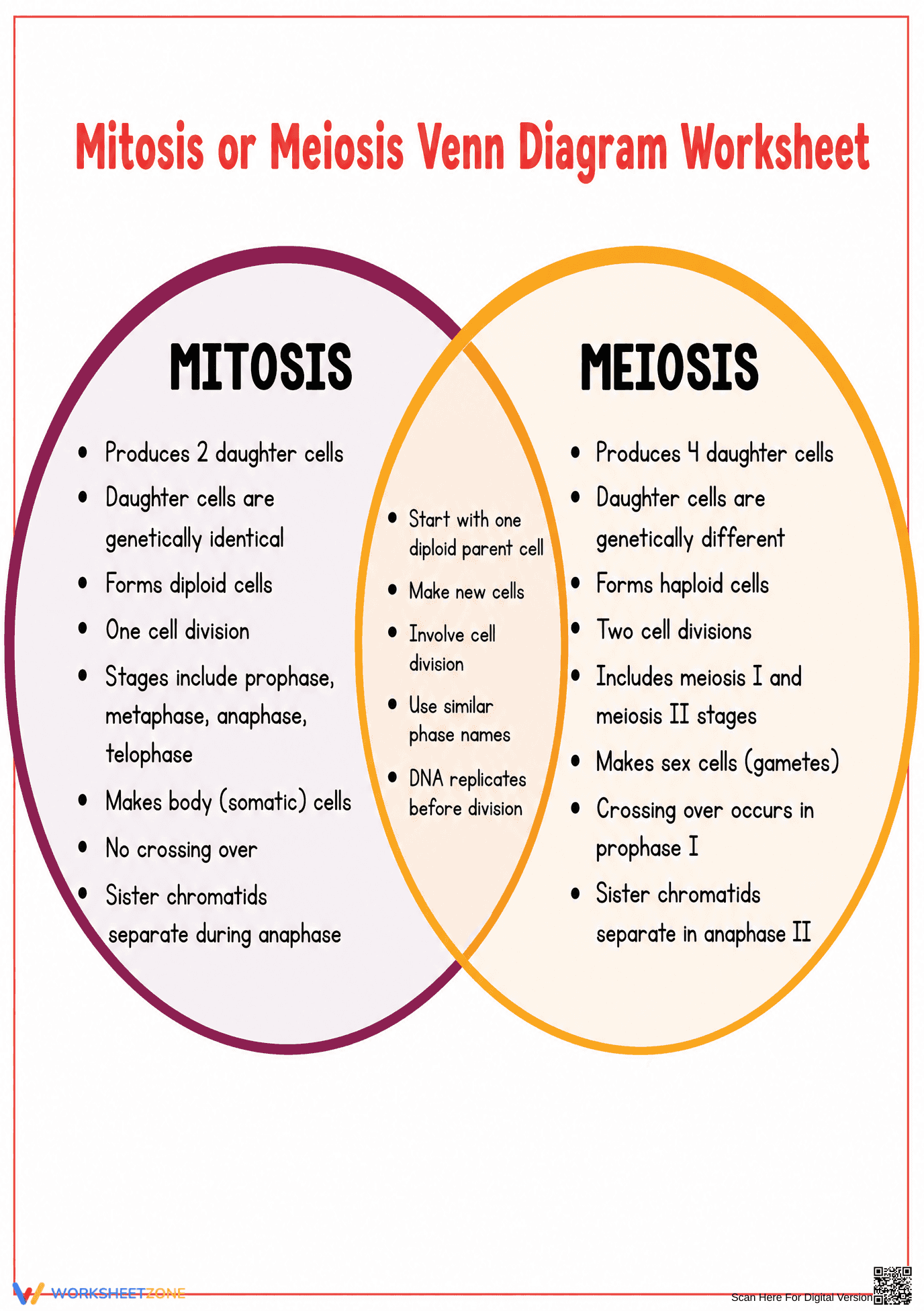

Mitosis vs Meiosis Venn Diagram | Essential Biology Guide
Paste this activity's link or code into your existing LMS (Google Classroom, Canvas, Teams, Schoology, Moodle, etc.).
Students can open and work on the activity right away, with no student login required.
You'll still be able to track student progress and results from your teacher account.
This high school biology worksheet provides a comprehensive visual comparison between mitosis and meiosis using a structured Venn diagram. Students identify critical differences in daughter cell production, genetic variation, and cellular ploidy. It serves as a definitive reference for mastering the complexities of cell division and inheritance patterns in living organisms.
At a Glance
- Grade: 9-12 · Subject: Biology
- Standard:
HS-LS3-2— Explain how inheritable genetic variations result from new combinations through meiosis- Skill Focus: Comparative Cell Division
- Format: 1 page · 20 comparison points · Answer key included · PDF
- Best For: High school biology study guide
- Time: 15–20 minutes
The resource features a dual-circle Venn diagram that explicitly contrasts 20 distinct characteristics of cellular reproduction. It details the number of daughter cells, genetic identity versus diversity, diploid and haploid states, and specific phase behaviors like crossing over in Prophase I. The layout includes a central intersection highlighting shared traits such as DNA replication and the use of similar phase nomenclature.
Zero-Prep Workflow
- Print: Select the single-page PDF and print enough copies for your class in under 30 seconds.
- Distribute: Hand out the diagrams as a reference sheet or a guided note-taking template during your lecture.
- Review: Use the completed diagram to facilitate a 5-minute check-for-understanding session at the end of the period.
Total teacher preparation time for this activity is less than 2 minutes, making it an ideal resource for busy classrooms or emergency sub plans.
Standards Alignment: Primary standard HS-LS3-2 requires students to make and defend claims based on evidence regarding inheritable genetic variations. This worksheet provides the foundational evidence by contrasting the clonal nature of mitosis with the recombinative nature of meiosis. Both standard codes can be copied directly into lesson plans, IEP goals, or district curriculum mapping tools.
How to Use It: Use this worksheet during the "Explain" phase of a 5E instructional cycle to clarify the distinct outcomes of somatic versus germ cell division. It is also an effective formative assessment tool; ask students to cover one side of the diagram and recreate the points from memory. Expected completion for a review session is 15 to 20 minutes.
Who It's For: This resource is designed for high school biology students, including those in AP Biology or Honors tracks who need a quick visual refresher. It pairs naturally with a microscopic observation lab or a digital simulation of the cell cycle. The clear bulleted format supports English Language Learners and students with processing needs by reducing heavy text blocks.
According to the RAND AIRS 2024 report on secondary science instruction, visual organizers like Venn diagrams significantly improve the retention of abstract biological concepts by reducing cognitive load. This HS-LS3-2 aligned worksheet targets the specific mechanisms of genetic variation, including crossing over and independent assortment, which are frequently tested on state assessments and the NAEP science framework. By explicitly comparing the 2 daughter cells of mitosis with the 4 genetically unique gametes of meiosis, the resource provides the evidence-based scaffolding necessary for students to construct arguments about heredity. Research from Fisher & Frey (2014) suggests that such graphic organizers serve as essential bridge tools between direct instruction and independent mastery, allowing students to categorize complex procedural knowledge into manageable conceptual frameworks for long-term academic success.


