


























Views
Downloads

Essential Mitosis vs Meiosis Venn Diagram | Grade 9-12
Paste this activity's link or code into your existing LMS (Google Classroom, Canvas, Teams, Schoology, Moodle, etc.).
Students can open and work on the activity right away, with no student login required.
You'll still be able to track student progress and results from your teacher account.
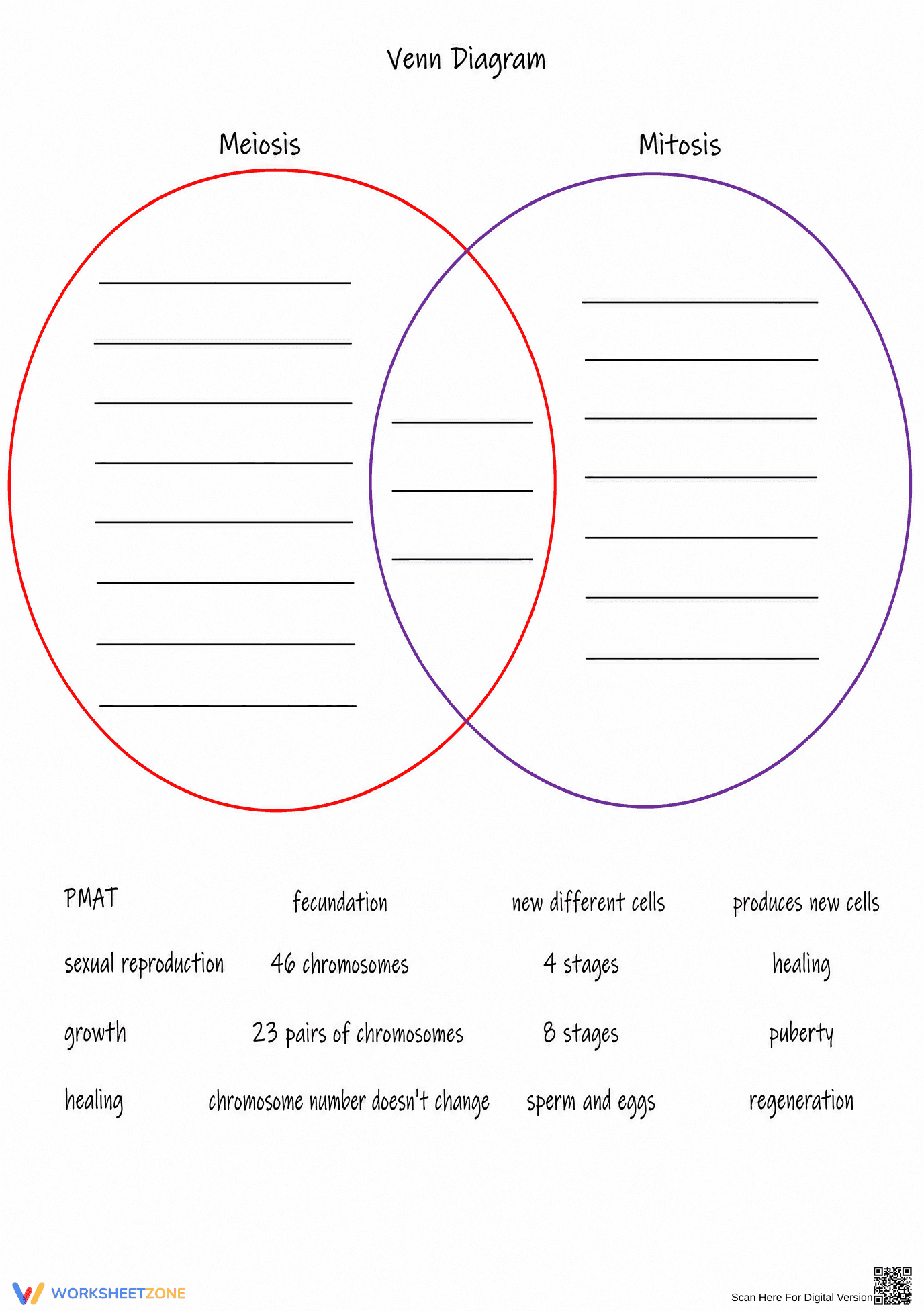
This high school biology worksheet provides a structured Venn diagram to help students master the complex differences between mitosis and meiosis. By categorizing 16 specific traits, learners develop a clear mental model of cellular division, reproductive processes, and genetic outcomes. It is an ideal tool for reinforcing core biological concepts during a genetics or cell unit.
At a Glance
- Grade: 9-12 · Subject: Biology
- Standard:
HS-LS1-4— Use models to illustrate the role of cellular division in organisms- Skill Focus: Comparative Analysis of Cell Division
- Format: 1 page · 16 sorting tasks · Answer key included · PDF
- Best For: Formative assessment or biology unit review
- Time: 15–20 minutes
The worksheet features a clean, two-circle Venn diagram layout with dedicated lines for legible writing. At the bottom, a curated list of 16 scientific terms and phrases—including "PMAT," "fecundation," and "regeneration"—serves as a word bank. This single-page PDF is designed for immediate distribution, requiring no additional student research to complete the primary sorting task.
Zero-Prep Workflow
- Print: Generate enough copies for your class in under 1 minute.
- Distribute: Hand out as a bell-ringer or exit ticket to gauge student understanding in 30 seconds.
- Review: Use the included answer key for a rapid whole-class review or peer-grading session in 2 minutes.
Its self-contained nature makes it an excellent choice for emergency sub plans or independent study packets where teacher guidance is limited.
This resource aligns with HS-LS1-4, which requires students to use a model to illustrate the role of cellular division. It specifically addresses the distinction between somatic cell maintenance and the production of gametes. Both standard codes can be copied directly into lesson plans, IEP goals, or district curriculum mapping tools.
Use this worksheet as a mid-unit check for understanding after students have been introduced to both PMAT cycles. During the activity, circulate and observe if students correctly place "8 stages" in the meiosis section, which serves as a quick formative assessment of their grasp on the two-stage division process. Expected completion time ranges from 15 to 20 minutes.
This is designed for high school biology students, including those in AP Biology needing a quick refresher. It provides excellent scaffolding for visual learners and can be paired with a microscopic slide lab or a cell cycle anchor chart to deepen the connection between theory and observation.
According to research by Fisher & Frey (2014) on the gradual release of responsibility, graphic organizers like this Venn diagram are essential for moving students from guided instruction to independent mastery of complex scientific systems. By requiring students to categorize 16 distinct biological traits, the worksheet forces active retrieval of information regarding HS-LS1-4. This process of comparative analysis is a proven method for reducing cognitive load when learning the nuanced differences between mitosis and meiosis. The inclusion of specific terms like "fecundation" and "regeneration" ensures that students are engaging with high-level academic vocabulary. This resource provides a reliable, evidence-based approach to biology instruction that can be integrated into any secondary science curriculum to improve student outcomes in cellular biology assessments.


