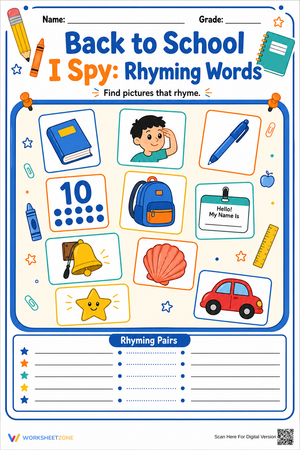
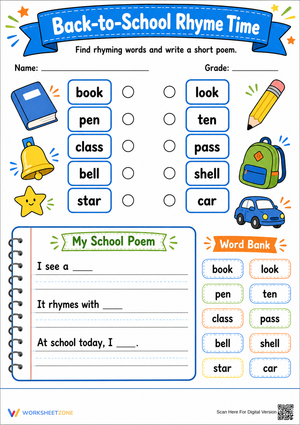
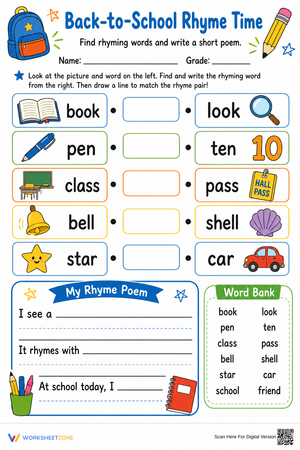
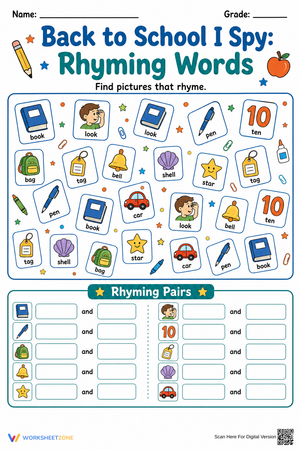
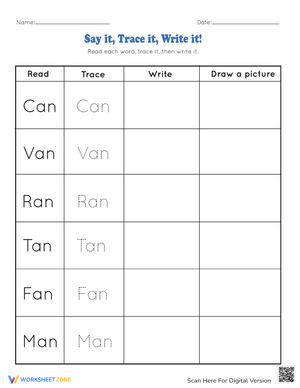
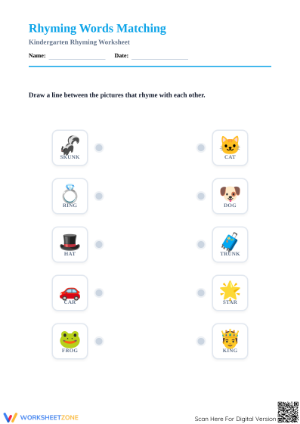
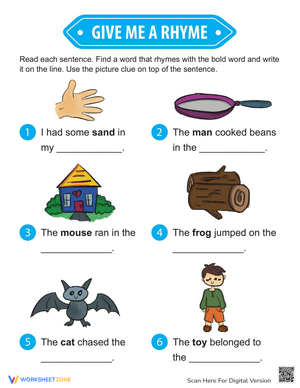
These 1st grade rhyming words worksheets resources put students to work on one of the most predictable skill gaps in early phonics: hearing where a word ends and recognizing that ending as a repeating pattern rather than a random collection of sounds. Each worksheet targets a specific task — matching, sorting, circling, or producing rhymes — so teachers can slot the right worksheet into the right moment of instruction without adapting on the fly. The collection spans from picture-supported matching for students who still rely on oral cues all the way to write-your-own prompts that require independent word generation.
The Specific Skills Each Worksheet Targets
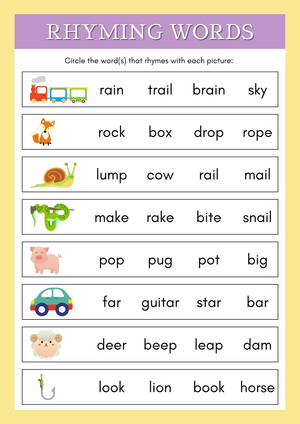
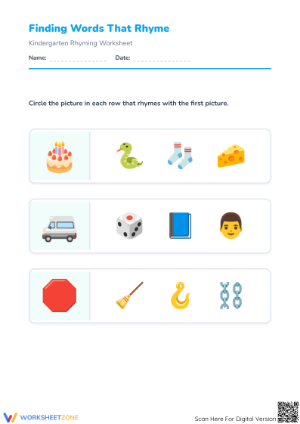
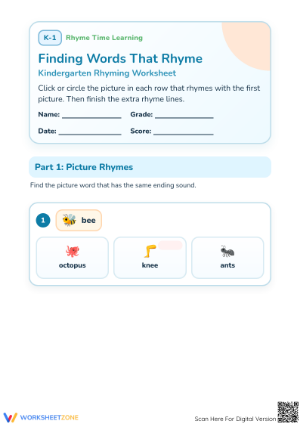
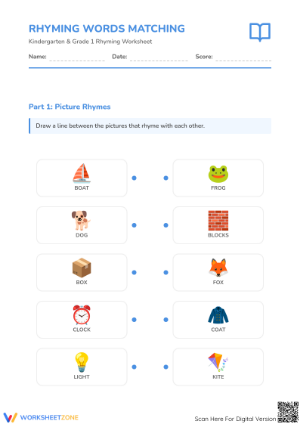
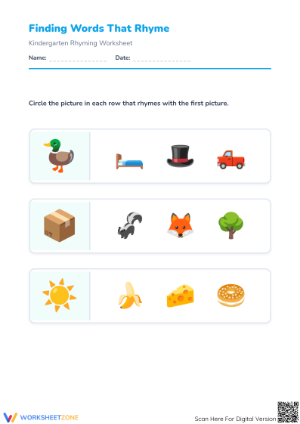
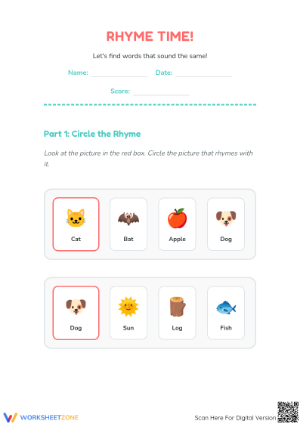
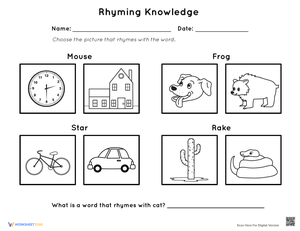
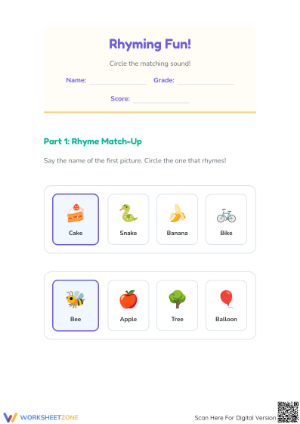
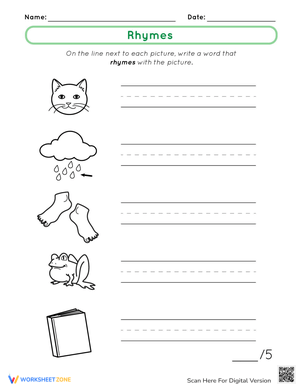
The task formats follow a deliberate progression through phonological complexity. Students first practice on picture-only worksheets, where they match a drawing of a cat to a drawing of a hat without needing to decode print at all. This keeps cognitive load manageable before students must hold both the sound task and the reading task in mind at the same time. One format worth noting in any strong set of 1st grade rhyming words worksheets resources: each worksheet uses a consistent visual layout within its task type, so students who have completed the matching format once do not spend mental energy decoding new directions on the second attempt — they spend it on the phonological work.
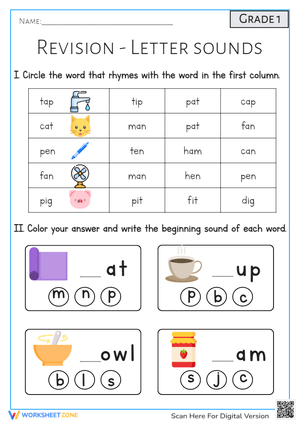
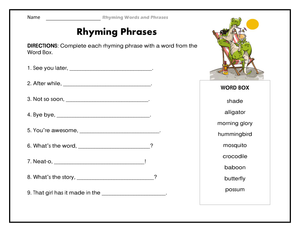
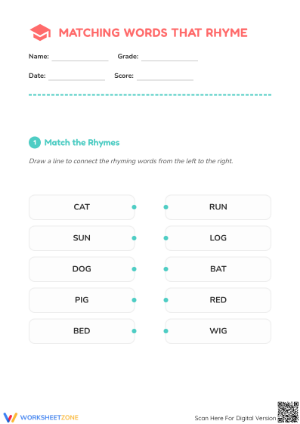
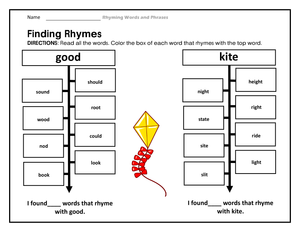
Later worksheets introduce print alongside pictures, asking students to read a simple CVC word and circle the rhyming match from two or three options. The final format removes visual support entirely and asks students to write a rhyme, pulling a word from memory and applying the ending pattern without prompting. Across the collection, students practice:
- Identifying the odd word out when two words in a trio rhyme and one does not
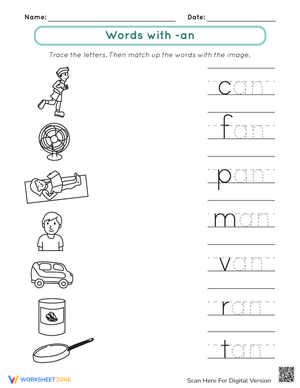
- Matching pictures by ending sound across common word families: -at, -an, -ig, -ot, -en, and -ump
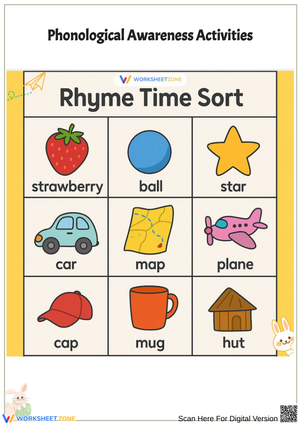
- Sorting picture cards into rhyming pairs during center rotations
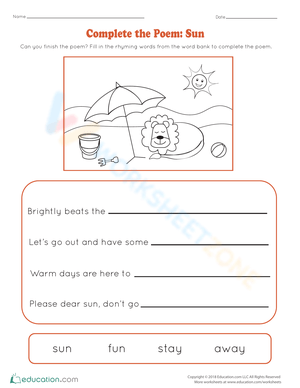
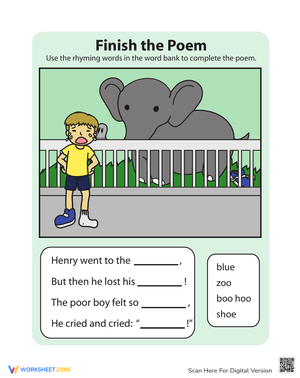
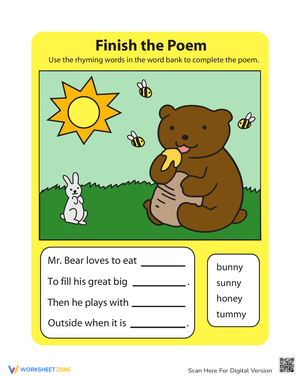
- Completing a rhyming couplet by writing the missing word
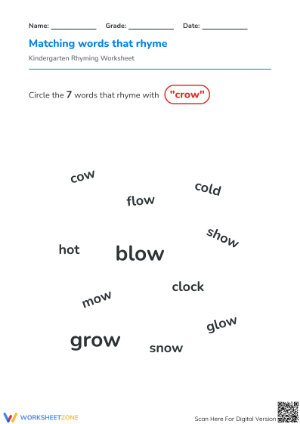
- Marking the two words in a row of three that share the same ending sound
Predictable Errors These Worksheets Help Teachers Catch
The most consistent error in first-grade rhyming work is confusing rhyme with alliteration. A student who hears "Which two words rhyme: sun, sand, fun?" will frequently circle sun and sand because the beginning sound matches — not the ending. When that pattern appears repeatedly on a completed worksheet, it signals that the student has not yet redirected attention to the back half of the word. That error does not self-correct through additional practice; it needs direct instruction that explicitly names the distinction between first sounds and last sounds, preferably with the teacher covering the beginning of the word and asking students to listen only to what remains.
A second error surfaces on picture-based worksheets: picture-labeling mismatches. When a student looks at a drawing of a coat and thinks jacket, they will not match it to boat, even if their phonological understanding is strong. A thirty-second image walk through the worksheet before students work independently — naming each picture aloud as a class — prevents that kind of false negative from distorting your instructional data.
A third pattern appears in the write-a-rhyme format: students produce a genuine rhyming word but spell it in a way that obscures the word-family pattern. A student asked to rhyme with cake might write bak rather than bake — the oral skill is intact, but the orthographic connection to the -ake family is not. Treat that as an entry point into word-family spelling rather than as an error to simply mark wrong.
Fitting These Worksheets Into the Literacy Block
The most reliable instructional sequence is oral first, written second. Before distributing a worksheet, spend five minutes at the rug: say word pairs aloud, ask students to repeat them, and exaggerate the ending sound together. That brief oral phase does more for accuracy on the written task than any amount of additional worksheet repetition. Once students have heard and said the pattern, the worksheet becomes meaningful confirmation rather than guesswork.
Morning work is one of the strongest natural slots — rhyming matching takes six to eight minutes, maps cleanly to the window between arrival and whole-group meeting, and requires no special materials beyond the printed worksheet. Small-group time is another reliable use: distribute one worksheet immediately after direct instruction, while students are still at the table, and treat it as a real-time formative check. You see instantly who is transferring the rhyming skill and who is reverting to initial-sound matching.
A classroom routine worth trying: use the same worksheet twice across the week. On Monday, complete it together with guided oral rehearsal before students work independently. On Thursday, distribute the same worksheet cold, without the warm-up. Compare the two sets of responses. Students who genuinely internalized the pattern finish the Thursday worksheet quickly and accurately. Students who were imitating the class on Monday slow down, skip items, or produce alliteration errors. That comparison tells you more than a separate quiz. The 1st grade rhyming words worksheets format works especially well for this routine because the tasks are contained and the responses are unambiguous — students marked the rhyming picture or they did not.
Standard Alignment
Rhyming is formally addressed under RF.K.2a in the Common Core framework — recognizing and producing rhyming words is a kindergarten-level phonological awareness benchmark. Grade 1 teachers use these worksheets because many students arrive in first grade without that skill consolidated. The broader RF.1.2 phonological awareness standard for Grade 1 covers understanding of spoken words, syllables, and phonemes; rhyming practice reinforces that foundation even when the dedicated rhyming benchmark is catalogued at the kindergarten level. State frameworks in Texas (TEKS §110.2 and §110.3, phonological awareness strand) and Florida (LAFS.K.RF.1.2a) mirror this structure. In classroom terms, rhyming worksheets fit most naturally in the first trimester of Grade 1 as consolidation work, then return in January and February as a short warm-up before lessons move to more demanding phoneme segmentation and blending tasks.
Adjusting the Task for a Range of Learners
Students who are still working at the picture-matching level need worksheets with no print demands. Name every picture aloud before students work independently, and reduce the choice set from four options to two. Two-option matching is sufficient to demonstrate whether a student hears the ending pattern. That adjustment removes the cognitive noise that causes struggling readers to guess randomly rather than apply phonological knowledge — and it costs nothing in terms of prep.
For students who have already mastered picture-based rhyming, move them to the write-a-rhyme format and add a second step: generate three rhymes for a given word rather than one. A student who can quickly name cat, bat, mat, and sat for a hat prompt is demonstrating phonological fluency, not just single-word recall. Students at this level can also begin to wrestle with words that have no common rhyme — orange, month — and discuss why, which bridges into early morphological awareness and opens up vocabulary exploration that goes well beyond the rhyming task itself.
Frequently Asked Questions
Are these worksheets appropriate for students who are still working at a kindergarten phonics level?
Yes. Because rhyming is technically a kindergarten phonological awareness benchmark, many first graders arrive needing the same picture-based matching practice these worksheets offer. The picture-supported formats are clear enough for kindergartners with strong visual support and useful enough for first graders reviewing a skill they did not fully consolidate the prior year. Grade level printed on the worksheet is a planning convenience, not a ceiling.
How many items is the right amount for a Grade 1 rhyming worksheet?
For independent practice, six to eight items gives enough data to identify a pattern in student responses without causing attention fatigue in early readers. For intervention use, four to six items with picture support is a strong working range — enough for the teacher to see whether the student hears the ending pattern, without overwhelming a student who already finds the task effortful. Fewer than four items rarely shows you whether a correct answer was skill or luck.
Can these worksheets serve as a formative assessment tool?
They work well in that role when collected immediately after instruction rather than administered as a stand-alone quiz. After a small-group lesson, sort completed worksheets into two groups: students who answered correctly and students who showed alliteration errors or left items blank. That informal sort gives you a clear instructional group for the next day without any additional paperwork. The 1st grade rhyming words worksheets format suits this kind of fast-cycle check because the tasks are short and the responses are binary — students identified the rhyming word or they did not.
Should I pre-teach vocabulary before distributing picture-based worksheets?
For most classes, yes — at minimum, name every picture aloud together before students work independently. English learners and students with limited exposure to print vocabulary are at real risk of missing a rhyming pair because they labeled an image differently than intended. A student who looks at a drawing of a can and thinks cup will not connect it to man, regardless of their phonological ability. A thirty-second image walk through the worksheet prevents that kind of false negative from distorting your read on what students actually know.












 Interactive Worksheet Maker
 Quiz Maker
 Word Search Maker
 Crossword Puzzle Maker
 Word Scramble Generator
 Sentence Scramble Generator
 Handwriting Worksheet Generator
 Name Tracing Generator
 Fill In The Blank Generator