


























Views
Downloads


Rhyming Words Matching Worksheet | Grade K-1 Printable
Paste this activity's link or code into your existing LMS (Google Classroom, Canvas, Teams, Schoology, Moodle, etc.).
Students can open and work on the activity right away, with no student login required.
You'll still be able to track student progress and results from your teacher account.
This Kindergarten and Grade 1 rhyming words worksheet helps students identify and match phonetic pairs through visual and textual cues. By connecting images like boat and coat, learners strengthen their phonemic awareness and foundational reading skills. This resource provides a structured way for early readers to recognize similar ending sounds in common vocabulary words.
At a Glance
- Grade: Kindergarten · Subject: ELA
- Standard:
CCSS.ELA-LITERACY.RF.K.2.A— Recognize and produce rhyming words during phonological awareness activities- Skill Focus: Rhyming & Phonemic Awareness
- Format: 2 pages · 10 problems · Answer key included · PDF
- Best For: Independent practice or morning work
- Time: 10–15 minutes
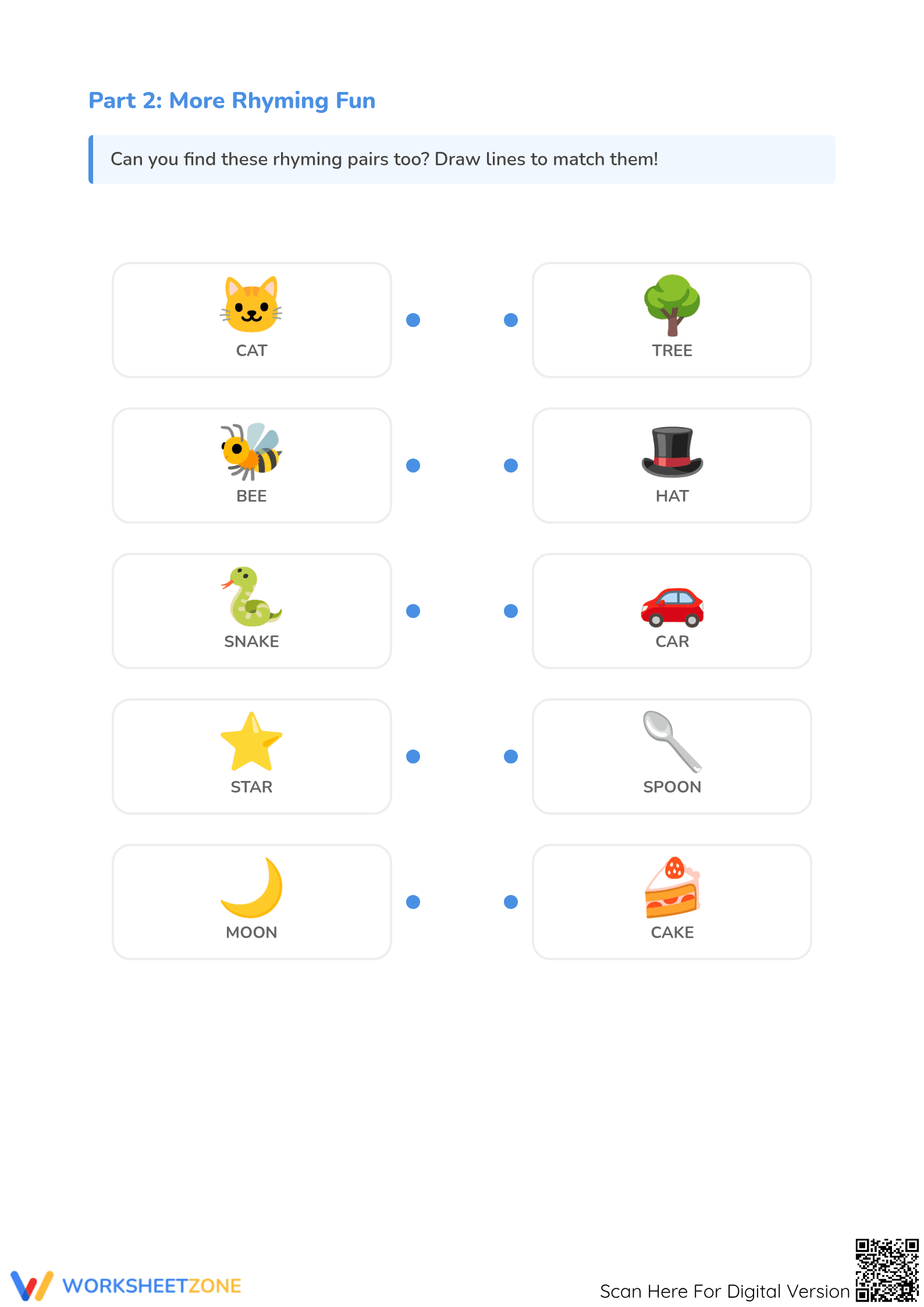
This comprehensive 2-page PDF features 10 distinct rhyming pairs designed for early childhood learners. Each page contains five matching tasks where students draw lines between corresponding items. To support diverse learners, every item includes both a high-quality colorful illustration and a clear text label in uppercase letters. A full answer key is provided to facilitate quick grading or self-correction.
Zero-Prep Workflow
- Print: Select the 2-page PDF and print enough copies for your class in less than 60 seconds.
- Distribute: Hand out the worksheets during your phonics block; the clear Part 1 and Part 2 headers require no additional explanation.
- Review: Use the included answer key to check student work in under 1 minute, or display it on a projector for a whole-class check.
Standards Alignment
The primary focus is CCSS.ELA-LITERACY.RF.K.2.A, which requires students to recognize and produce rhyming words. By matching visual representations with their written names, students also engage with CCSS.ELA-LITERACY.RF.K.3, identifying common letter-sound correspondences. Both standard codes can be copied directly into lesson plans, IEP goals, or district curriculum mapping tools.
How to Use It
Use this worksheet as a formative assessment after a direct instruction lesson on ending sounds. It works exceptionally well as a "must-do" activity during literacy centers. While students work, observe if they are sounding out the words or relying solely on the pictures; this provides a quick check on their blending progress. Expect completion in approximately 12 minutes.
Who It's For
This resource is ideal for Kindergarten students and Grade 1 learners needing phonics intervention. It is also suitable for Preschoolers showing advanced phonological readiness. Pair this worksheet with a rhyming read-aloud or an anchor chart featuring common word families like -at, -og, and -ox to reinforce the auditory patterns.
Phonological awareness is a critical predictor of later reading success, and rhyming is a foundational component of this developmental sequence. According to Fisher & Frey (2014), the gradual release of responsibility model is most effective when students have clear, scaffolded opportunities to practice discrete skills like identifying rhyming pairs. This worksheet aligns with that research by providing 10 structured matching tasks that bridge the gap between auditory recognition and visual word association. By using both images and text labels, the resource supports the dual-coding theory of cognition, helping students store phonetic information more effectively. The inclusion of the CCSS.ELA-LITERACY.RF.K.2.A standard ensures that the practice remains focused on grade-level expectations for phonological awareness. Educators can use the 2-page format to monitor progress over multiple sessions, ensuring that students can consistently recognize rhymes across different word families and vowel sounds.


