




























Views
Downloads
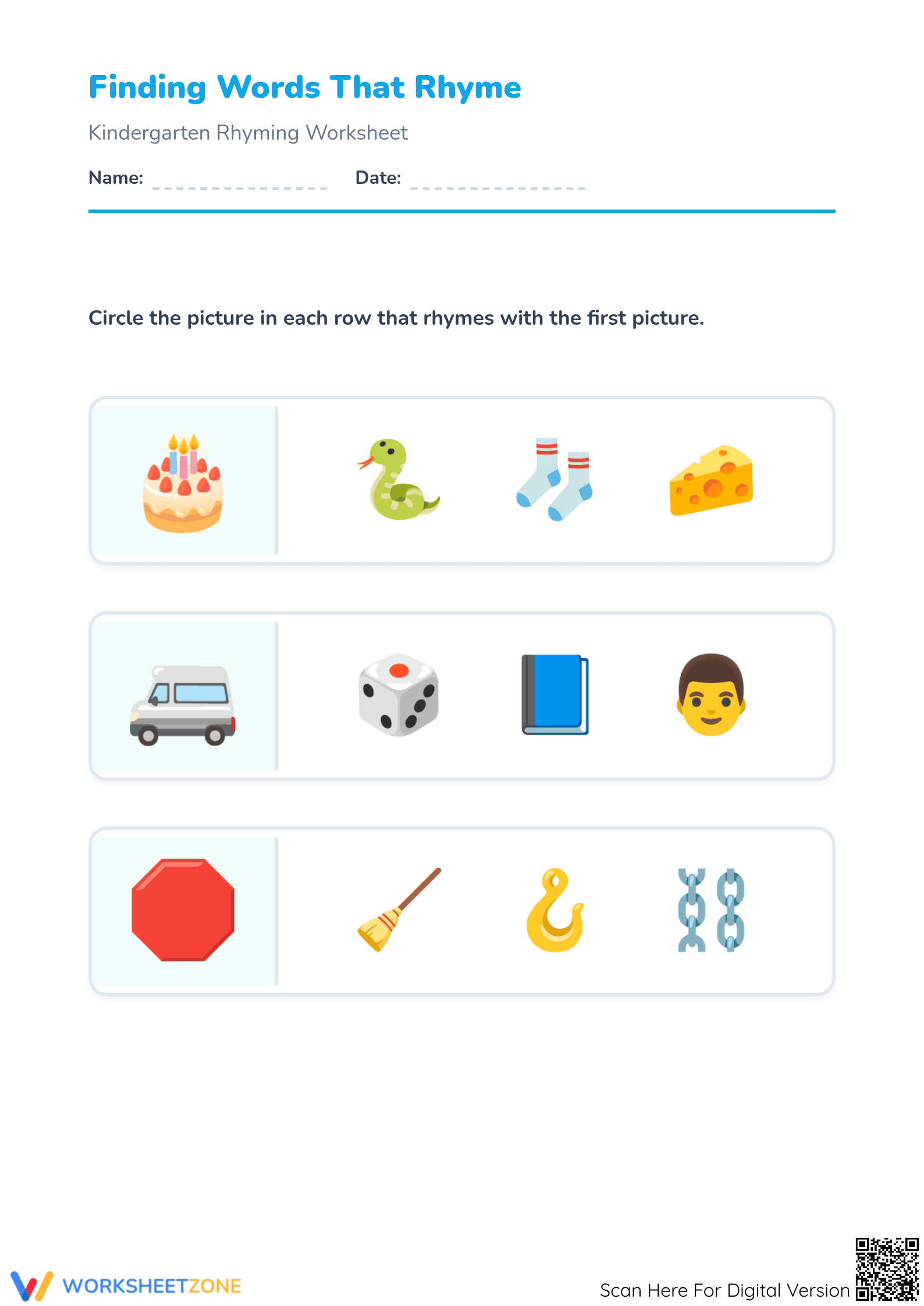


Finding Rhyming Words Worksheet | Essential Grade K-1

Paste this activity's link or code into your existing LMS (Google Classroom, Canvas, Teams, Schoology, Moodle, etc.).
Students can open and work on the activity right away, with no student login required.
You'll still be able to track student progress and results from your teacher account.
Strengthen early literacy foundations with this focused rhyming worksheet designed for Kindergarten and Grade 1 students. By identifying words that share ending sounds through visual prompts, learners develop the phonemic awareness necessary for decoding and reading fluency. This resource provides a clear, distraction-free layout that allows young students to focus entirely on the auditory relationship between objects.
At a Glance
- Grade: Kindergarten · Subject: ELA
- Standard:
RF.K.2.A— Recognize and produce rhyming words through auditory and visual identification.- Skill Focus: Rhyming & Phonemic Awareness
- Format: 2 pages · 4 problems · Answer key included · PDF
- Best For: Early literacy centers and phonics practice
- Time: 10–15 minutes
What's Inside: This 2-page PDF features 4 distinct rhyming challenges. Each row presents a target image followed by three options. Students must say the names of the objects aloud to determine which one rhymes with the lead picture. The worksheet includes a full answer key, making it easy for teachers or parents to verify student progress at a glance without additional preparation.
Zero-Prep Workflow
- Print: Select the 2 pages and hit print. Total prep time is under 30 seconds.
- Distribute: Hand out the sheets during your phonics block or as a morning work activity.
- Review: Use the included answer key to check for understanding in less than 1 minute per student.
This streamlined workflow makes the resource an ideal choice for emergency sub plans or quick formative assessments during literacy rotations.
Standards Alignment: This resource is specifically aligned to `CCSS.ELA-LITERACY.RF.K.2.A`, which requires students to demonstrate understanding of spoken words, syllables, and sounds (phonemes) by recognizing and producing rhyming words. Both standard codes can be copied directly into lesson plans, IEP goals, or district curriculum mapping tools.
How to Use It: Use this worksheet during the "You Do" phase of a gradual release lesson on phonological awareness. It works exceptionally well in a small-group setting where a teacher can listen to students vocalize the words. For a formative assessment, observe if students are segmenting the onset and rime as they compare the pictures. Expect completion within 10 to 15 minutes.
Who It's For: This activity is tailored for Preschool, Kindergarten, and early Grade 1 students who are beginning to explore word families. It provides excellent support for English Language Learners (ELLs) by using clear icons to build vocabulary. Pair this worksheet with a rhyming anchor chart or a read-aloud of a classic rhyming text to reinforce the concept.
Research from the RAND AIRS 2024 report emphasizes that phonological awareness, specifically the ability to recognize rhyme, is one of the strongest predictors of later reading success in primary grades. This worksheet applies these findings by providing 4 targeted visual prompts that isolate the rime without the cognitive load of complex text. By engaging in these structured identification tasks, students build the neural pathways required for mapping sounds to letters. The inclusion of an answer key ensures that instructional feedback is immediate, which is a critical factor in early childhood learning retention. Educators can utilize this resource to bridge the gap between auditory recognition and print awareness, ensuring that 100% of the student's focus remains on the phonemic relationship between the target and the choice images. This systematic approach to rhyming supports the development of a robust internal lexicon and prepares learners for more advanced decoding tasks in subsequent units.


