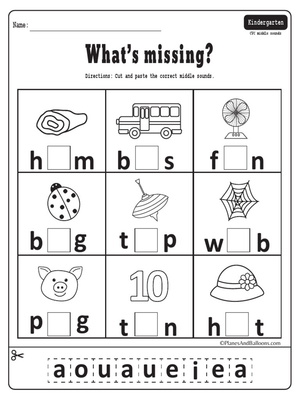
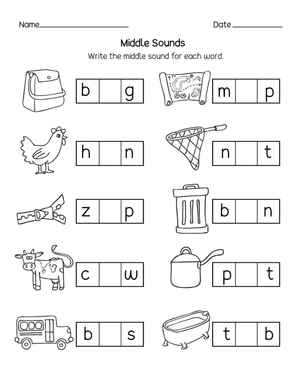
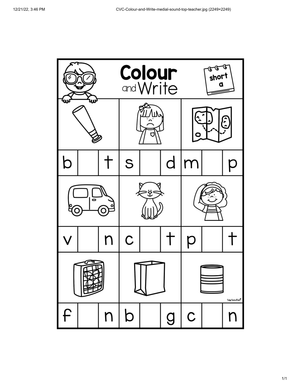
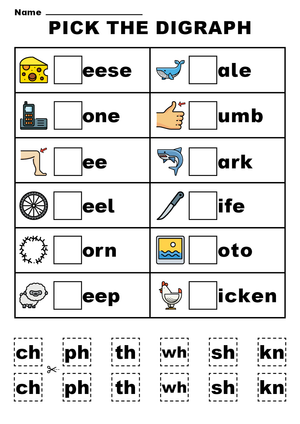
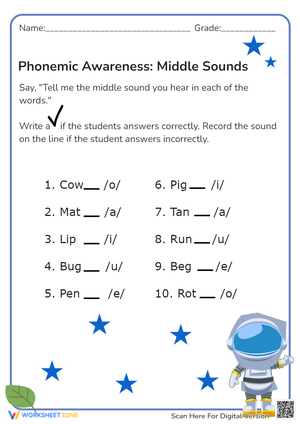
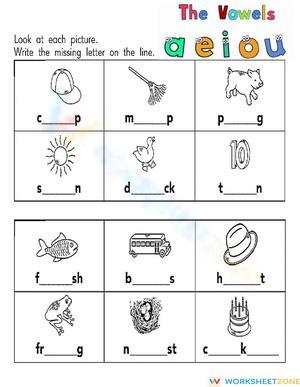
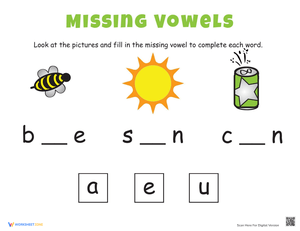
These 1st grade middle sound printable worksheets target the phonics skill that first graders struggle with longest: pulling the short vowel out from between the two consonants that surround it in a CVC word. The set covers all five short vowels across several formats — missing-vowel fill-ins, picture sorts by vowel category, color-by-medial-vowel tasks, and cut-and-paste word-building activities — so students practice the same core skill through different kinds of demands.
Why the Middle Vowel Is the Last Short-Vowel Skill to Stick
The difficulty isn't arbitrary. In spoken language, the medial vowel in a word like "pig" doesn't exist as a discrete unit — it's launched by the /p/ and immediately absorbed by the /g/ before a first grader can lock onto it. Students who correctly identify /p/ as the first sound in "pan" will reliably write "pen" for "pin," because the distinction between short /e/ and short /i/ is genuinely subtle: both vowels share similar tongue placement, and neither carries the acoustic salience of a stop consonant. The confusion between short /a/ and short /u/ shows up similarly in student writing — "bag" becomes "bug" not because students can't hear the word but because both vowels feel like they live in the same vague middle register. Worksheets that require a written commitment — circle one vowel, write one letter — create the kind of forced discrimination that repeated oral drills alone don't demand.
What Each Worksheet Asks Students to Do
Each worksheet isolates a specific task within the medial vowel skill so teachers can diagnose exactly where a student's phonological processing breaks down.
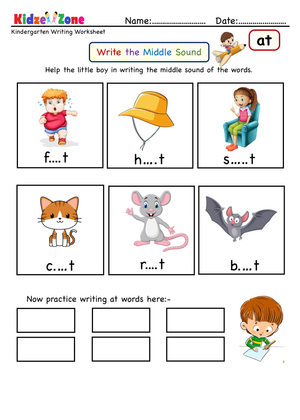
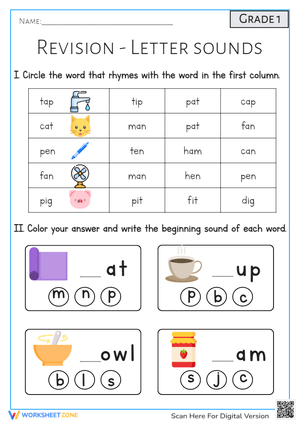
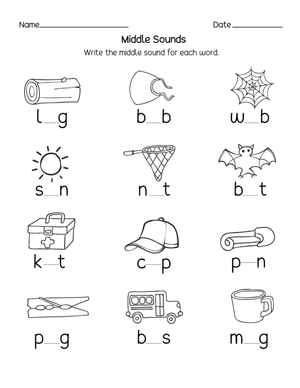
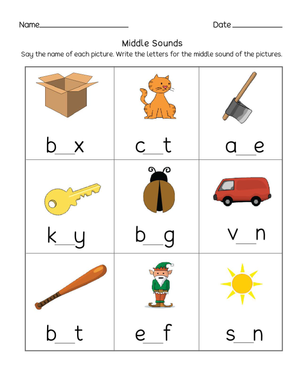
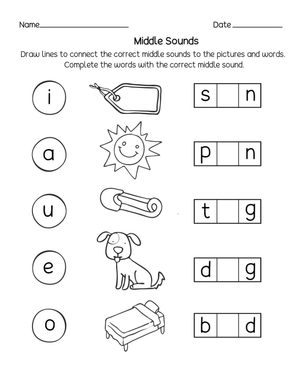
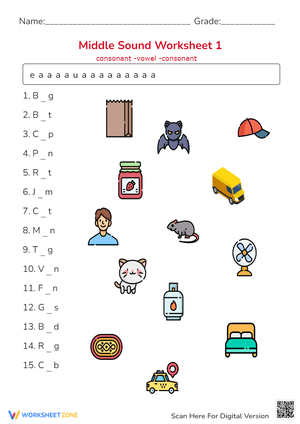
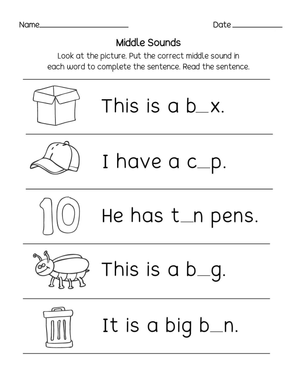
- Missing-vowel fill-ins: Students see a picture of a "cup" paired with "c_p" and must supply the /u/. This format directly tests whether a student can translate an auditory phoneme into its written grapheme.
- Picture sorts by vowel sound: Students sort a set of images into columns labeled with each short vowel. A "hat" and a "flag" go in the /a/ column; a "net" and a "sled" go in the /e/ column. The sorting format requires students to hold each vowel's sound in working memory while scanning across images — a genuinely different cognitive demand than writing a letter in a blank.
- Color-by-medial-vowel: Students color sections of a larger image based on the middle vowel in each labeled picture. The format keeps engagement high during independent practice without adding instructional complexity.
- Cut-and-paste word building: Students cut out letter tiles and assemble them into beginning, middle, and ending boxes. The physical handling of the vowel tile slows students down in a productive way — they can't rush through without touching the middle sound directly.
Getting the Most From These Worksheets in Your Literacy Block
The most consistent place teachers use 1st grade middle sound printable worksheets is morning arrival. Having a single-focus phonics task waiting on each desk gives students something purposeful to begin while attendance is taken and the room settles. The missing-vowel format works particularly well here because it requires no teacher setup once students have seen the format once or twice.
Literacy centers are a strong fit for the picture-sort worksheets. When students work in pairs at a center, they tend to verbalize their thinking — "I hear /a/ in 'crab,' so it goes in this column" — which produces exactly the kind of oral phonemic awareness practice that reinforces what the written task demands. For small-group intervention, the word-building format gives the teacher a clear window into a student's processing: you can watch whether a student reaches for the correct vowel tile with confidence or cycles through two or three before committing. That moment of hesitation tells you more than the final answer does. Collecting completed worksheets as exit tickets after whole-group instruction also generates fast, sortable data — a stack of 24 papers sorted into "correct middle sound" and "wrong vowel" takes about three minutes and tells you exactly who needs a targeted pull the next morning.
Mistakes Students Make That Teachers Need to See
The most predictable error isn't a random guess — it's a systematic neighbor swap. Students who write "pet" for "pit" or "sit" for "set" are not guessing; they are applying a real but imprecise phonological category. The short /e/ and short /i/ confusion is so consistent that it's worth anticipating on the first worksheet that introduces these two vowels side by side. When you see that swap repeating, more worksheet practice doesn't fix it — mouth-position awareness does. Have the student feel where their jaw sits when they say /e/ (more open) versus /i/ (narrower, lips slightly pulled back) before they return to the paper.
A different error pattern surfaces with the cut-and-paste word-building format: students correctly identify the vowel sound but place the tile in the wrong box — the beginning or ending position — because they're responding to the phoneme's presence rather than its location in the sequence. When that happens, the problem isn't vowel identification; it's phoneme position awareness, and that calls for Elkonin box work before more medial-sound practice on these worksheets.
Standard Alignment
These worksheets address RF.1.2.C of the Common Core State Standards for English Language Arts, which requires first graders to isolate and pronounce initial, medial vowel, and final sounds in spoken single-syllable words. In classroom terms, RF.1.2.C sits at the intersection of phonemic awareness and phonics instruction — it asks students to work with sounds orally while the written worksheet connects those sounds to their graphemic representations. Most first-grade scope-and-sequence documents place medial vowel work after students have had solid exposure to initial and final consonants, typically mid-year, though teachers in higher-performing groups often reach it by late fall.
Adjusting the Set for a Classroom Full of Different Learners
For students who are behind grade level, introduce worksheets with only two contrasting vowels — short /a/ and short /o/ are the most acoustically distinct pair to start — rather than presenting all five at once. Cognitive load drops significantly when students choose between two options instead of five, and early success with a two-column sort builds the confidence that keeps them engaged with harder versions. The 1st grade middle sound printable worksheets that focus on a single vowel pair also function cleanly as targeted intervention tools without requiring the teacher to produce new materials.
English Language Learners need vocabulary front-loading before any worksheet is useful. If a student doesn't recognize the image of a "mop" as a mop, the phonics task is blocked before it starts. Five minutes of picture-vocabulary preview — holding up each image, naming it, having students repeat — removes that barrier so the worksheet actually functions as phonics practice rather than a vocabulary guessing game. For advanced students, the same medial-vowel position can be practiced in words with initial blends ("clap," "frog," "step"), where the structural challenge is higher but the core skill — identifying the vowel — stays the same as in standard CVC words.
Frequently Asked Questions
How do these worksheets work as a quick formative assessment?
Collect them at the end of a lesson and sort by error type rather than overall score. A student who missed every short /e/ item tells a different instructional story than a student who missed a random scatter of vowels. Grouping errors by vowel lets you form a targeted small group around a specific sound rather than a vague "needs more phonics" group. Teachers tracking RF.1.2.C progress can attach completed 1st grade middle sound printable worksheets to a phonics portfolio as a dated record of where each student was performing week by week — useful at parent conferences and progress monitoring meetings alike.
When in the year should medial vowel work begin?
Most first graders are ready for focused medial vowel practice once they reliably identify initial and final consonants — usually somewhere between October and December, depending on the class. Starting too early, before students have stable consonant anchors, tends to produce frustration rather than growth because they can't hold the beginning and ending sounds steady enough to isolate what's in the middle. If students are still uncertain about final sounds, two more weeks there before introducing these worksheets is a better investment.
What should I do when a student consistently identifies the wrong vowel?
First, determine whether the error is systematic or random. Systematic errors — always writing /a/ for /e/, for instance — point to a phonological categorization problem and respond well to minimal-pair oral practice before returning to the worksheet. Random errors usually mean the student is guessing rather than listening, which typically signals that an unfamiliar picture is blocking the phonics task. Random errors can also indicate auditory processing difficulties worth flagging for a specialist if the pattern persists across multiple weeks of instruction.












 Interactive Worksheet Maker
 Quiz Maker
 Word Search Maker
 Crossword Puzzle Maker
 Word Scramble Generator
 Sentence Scramble Generator
 Handwriting Worksheet Generator
 Name Tracing Generator
 Fill In The Blank Generator