




























Views
Plays
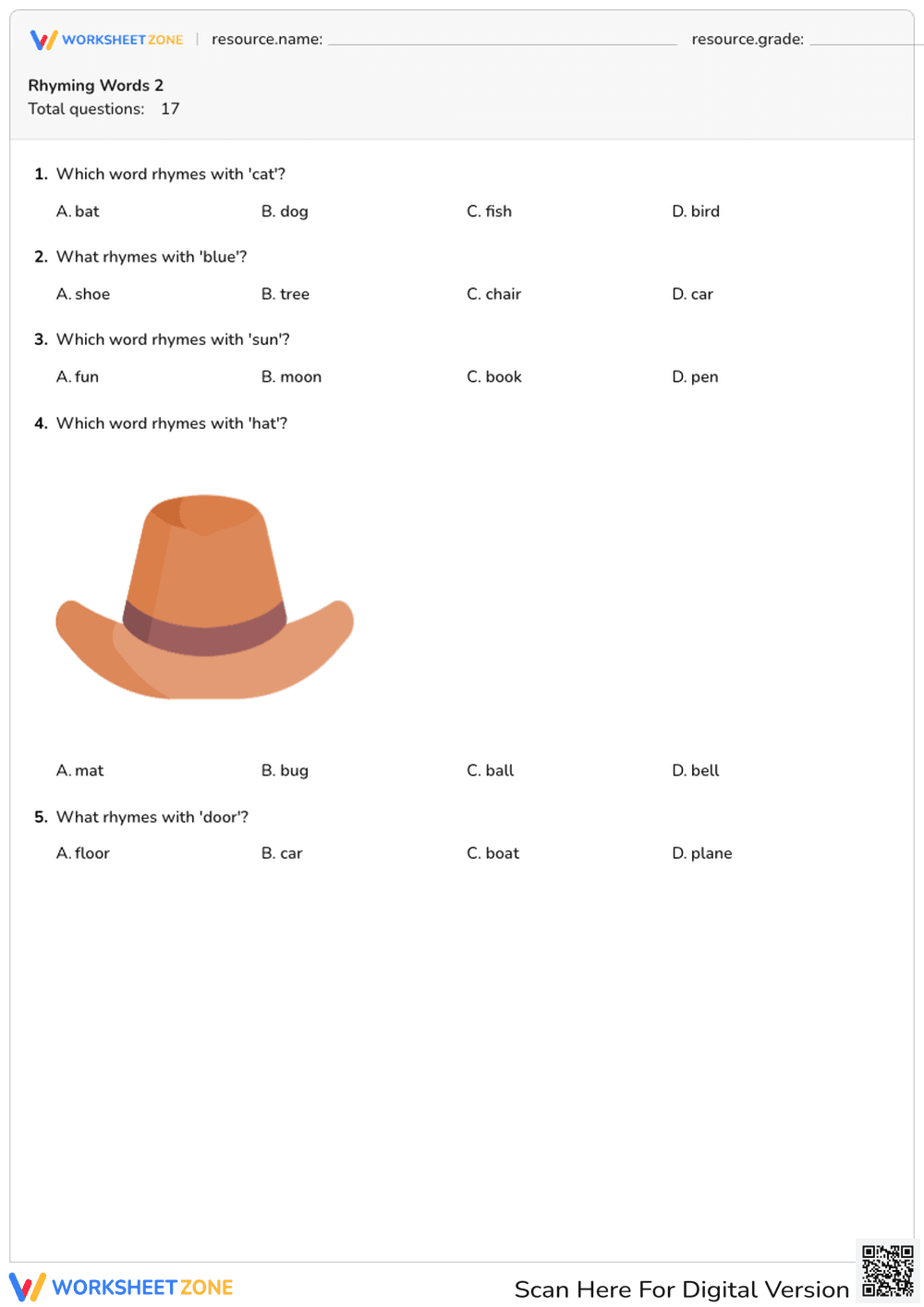


Rhyming Words Printable Worksheet | Grade 1 ELA

Paste this activity's link or code into your existing LMS (Google Classroom, Canvas, Teams, Schoology, Moodle, etc.).
Students can open and work on the activity right away, with no student login required.
You'll still be able to track student progress and results from your teacher account.
This foundational phonics worksheet helps early readers master sound recognition by identifying rhyming words. By working through a series of highly visual, multiple-choice questions, students will strengthen their phonological awareness and decoding abilities. This targeted practice builds the essential auditory discrimination skills required for reading fluency and spelling success.
At a Glance
- Grade: 1 · Subject: ELA
- Standard:
CCSS.ELA-LITERACY.RF.K.2.A— Recognize and produce rhyming words- Skill Focus: Identifying Rhyming Words
- Format: 4 pages · 17 problems · Answer key included · PDF
- Best For: Independent practice and review
- Time: 15–20 minutes
This comprehensive four-page printable features 17 multiple-choice questions designed to test and reinforce rhyming skills. Each problem presents a target word—often accompanied by a clear illustration like a hat or bee—and requires students to select the matching rhyme from four options. The clean layout minimizes visual clutter. A complete answer key is included to streamline grading.
This resource supports a gradual release of responsibility:
- Guided practice: Teachers can use the first few illustrated questions to model isolating ending sounds.
- Supported practice: Students work through image-supported questions, using visual cues to decode target words.
- Independent practice: The final text-only questions challenge students to rely solely on phonetic decoding skills.
This progression complements an I Do, We Do, You Do instructional model.
This worksheet is strictly aligned to CCSS.ELA-LITERACY.RF.K.2.A: "Recognize and produce rhyming words." It also supports early Grade 1 phonological awareness standards by requiring students to decode simple words and identify matching ending phonemes. Both standard codes can be copied directly into lesson plans, IEP goals, or district curriculum mapping tools.
This versatile phonics quiz can be deployed in multiple ways within the classroom. Assign it as a morning work activity immediately following a whole-group mini-lesson on word families to reinforce the day's concept. Alternatively, place it in a literacy center for independent review. As a formative assessment tip, observe students as they complete the text-only questions; if they struggle to find the rhyme without a picture cue, they may need additional support with basic decoding. Most students will complete this activity within 15 to 20 minutes.
This resource is primarily designed for Kindergarten and Grade 1 students developing their early reading skills. It is also highly effective for Grade 2 students who need targeted intervention in phonological awareness, or English Language Learners building their English vocabulary. For optimal results, pair this worksheet with a pocket chart sorting activity or a direct instruction lesson on specific word families.
Mastering phonological awareness is a critical stepping stone in early literacy development. By practicing with targeted resources aligned to CCSS.ELA-LITERACY.RF.K.2.A, students learn to effectively recognize and produce rhyming words. This auditory discrimination directly impacts their future ability to decode complex texts, recognize word families, and spell accurately. According to a recent EdReports 2024 analysis, foundational skills instruction that includes explicit, systematic practice with rhyming and phoneme manipulation significantly improves overall reading proficiency in early elementary grades. When young learners engage with structured multiple-choice formats, they not only reinforce their phonetic knowledge but also build essential test-taking confidence. Providing consistent, targeted opportunities to identify matching sounds ensures that students develop the robust phonological foundation necessary for long-term academic success across all subject areas, bridging the gap between spoken language and written text.


