


























Views
Downloads

Rhyming Words Matching Worksheet | Essential Grade K
Paste this activity's link or code into your existing LMS (Google Classroom, Canvas, Teams, Schoology, Moodle, etc.).
Students can open and work on the activity right away, with no student login required.
You'll still be able to track student progress and results from your teacher account.
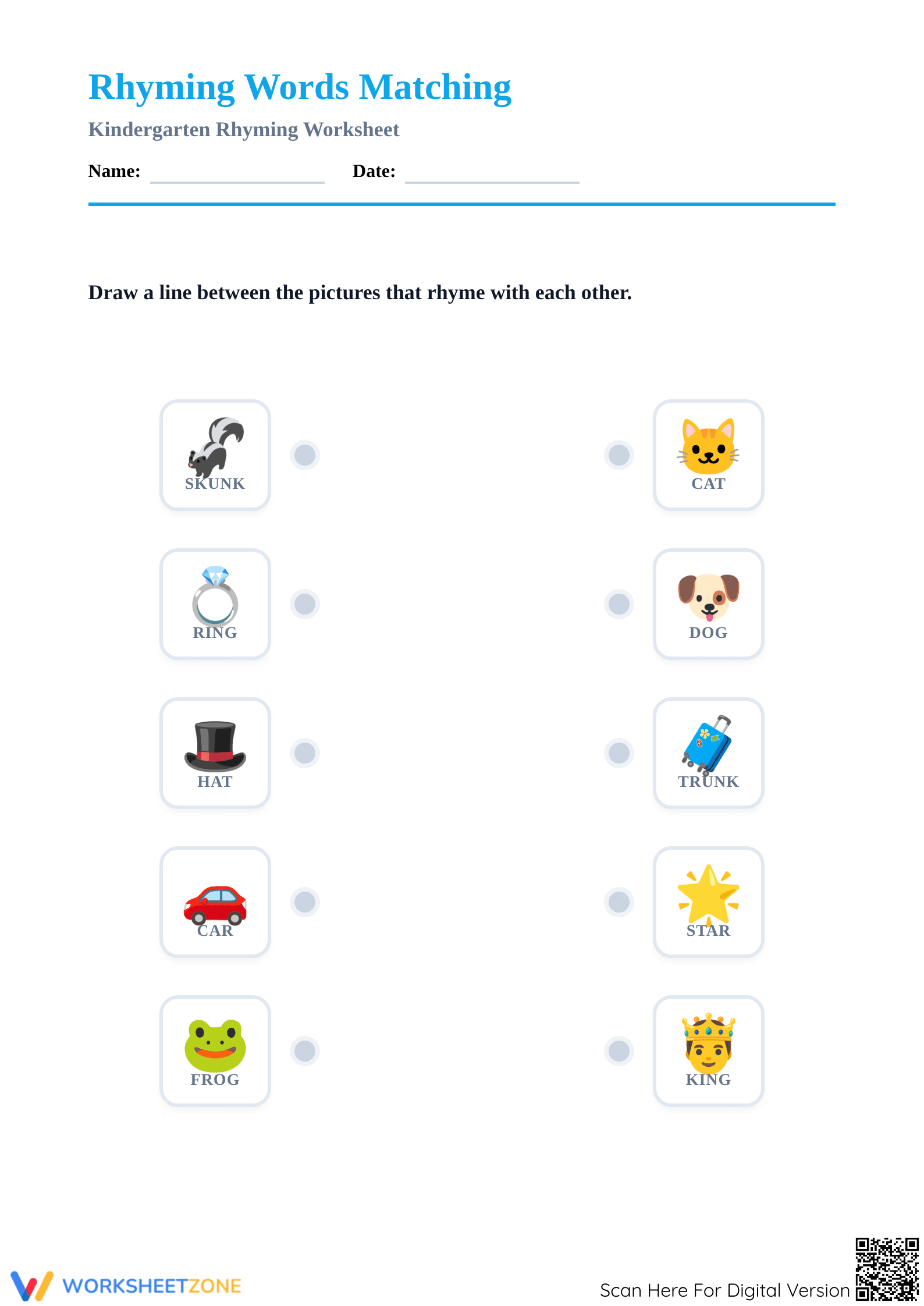
This Kindergarten rhyming worksheet helps young learners identify and match words with similar ending sounds to build foundational phonemic awareness. By connecting visual cues with phonetic patterns, students strengthen their ability to recognize auditory rhymes, a critical precursor to successful reading and spelling. It provides immediate, focused practice for early literacy development.
At a Glance
- Grade: Kindergarten · Subject: ELA
- Standard:
CCSS.ELA-LITERACY.RF.K.2.A— Recognize and produce rhyming words through auditory and visual matching- Skill Focus: Phonemic Awareness
- Format: 1 page · 5 problems · Answer key included · PDF
- Best For: Independent practice or morning work
- Time: 5–10 minutes
The worksheet features five distinct matching pairs using clear, student-friendly illustrations and bold text labels. Students draw lines between rhyming pairs such as "Skunk" and "Trunk" or "Frog" and "Dog." The single-page layout includes a dedicated space for student names and dates, accompanied by a full-page answer key for rapid grading and feedback.
This resource follows a streamlined zero-prep workflow. First, print the single-page PDF in under 30 seconds. Second, distribute the sheets to students for a 10-minute independent activity. Third, use the included answer key to review results in less than one minute. This makes it an ideal choice for emergency sub plans, morning work, or transition periods between core lessons.
This activity aligns with CCSS.ELA-LITERACY.RF.K.2.A, which requires students to demonstrate understanding of spoken words, syllables, and sounds by recognizing and producing rhyming words. It also supports vocabulary acquisition by pairing images with written labels. Both standard codes can be copied directly into lesson plans, IEP goals, or district curriculum mapping tools.
Use this worksheet as a formative assessment after a whole-group lesson on rhyming sounds. Observe if students can identify the rhyme by looking at the picture or if they need to say the words aloud to hear the phonetic connection. It also works well as a quiet center activity for students who finish their primary ELA tasks early and need meaningful reinforcement.
This resource is designed for Kindergarten students, though it is highly effective for Preschoolers ready for phonics or Grade 1 students needing remedial support. It pairs naturally with rhyming picture books or phonics anchor charts that display common word families like -at, -og, and -ing. The visual nature of the tasks makes it accessible for English Language Learners.
Research from the RAND AIRS 2024 report emphasizes that phonemic awareness, specifically the ability to recognize rhymes, is one of the strongest predictors of later reading achievement in primary grades. This worksheet targets that specific cognitive milestone by requiring students to isolate ending sounds across five distinct word families. By utilizing both visual icons and printed text, the resource supports dual-coding theory, helping students bridge the gap between auditory recognition and orthographic representation. Systematic practice with rhyming words, as facilitated by this structured matching task, ensures that students develop the phonological sensitivity required for decoding more complex text. The inclusion of an answer key allows for immediate feedback, which is a core component of effective instructional design for early learners. This CCSS.ELA-LITERACY.RF.K.2.A aligned tool provides a reliable method for tracking student progress toward phonological mastery.


