


























Views
Downloads
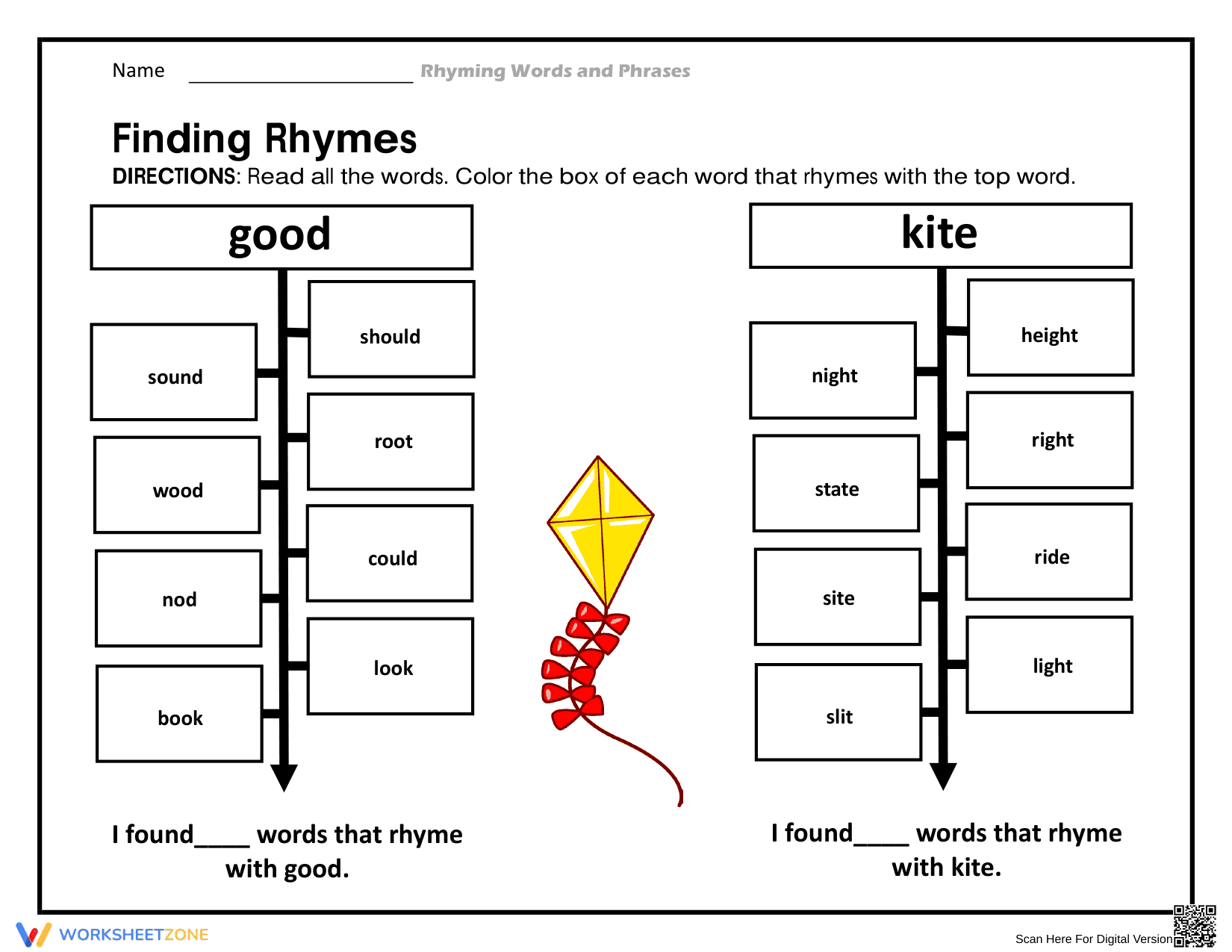

Essential Finding Rhymes Worksheet | Grades 1-3 Phonics
Paste this activity's link or code into your existing LMS (Google Classroom, Canvas, Teams, Schoology, Moodle, etc.).
Students can open and work on the activity right away, with no student login required.
You'll still be able to track student progress and results from your teacher account.
This Essential Finding Rhymes worksheet empowers early learners to master phonological awareness through engaging, structured practice. By identifying and coloring rhyming matches for common anchor words, students strengthen their auditory discrimination and spelling pattern recognition. This printable resource provides a clear path for students to bridge the gap between spoken sounds and written phonemic structures.
At a Glance
- Grade: 1-3 · Subject: ELA
- Standard:
CCSS.ELA-LITERACY.RF.1.2.A— Distinguish long from short vowel sounds and recognize rhyming word families- Skill Focus: Rhyming Word Recognition
- Format: 1 page · 16 problems · Answer key included · PDF
- Best For: Independent phonics practice and morning work
- Time: 10–15 minutes
This focused one-page worksheet features two primary rhyming anchors: "good" and "kite." Surrounding each anchor are eight potential matches, ranging from direct rhymes like "wood" and "light" to distractor words like "nod" and "state" that challenge precision. The layout includes clear directions, a name line, and a summary section where learners count and record their findings, reinforcing basic numeracy alongside literacy.
Zero-Prep Workflow
Designed for the busy educator, this resource follows a straightforward three-step implementation. First, print the single-page PDF (taking less than 30 seconds). Second, distribute the sheets to your literacy centers or individual desks with coloring supplies. Finally, review the student counts using the included answer key for immediate feedback. The entire process requires under two minutes of teacher preparation time.
Standards Alignment
The worksheet is primary aligned to CCSS.ELA-LITERACY.RF.1.2.A, which requires students to demonstrate understanding of spoken words, syllables, and sounds. By isolating terminal phonemes and identifying matching patterns, students build the foundational decoding skills necessary for fluent reading. This standard code can be copied directly into lesson plans, IEP goals, or district curriculum mapping tools to ensure instructional consistency.
How to Use It
Use this worksheet as a formative assessment during your phonics unit on word families. Observe students as they say the words aloud; those struggling to identify "night" as a rhyme for "kite" may need additional support with silent-e patterns. Alternatively, assign it as a fast-finisher activity or morning warm-up to keep phonemic awareness sharp throughout the school week.
Who It's For
This resource is tailored for Grade 1 and Grade 2 students who are developing their phonological awareness. It is also suitable for Grade 3 learners requiring remedial support or English Language Learners focusing on American English pronunciation patterns. Pair this worksheet with a rhyming picture book or a digital word-sort game to create a multi-modal learning experience for diverse needs.
According to RAND AIRS 2024, consistent engagement with phonological awareness tasks, such as identifying rhyming word families, is a critical predictor of long-term reading fluency and orthographic mapping success. This worksheet targets the CCSS.ELA-LITERACY.RF.1.2.A standard by requiring students to actively discriminate between similar-sounding words and identify shared rimes. Research by Fisher & Frey (2014) emphasizes that "gradual release" activities like this—which provide a clear anchor and guided choices—allow students to build the confidence necessary for independent phonemic manipulation. By integrating auditory processing with visual coloring tasks, this resource aligns with best practices for multisensory literacy instruction. Educators can utilize the quantitative feedback from the 16 tasks to identify specific phonetic gaps in student understanding. This evidence-based approach ensures that foundational literacy skills are reinforced through structured, repeatable practice that fits easily into any classroom schedule or district curriculum framework.


