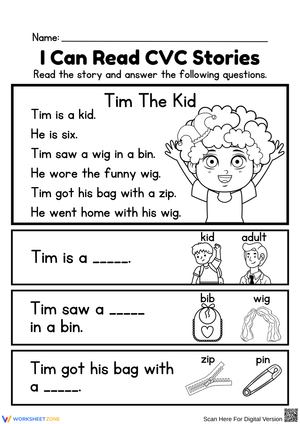
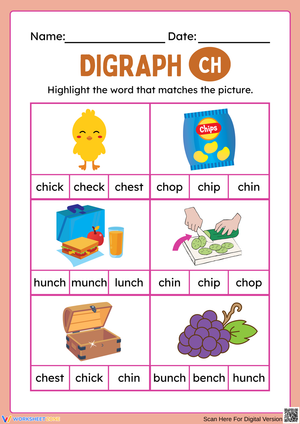
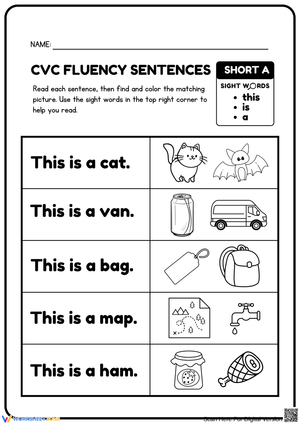
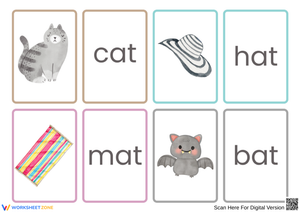
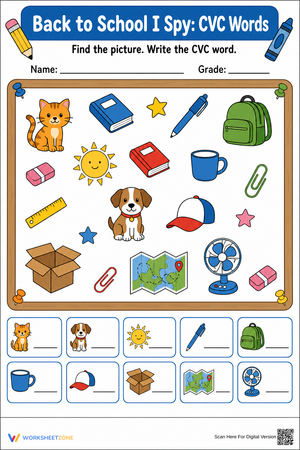
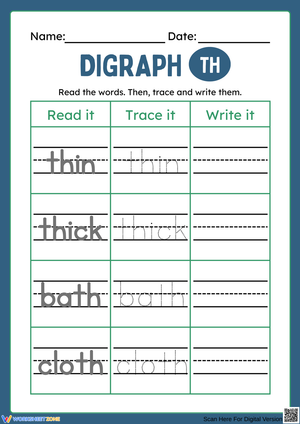
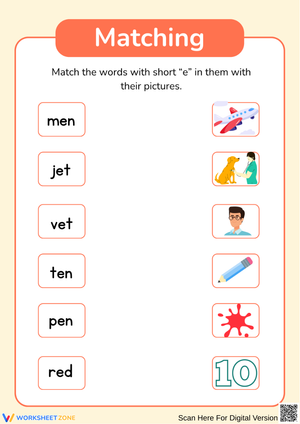
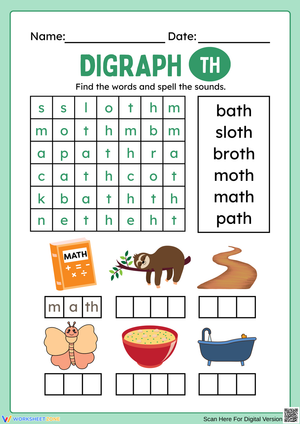
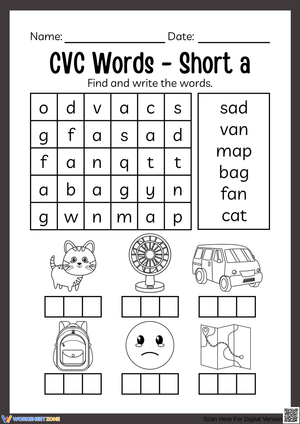
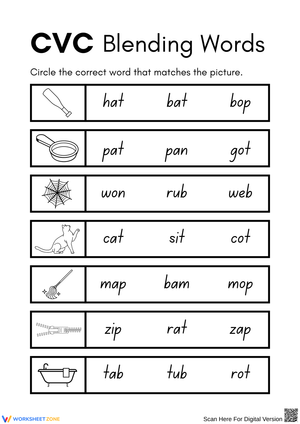
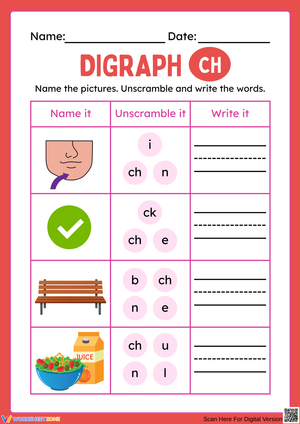
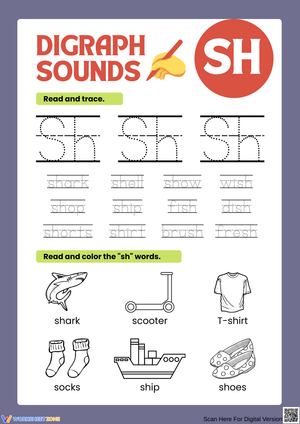
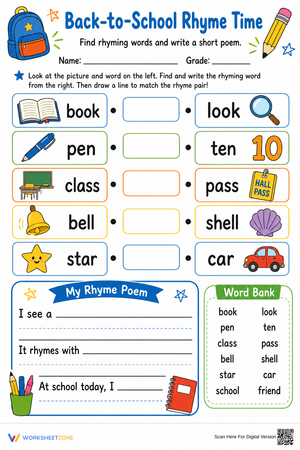
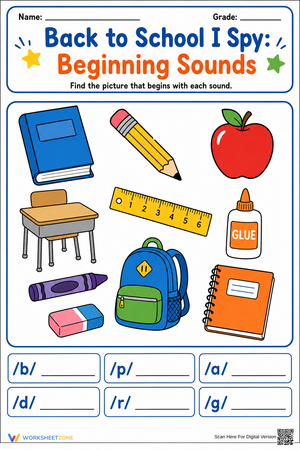
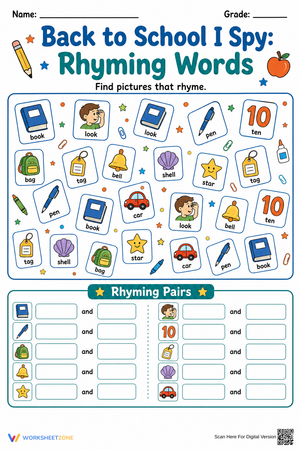
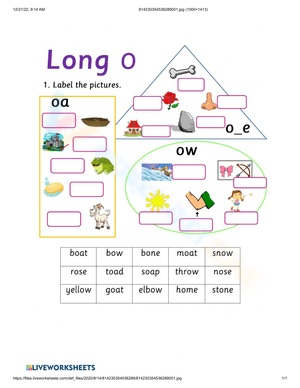
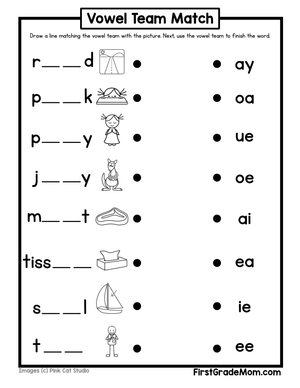
These 1st grade phonics printable worksheets cover the full decoding progression of Grade 1 — from short vowel discrimination in CVC words through consonant blends, digraphs, and vowel teams — giving teachers targeted practice for every point in the year. Each worksheet focuses on one discrete skill, so it drops cleanly into a morning warm-up, a literacy center, or a small-group session without modification.
The Phonics Progression These Worksheets Cover
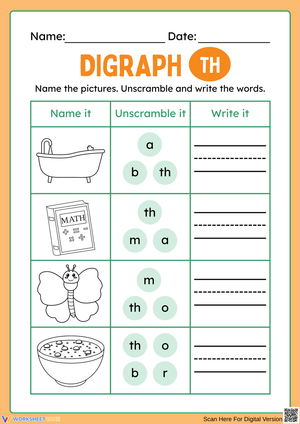
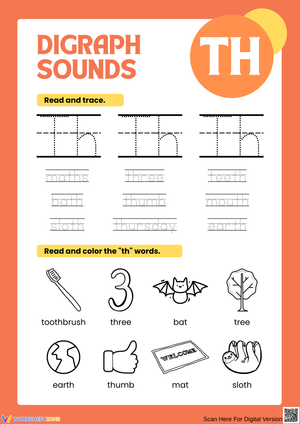
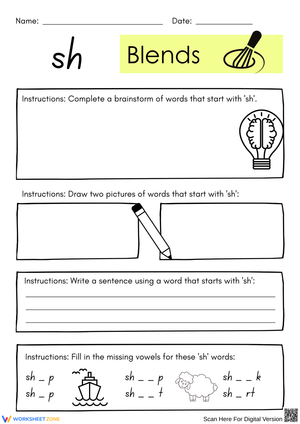
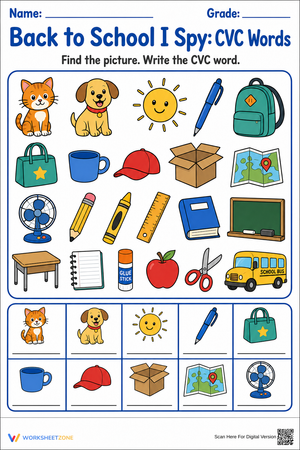
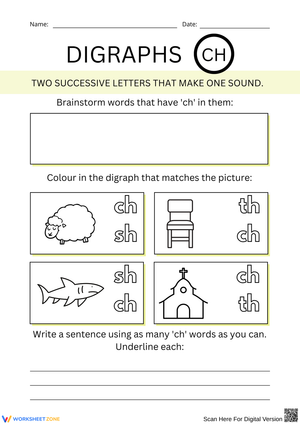
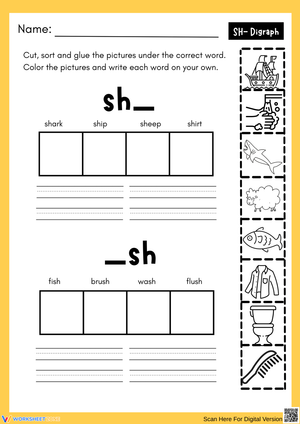
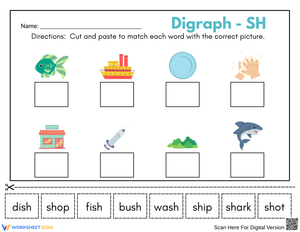
The set is organized around the sequence most Grade 1 classrooms follow. Early worksheets concentrate on short vowel discrimination — students mark the medial vowel, sort words by vowel sound, or rewrite a word after swapping one phoneme. Mid-year worksheets shift to consonant blends and digraphs: underlining the blend in a printed word, writing the missing digraph to complete a word, or sorting picture cards into "sh-," "ch-," and "th-" columns. The later worksheets address vowel teams — "ai," "ea," "oa," and several others that appear regularly in decodable texts by spring.
Task formats vary throughout the set rather than following a single type from start to finish. Students might:
- underline the target phonics element in a printed word or phrase
- sort words and pictures by vowel sound or spelling pattern
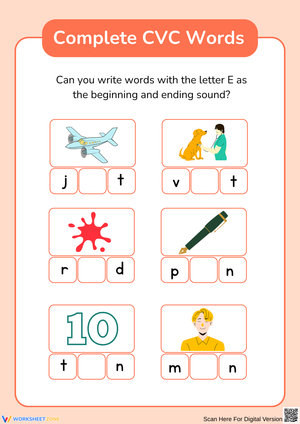
- write the missing blend, digraph, or vowel team to complete a word
- annotate a sentence by circling every word containing the target pattern
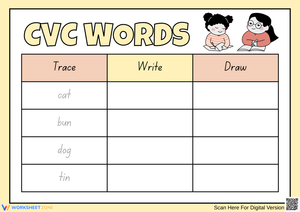
- build words by writing from picture prompts — encoding practice, not just decoding
That variation keeps students from going on autopilot, which matters more in early phonics instruction than it might seem.
Where First Graders Predictably Stumble — and What to Do About It
The silent-e rule produces the most consistent confusion in the set. Students who successfully read "cap" often read "cape" the same way, treating the final e as a letter to decode rather than a signal. What this looks like in actual student work: a student circles "cape" as having a short vowel sound because the letter a is present, ignoring the final e entirely. The worksheets address this by placing minimal pairs side by side — "tap/tape," "kit/kite," "hop/hope" — and requiring students to underline the vowel sound they actually hear before selecting short or long. Seeing the pair together disrupts the automatic short-vowel assumption.
Digraphs surface a different error pattern. Students frequently omit the second letter of a digraph when spelling — writing "wen" for "when" or "sip" for "ship" — because early phonics training reinforces one letter, one sound. Worksheets that require writing the complete digraph before finishing the word, rather than selecting it from a word bank, reveal this omission faster than any oral check.
Vowel teams are where the "two vowels go walking, the first one does the talking" rule publicly breaks down. It holds for "ai" and "ea" in many words, but students who apply it rigidly to "oo," "ou," or "ow" generate errors that no follow-up rule easily fixes. The more durable instructional approach is to treat vowel teams as units memorized within word families, not as rules applied letter by letter — and the sorting and word-building tasks in these worksheets push students toward that pattern-recognition strategy rather than rule-following.
Standard Alignment
The 1st grade phonics printable worksheets in this set align to the Common Core State Standards ELA — Reading: Foundational Skills for Grade 1, specifically RF.1.2 (phonological awareness) and RF.1.3 (phonics and word recognition). In instructional terms, the sub-standards map onto the school year's pacing: RF.1.3a covers single-letter grapheme correspondences and belongs early in the year; RF.1.3b addresses the final-e convention and typically lands mid-year; RF.1.3c covers common vowel teams and fits best in the third and fourth quarters, when most structured literacy programs introduce those patterns. Knowing which sub-standard each worksheet targets makes lesson plan documentation straightforward.
How to Work These Worksheets Into Your Daily Literacy Block
The most reliable placement is the warm-up at the start of the literacy block — typically the eight or ten minutes before transitioning to guided reading groups. A short-vowel sort takes about six minutes for most first graders working independently, which is exactly long enough to settle the room without leaving early finishers idle. The right choice here is a worksheet that reviews a skill already taught, not one introducing anything new. That Monday-morning short-vowel review does genuine retrieval practice without eating into instruction time.
For literacy centers, cut-and-paste vowel-team worksheets and digraph-sorting tasks work well because they produce a visible product students can hold up for a quick teacher check. Sliding any worksheet into a dry-erase pocket turns it into a reusable center activity — students write in marker, a partner checks their work, then they wipe the sheet clean for the next rotation. This works especially well for word-building exercises where students fill in a missing blend or vowel team, because the immediate erase-and-retry cycle lowers the stakes on skills many students are still consolidating.
As a formative tool, giving a single worksheet immediately after a lesson on a new digraph tells a teacher within minutes which students have the sound-symbol connection and which are guessing. That kind of quick read is harder to get from a whole-group discussion, where uncertain students can stay silent or echo a confident peer.
Adapting These Worksheets Across Your Classroom's Skill Spread
For students still working on phoneme blending — who can identify individual sounds but cannot yet hold them together to produce a word — pairing a worksheet with letter tiles is more productive than having them work from print alone. The student builds the word physically with tiles, then writes it on the worksheet. That physical step distributes the cognitive work so that decoding and writing don't compete for the same limited attention. These 1st grade phonics printable worksheets are designed with enough white space and visual clarity that adding manipulatives alongside them doesn't feel crowded.
Students reading above grade level move through CVC and blend work quickly and benefit from vowel-team and encoding worksheets earlier than the pacing guide suggests. Give them worksheets that ask them to spell words from picture prompts rather than read and sort — encoding is a stronger measure of phonics mastery than decoding, and it is often exactly what advanced first graders lack when comprehension eventually becomes a bottleneck in later grades.
Frequently Asked Questions
What phonics skills should a first grader have by the end of the year?
By June, a Grade 1 student should decode single-syllable words across the major patterns: short vowels, long vowels marked by silent e, common consonant blends and digraphs, and the most frequent vowel teams. They should read grade-appropriate sight words automatically and apply phonics knowledge in writing, not only in reading. The worksheets in this set map directly to those end-of-year targets.
How many worksheets per week is reasonable?
Two to three worksheets per week is a practical ceiling for most classrooms. Beyond that, worksheet time starts competing with activities — shared reading, word work with manipulatives, decodable text reading — that build fluency in ways a printed page cannot replicate. Quantity matters less than whether the skill on the worksheet matches what students were taught that week.
Do these worksheets work as homework?
They work best when the skill is already partially consolidated at school. Sending home a vowel-team worksheet before students have had any success with that pattern in class typically produces frustration rather than practice. A better approach: send the worksheet home the day after the lesson, when students have had at least one guided attempt in the classroom. Parents appreciate seeing the specific skill named on the worksheet — it gives them something concrete to discuss rather than guessing what "phonics" means on any given night.
Do these worksheets align with science of reading principles?
The tasks reflect systematic, explicit phonics instruction — the approach that reading science research most consistently supports. Students practice decoding and encoding in isolation before applying those same patterns in connected text, matching the gradual move from controlled practice to authentic reading. Teachers using structured literacy programs will find that 1st grade phonics printable worksheets at this level map cleanly onto most program sequences, though the worksheet-to-lesson fit depends on each program's specific pacing.












 Interactive Worksheet Maker
 Quiz Maker
 Word Search Maker
 Crossword Puzzle Maker
 Word Scramble Generator
 Sentence Scramble Generator
 Handwriting Worksheet Generator
 Name Tracing Generator
 Fill In The Blank Generator