


























Views
Downloads
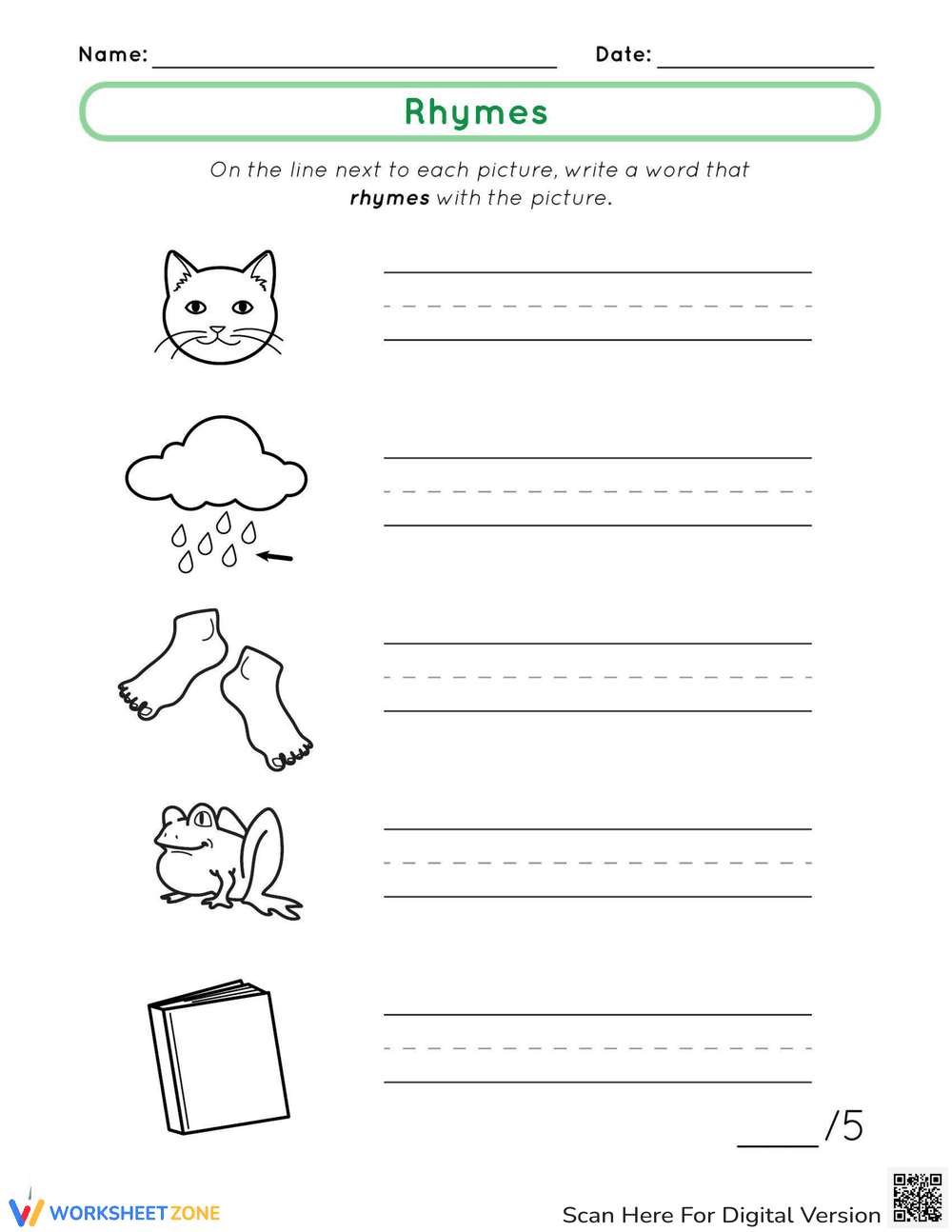

Rhyming Words Worksheet | Grade 1 Printable ELA
Paste this activity's link or code into your existing LMS (Google Classroom, Canvas, Teams, Schoology, Moodle, etc.).
Students can open and work on the activity right away, with no student login required.
You'll still be able to track student progress and results from your teacher account.
This Grade 1 rhyming words worksheet builds phonological awareness by asking students to generate rhyming words from picture prompts alone — no written cues, no word banks. Students practice hearing and producing word families, strengthening the sound-pattern recognition that underpins early decoding and spelling success.
At a Glance
- Grade: 1 · Subject: English Language Arts
- Standard:
CCSS.ELA-LITERACY.RF.1.2— Demonstrate understanding of spoken words, syllables, and sounds- Skill Focus: Generating rhyming words from picture prompts
- Format: 1 page · 6 problems · Answer key included · PDF
- Best For: End-of-unit rhyming skills assessment
- Time: 10–15 minutes
Inside: 6 fill-in-the-blank items, each anchored by a picture. Students identify the pictured object, then produce a rhyming word in the blank. No word bank is provided, making this a true generative task. The single-page layout prints cleanly; the included answer key lists accepted rhyming responses for fast teacher review.
- Guided practice (problems 1–2): High-frequency picture pairs (e.g., cat/hat) with familiar CVC patterns. Scaffold level: high — most Grade 1 students recognize these word families on sight.
- Supported practice (problems 3–4): Less common picture prompts requiring students to manipulate onset and rime independently. Scaffold level: moderate — students apply pattern knowledge without visual word support.
- Independent practice (problems 5–6): Novel picture cues that demand flexible phoneme substitution. Scaffold level: low — students produce rhymes with no contextual hints beyond the image.
This gradual-release structure mirrors the I Do / We Do / You Do model: early items build confidence, later items confirm mastery without teacher support.
CCSS.ELA-LITERACY.RF.1.2 — Demonstrate understanding of spoken words, syllables, and sounds (phonemes). Sub-skills addressed include RF.1.2.A (distinguish long/short vowels in spoken single-syllable words) and RF.1.2.B (orally produce single-syllable words by blending phonemes). Supporting standard RF.1.2.D (segment spoken single-syllable words into their complete sequence of individual sounds) is reinforced when students isolate the rime before generating a match. Both standard codes can be copied directly into lesson plans, IEP goals, or district curriculum mapping tools.
Use before direct instruction as a diagnostic: note which students stall on novel picture cues — this flags weak rime-pattern flexibility. Use after instruction as a formative check: a score of 5–6 correct signals readiness to move to blending and segmenting multi-syllable words. Completion time runs 10–12 minutes for on-level students; allow up to 15 minutes for students still consolidating CVC patterns.
Designed for end-of-Grade-1 phonological awareness review. Works equally well as a center activity, a homework send-home, or a quick sub-plan task requiring zero teacher setup. Pairs naturally with a word-family anchor chart or a read-aloud featuring strong rhyme patterns (e.g., Hop on Pop or Each Peach Pear Plum).
Phonological awareness — the ability to hear, identify, and manipulate units of sound — is one of the strongest predictors of early reading success. NAEP data consistently show that students who enter Grade 2 without secure rhyme-generation skills score lower on decoding fluency measures through Grade 4. This worksheet targets CCSS.ELA-LITERACY.RF.1.2, requiring students to produce rhyming words from picture prompts, a generative task that demands both phoneme awareness and lexical retrieval. Fisher and Frey (2014) identify productive practice — tasks where students generate responses rather than select them — as critical for consolidating phonological knowledge. Six picture-based items move from high-frequency CVC pairs to novel prompts, giving teachers a quick, scorable snapshot of rhyme-generation fluency at the close of Grade 1.


