


























Views
Downloads

Essential Rhyming Phrases Worksheet | Grade 1-2 ELA
Paste this activity's link or code into your existing LMS (Google Classroom, Canvas, Teams, Schoology, Moodle, etc.).
Students can open and work on the activity right away, with no student login required.
You'll still be able to track student progress and results from your teacher account.
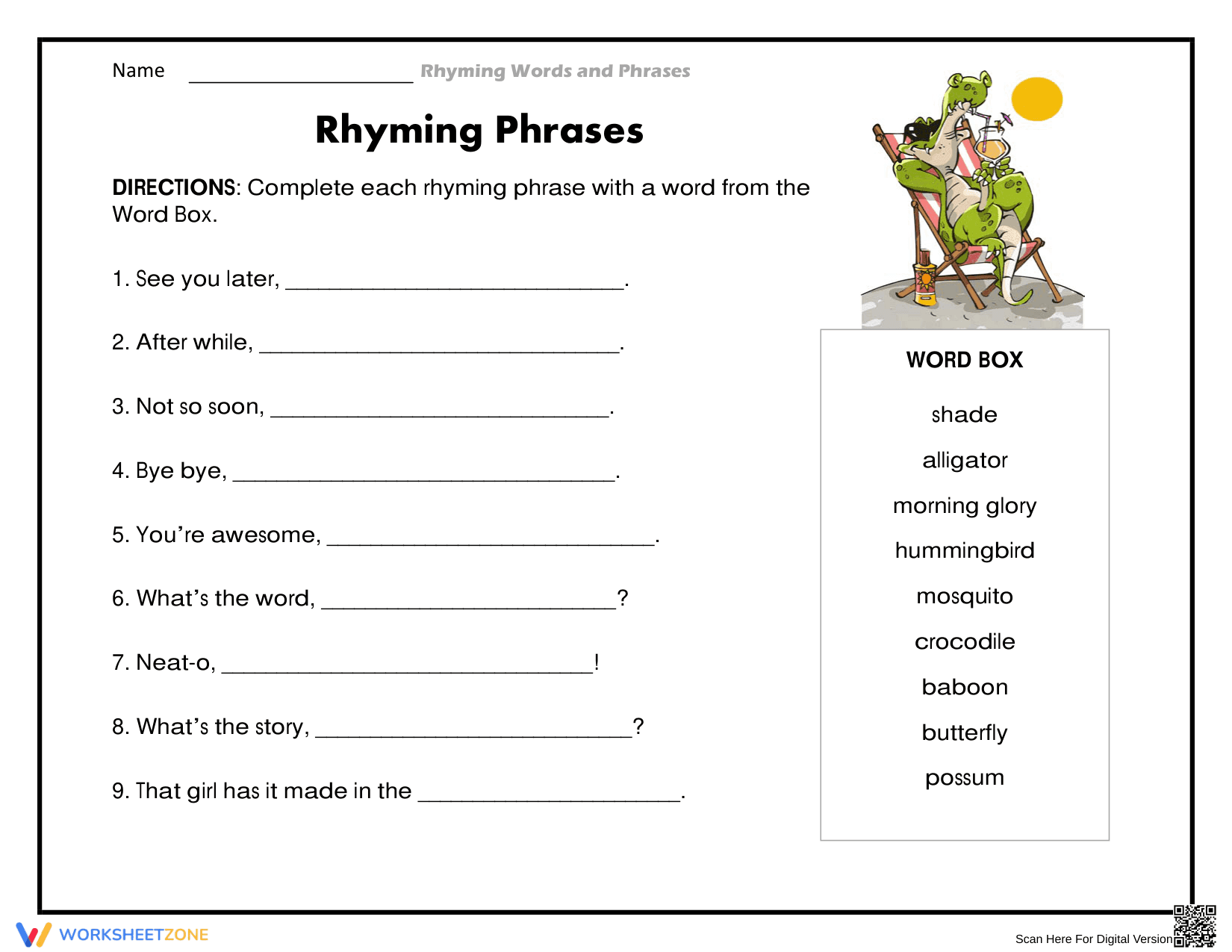
This Rhyming Phrases worksheet helps students strengthen their phonological awareness and vocabulary through engaging sentence completion tasks. By matching words from a provided word box to common idiomatic rhyming expressions, learners develop a better ear for sounds and a deeper understanding of word relationships in English Language Arts.
At a Glance
- Grade: 1-2 · Subject: English Language Arts
- Standard:
CCSS.ELA-LITERACY.RF.1.2— Demonstrate understanding of spoken words, syllables, and sounds (phonemes)- Skill Focus: Phonological Awareness & Rhyming
- Format: 1 page · 9 problems · Answer key included · PDF
- Best For: Independent practice or morning work
- Time: 10–15 minutes
What's Inside
This single-page PDF features nine distinct rhyming phrase prompts designed for primary learners. Each item presents the start of a familiar or playful phrase, requiring students to select the correct rhyming counterpart from a clear, formatted Word Box. The worksheet includes an answer key for quick grading and a dedicated name and date header to support classroom organization.
Zero-Prep Workflow
This resource is designed for an immediate classroom transition with a three-step workflow. First, print the single-page document (30 seconds). Second, distribute the copies to students as a bell-ringer or transitional activity (1 minute). Third, review the answers collectively or use the provided key for rapid individual assessment (2 minutes). The total teacher preparation time is under two minutes, making it an ideal choice for emergency sub plans or low-prep literacy centers.
Standards Alignment
The primary alignment is to CCSS.ELA-LITERACY.RF.1.2, which requires students to demonstrate understanding of spoken words, syllables, and sounds. By identifying and producing rhymes within the context of phrases like "See you later, alligator," students practice identifying phonological patterns. Both standard codes can be copied directly into lesson plans, IEP goals, or district curriculum mapping tools.
How to Use It
Use this worksheet as a formative assessment after a direct instruction lesson on word families or phonemes. It serves as an excellent check for understanding to see if students can identify auditory patterns without heavy scaffolding. Alternatively, assign it as a quiet morning work task to settle students into the literacy block. For a formative observation tip, watch for students who mouth the words to test the rhyme; this indicates active phonological processing.
Who It's For
This activity is tailored for first and second-grade students who are mastering phonological awareness. It is also highly effective for English Language Learners (ELLs) who benefit from learning idiomatic rhyming expressions in a structured format. For best results, pair this resource with a rhyming picture book or an anchor chart displaying common word endings to provide additional visual support for struggling readers.
Phonological awareness is a critical precursor to reading fluency and orthographic mapping. According to the RAND AIRS 2024 report, early mastery of rhyming patterns significantly predicts later reading success by building the cognitive pathways necessary for decoding unfamiliar text. This worksheet directly addresses these foundational skills by requiring students to recognize and produce rhyming words in a contextualized format. Specifically, the task of completing rhyming phrases aligns with CCSS.ELA-LITERACY.RF.1.2, focusing on the auditory discrimination of phonemes. By providing a controlled vocabulary through a Word Box, the resource scaffolds the cognitive load, allowing students to focus on the phonetic relationship between word endings. This structured practice is essential for developing the phonological loop, which is vital for long-term literacy retention and effective language acquisition in early childhood education settings.


