


























Views
Downloads

Should I Travel? Reading Worksheet | Grade 5 Essential
Paste this activity's link or code into your existing LMS (Google Classroom, Canvas, Teams, Schoology, Moodle, etc.).
Students can open and work on the activity right away, with no student login required.
You'll still be able to track student progress and results from your teacher account.
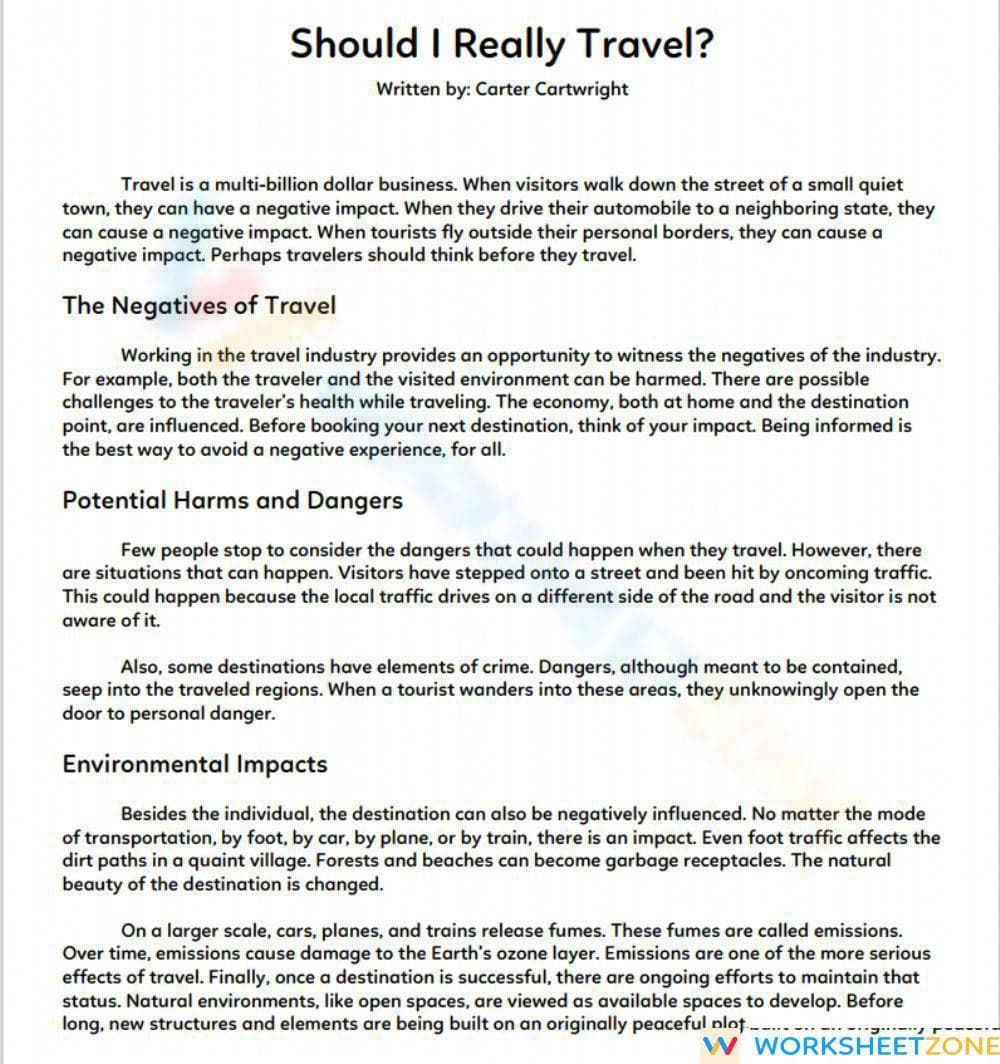
This Grade 5 reading comprehension worksheet helps students analyze the environmental and social impacts of the global travel industry through a focused informational passage. By examining the arguments presented in "Should I Really Travel?", learners develop critical thinking skills necessary to determine the author's main idea and supporting details effectively.
At a Glance
- Grade: 5 · Subject: ELA
- Standard:
CCSS.ELA-LITERACY.RI.5.8— Explain how an author uses reasons and evidence to support particular points- Skill Focus: Informational Text Analysis and Argument Evaluation
- Format: 1-page high-interest reading passage with 5 evidence-based problems and full answer key included in the PDF
- Best For: Independent literacy centers, homework assignments, or emergency sub plans
- Time: 20–30 minutes of focused classroom work
What's Inside
The resource features a high-interest informational text titled "Should I Really Travel?" by Carter Cartwright, structured with clear subheadings for optimal readability. It includes one comprehensive reading page followed by five evidence-based comprehension questions that target main idea identification and vocabulary acquisition. A complete answer key is provided to facilitate rapid grading and immediate student feedback.
Zero-Prep Workflow
This zero-prep resource is designed for immediate classroom implementation through a simple three-step workflow. First, print the single-page PDF (30 seconds). Second, distribute materials for independent or paired reading (15 minutes). Third, review the answers using the included key for a whole-class check or individual grading (5 minutes). This streamlined process requires less than two minutes of teacher preparation time, making it an ideal candidate for emergency sub plans or busy Monday morning literacy blocks.
Standards Alignment
The worksheet is aligned to CCSS.ELA-LITERACY.RI.5.8, which requires students to explain how an author uses reasons and evidence to support particular points in a text. The passage specifically provides evidence regarding traffic safety, crime, and ozone layer damage to support the central argument. Both standard codes can be copied directly into lesson plans, IEP goals, or district curriculum mapping tools.
How to Use It
Utilize this worksheet during the "Independent Practice" phase of a lesson on argumentative text structures or as a formative assessment after direct instruction on informational reading. Teachers should observe whether students refer back to specific subheadings like "Environmental Impacts" to find evidence. The expected completion time is 25 minutes, allowing for both careful reading and thoughtful response construction.
Who It's For
This resource is tailored for Grade 5 students, though it remains accessible for Grade 4 and Grade 6 learners needing informational text support. It is particularly effective for students developing evidence-based writing skills. Pair this worksheet with a short video on sustainable tourism or an anchor chart detailing text features to provide a comprehensive learning experience for all student populations.
Research from the RAND AIRS 2024 study emphasizes that frequent exposure to structured informational texts significantly improves a student's ability to identify author bias and evaluate complex evidence-based claims. This Grade 5 worksheet addresses CCSS.ELA-LITERACY.RI.5.8 by tasking learners to evaluate how specific reasons—such as carbon emissions and local infrastructure strain—support the author's critical perspective on travel. Fisher & Frey (2014) note that gradual release begins with accessible passages that allow for independent mastery. This resource provides that foundation by bridging the gap between basic reading and rigorous evidence analysis. Integrating this focused practice into daily routines ensures that students meet the NAEP benchmarks for reading proficiency and informational literacy while developing a more critical understanding of global industries.


