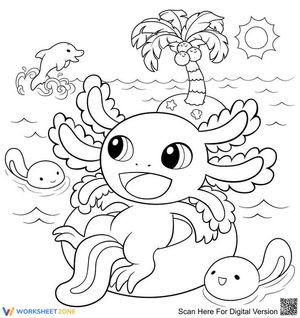
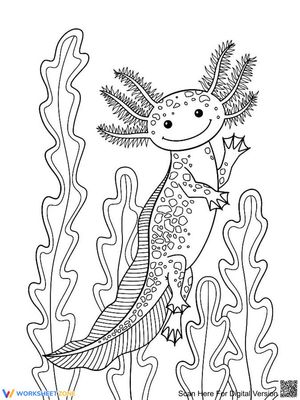
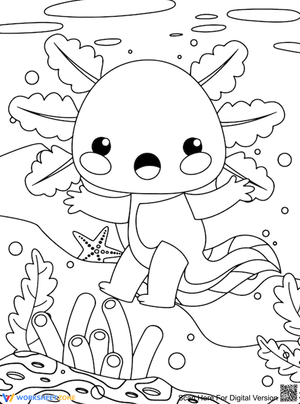
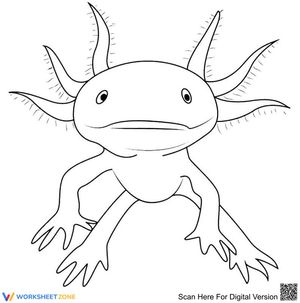
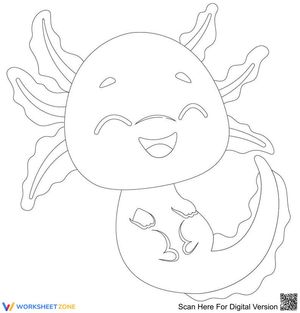
I still remember the day a student asked me why the creature on the worksheet looked like it had feathers growing out of its head. That question sparked a twenty-minute conversation about axolotls, their remarkable biology, and why scientists around the world study them so closely. That moment reminded me how much a single axolotl coloring pages activity can do for a classroom that seems checked out on a slow Tuesday morning.
Once I started weaving these printable sheets into my weekly lesson plans, something shifted. Students who rarely spoke up during science time began asking questions about regeneration, habitat, and why axolotls never quite grow up the way other salamanders do. The act of coloring each gill tuft and dorsal fin detail gave them a physical connection to the subject, turning abstract biology into something they could hold in their hands. Worksheetzone designs each page to be accurate enough to prompt real discussion while remaining approachable for a range of skill levels.
There is something powerful about letting curiosity lead. When a student wonders whether axolotls can be different colors in real life, that question opens the door to lessons about albinism, leucism, and selective breeding. The worksheet becomes a launchpad rather than an endpoint. Teachers and parents who want to keep that momentum going can also explore animal jokes for kids as a lighthearted way to wrap up a session and help children retain what they just learned through laughter.
At home, the effect is just as strong. A parent told me her daughter spent an entire Saturday afternoon coloring axolotl pages and then insisted on watching a documentary about Mexican lakes. That is the kind of self-directed learning that no worksheet can guarantee but every good one can inspire. Pairing axolotl coloring pages with a look at broader aquatic habitats through ocean coloring pages helps children build a wider picture of the natural world and how different creatures adapt to their environments.
Every educator deserves tools that do more than fill time. Worksheetzone brings together printable resources that connect students, teachers, and parents around genuine discovery. If you are looking for a simple way to create one of those lightbulb moments in your classroom or at your kitchen table, axolotl coloring pages are a wonderful place to start.
Frequently Asked Questions
Question 1: What age group benefits most from axolotl coloring pages?
Axolotl coloring pages work well for students in kindergarten through middle school. Younger children develop fine motor skills and color recognition, while older students use the detailed anatomy of the axolotl to support lessons in biology, adaptation, and conservation. Teachers can adjust the discussion depth to match any grade level.
Question 2: How can teachers use these printable worksheets in a science lesson?
Teachers can introduce axolotl coloring pages as a visual anchor for lessons on amphibians, metamorphosis, or endangered species. Students label external gills, the dorsal fin, and limb structure while discussing each feature. The worksheet supports both independent study and group activity, making it a flexible tool across a variety of classroom formats.
Question 3: Are these axolotl coloring pages suitable for home learning?
Yes, parents and homeschool educators find these printable sheets highly practical. They require no preparation beyond printing and work as a standalone activity or alongside a nature documentary or library book. Children build focus and attention to detail while learning about a genuinely unusual animal that captures their imagination right away.
Question 4: What makes axolotls a good subject for educational coloring activities?
Axolotls have a distinctive appearance with external gill stalks, wide heads, and small limbs that make them visually interesting to color and study. Their biological traits, including regenerative abilities and permanent larval form, give teachers natural entry points for deeper science conversations. This combination of visual appeal and educational richness makes them an ideal worksheet subject.