


























Views
Downloads
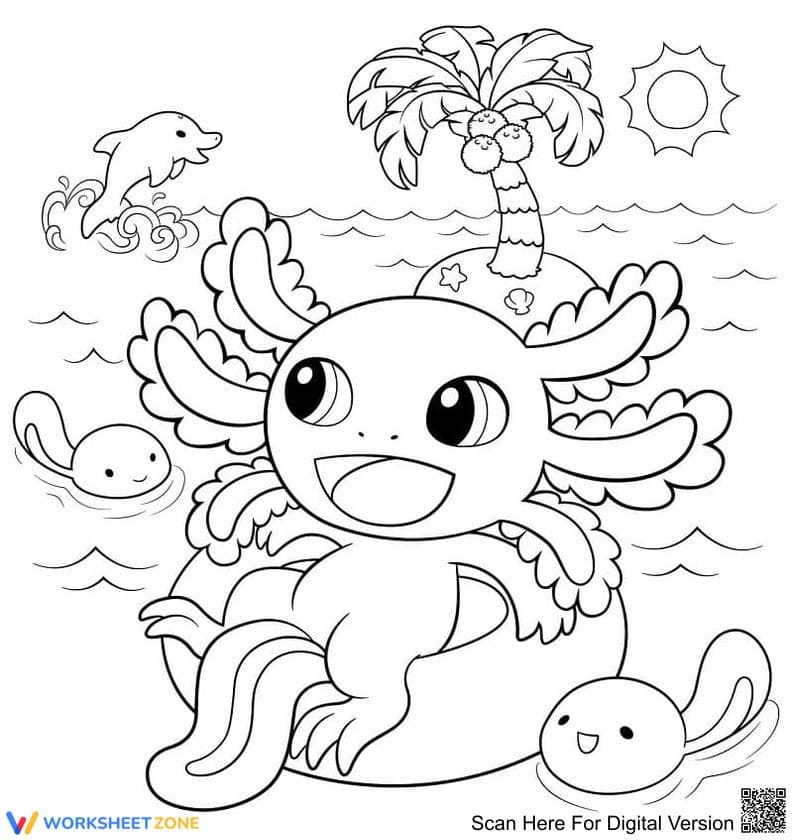

Printable Axolotl Coloring Page for Grades 1-2
Paste this activity's link or code into your existing LMS (Google Classroom, Canvas, Teams, Schoology, Moodle, etc.).
Students can open and work on the activity right away, with no student login required.
You'll still be able to track student progress and results from your teacher account.
This printable axolotl coloring page helps early elementary students develop essential fine motor control and creative expression. By coloring the detailed beach scene, children practice grip strength and spatial awareness. This activity serves as an engaging visual aid to support speaking and listening narratives about summer adventures.
At a Glance
- Grade: 1-2 · Subject: Fine Art & ELA
- Standard:
CCSS.ELA-LITERACY.SL.1.5— Add drawings to descriptions to clarify ideas- Skill Focus: Fine motor control and creative expression
- Format: 1 page · 1 task · Answer key not applicable · PDF
- Best For: Morning work or early finishers
- Time: 15–20 minutes
This resource consists of a single-page PDF featuring a cartoon axolotl floating at the beach. The scene includes a palm tree, sun, dolphin, and small aquatic companions. These elements provide multiple coloring areas that challenge students to select colors and stay within lines, requiring no prior preparation.
Zero-Prep Classroom Workflow
This activity integrates into your daily routine with zero preparation. Follow these steps to implement the worksheet:
- Print (1 minute): Copy the single-page PDF for your class.
- Distribute (1 minute): Hand out the sheets with crayons or markers.
- Review (5 minutes): Have students describe the beach scene to a partner.
The setup takes under 2 minutes of teacher preparation, making it ideal for substitute plans or transitions.
Standards Alignment
This worksheet aligns with CCSS.ELA-LITERACY.SL.1.5, encouraging students to add drawings to descriptions to clarify ideas. By coloring this beach scene, students create a visual anchor to describe a summer setting. Both standard codes can be copied directly into lesson plans, IEP goals, or district curriculum mapping tools.
How to Use It
Use this worksheet during transitions or after a reading lesson about marine life. Observe pencil grip and color boundaries to gauge fine motor progression. The activity takes approximately 15 to 20 minutes to complete.
Who It's For
This worksheet is designed for first and second-grade students. Pair this coloring page with a read-aloud book about ocean animals to build a cohesive thematic unit connecting science, art, and literacy.
This coloring worksheet supports early childhood development by combining artistic expression with foundational literacy skills. According to research from Fisher & Frey (2014) on purposeful learning, integrating visual arts into early elementary classrooms enhances student engagement and provides a non-verbal pathway for students to organize thoughts before speaking. By focusing on the detailed beach scene, young learners practice the fine motor precision necessary for writing while building vocabulary related to marine environments. The alignment with standard CCSS.ELA-LITERACY.SL.1.5 ensures that this coloring task serves a clear academic purpose, helping educators justify creative time as a scaffold for oral language development. Teachers can confidently utilize this resource to support diverse learners, including those requiring fine motor intervention, while maintaining alignment with district curriculum expectations.


