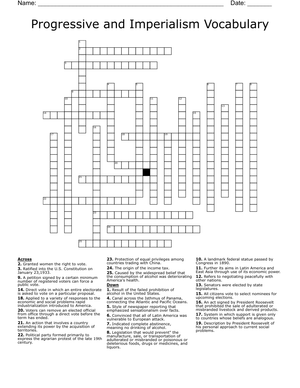
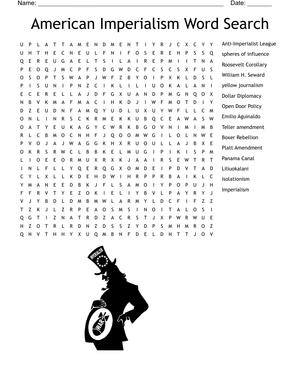
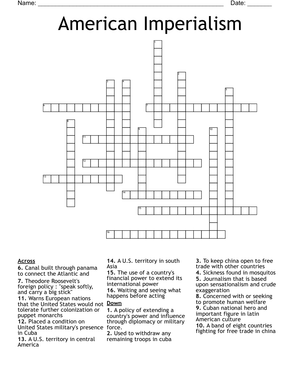
American Imperialism worksheets give US History and Social Studies teachers a way to move students through a dense stretch of curriculum without losing momentum. The period from the late 1890s through the early 1900s packs in the Spanish-American War, the annexation of Hawaii and the Philippines, the Open Door Policy in China, and the Panama Canal. Trying to lecture through all of that leaves students with disconnected facts instead of a working understanding of why the United States expanded and who pushed back. Worksheets built around this content let you sequence the unit so students build causes first, then examine events, then weigh the imperialist versus anti-imperialist debate with evidence in hand.
Core Events to Anchor the Unit
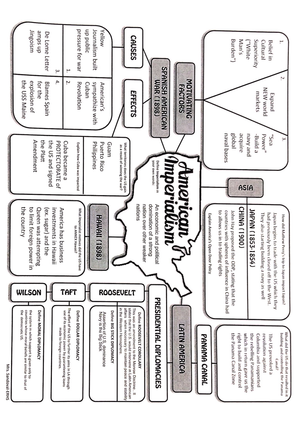
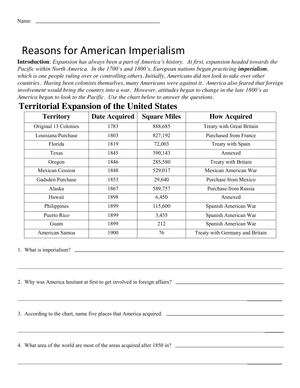
Most classroom-ready sequences organize instruction around four fixed points: the Spanish-American War of 1898, the annexation of Hawaii in 1898, the annexation of the Philippines, and the Open Door Policy toward China, often paired with the Panama Canal as a follow-on case of US influence abroad. Worksheets that isolate one event per page keep students from blending causes and effects across cases that had genuinely different motivations, from naval strategy to sugar plantation economics to trade access.
Teaching guidance for this unit commonly asks students to name three primary causes of imperialism and then test those causes against multiple regions, comparing the US case in Hawaii and the Philippines to European expansion in Africa, India, and China. That comparative step is what pushes students from memorizing a timeline into recognizing imperialism as a pattern with recurring economic, military, and ideological drivers.
Building the Unit Around Primary Sources
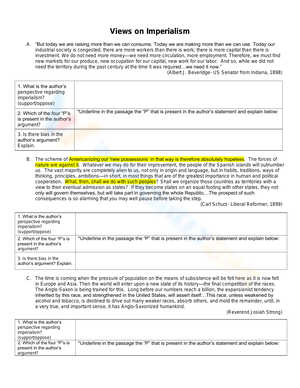
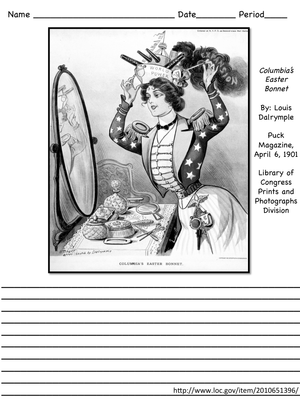
A worksheet-based approach to this period leans heavily on primary sources from the late 1890s and early 1900s: political cartoons, newspaper coverage of the war, government documents, public speeches, and diary entries from soldiers or officials. Each source type calls for a different worksheet structure. Political cartoons work well with a short annotation worksheet asking students to identify symbols, label the intended audience, and state the cartoonist's position in one sentence. Speeches and government documents need a worksheet that isolates one claim per paragraph so students are not overwhelmed by period language.
Sequencing matters here too. Introduce a cartoon or short primary source before the lecture content on a given event, then use a second worksheet after direct instruction to have students revisit the same source with new background knowledge. That before-and-after structure is a simple way to show growth without adding a separate assessment.
Structuring the Imperialists vs. Anti-Imperialists Debate
The imperialist and anti-imperialist debate is the natural centerpiece of this unit, and it is the part students remember longest when it is run as an actual structured activity rather than a single reading. A debate-prep worksheet should have students collect three pieces of textual evidence for each side, drawn from period speeches or editorials, before they are assigned a position. Splitting the class into imperialist and anti-imperialist teams, then requiring each side to respond directly to one claim from the opposing worksheet, keeps the activity focused on argument rather than general opinion.
For classes with less time, a shortened version works as a four-corners activity: strongly imperialist, imperialist, anti-imperialist, strongly anti-imperialist, with students moving to a corner based on a worksheet-based evidence review before discussion.
Teacher Tips for Running This Unit Smoothly
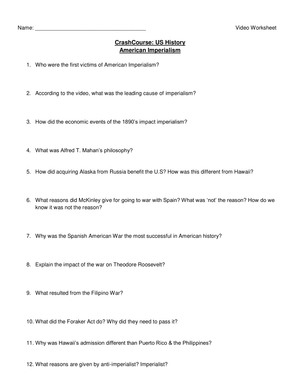
Start each new event with a single image or one-paragraph source rather than a full lecture, and let the worksheet questions drive the initial discussion. Keep a consistent worksheet format across the unit, primary source excerpt, three guided questions, one open-response prompt, so students spend their energy on content instead of relearning a new task structure every day. Save the debate activity for after all four core events have been covered, since students need evidence from the full unit, not just the Spanish-American War, to argue either side convincingly. Finally, build in one review worksheet before any summative assessment that asks students to place all four events on a single timeline with a one-sentence cause for each.
Frequently Asked Questions
1. What grade levels typically teach American Imperialism worksheets?
This content is most common in middle school and high school US History or Social Studies classes, generally where the curriculum reaches the late 1800s and early 1900s expansion period.
2. What primary sources pair well with American Imperialism worksheets?
Political cartoons, newspaper articles, government documents, public speeches, and diary entries from the late 1890s and early 1900s all pair well with structured worksheet tasks for this unit.
3. How can teachers use these worksheets for a debate-style lesson?
Use a debate-prep worksheet to have students collect textual evidence for either the imperialist or anti-imperialist position before assigning sides, then run the debate so each side responds directly to a claim from the other team's worksheet.
4. How do these worksheets support Common Core aligned instruction?
Worksheets built around primary source analysis and evidence-based argument writing align naturally with reading and writing standards that ask students to cite specific textual evidence and evaluate competing claims.
5. How much class time does an American Imperialism worksheet activity typically take?
A single-event worksheet, such as one focused on the Spanish-American War or the Philippines annexation, generally fits a 40-50 minute class period, while the full debate activity often needs a dedicated class period after the core events have been taught.