What the Who Rules? iCivics Worksheets Cover
If you're planning a forms-of-government unit, the who rules icivics worksheets give you a ready-made anchor activity that gets students comparing democracy, oligarchy, and autocracy in one class period. The Who Rules? lesson comes from iCivics' Foundations of Government unit, and it's built to move students from vague ideas about "leaders" to precise, evidence-based descriptions of how governments actually distribute control. That shift matters most in grades 6-8, where students first meet comparative political vocabulary and need concrete scaffolds to hold it.
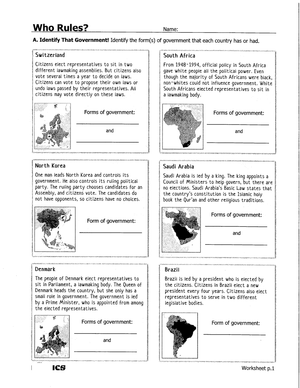
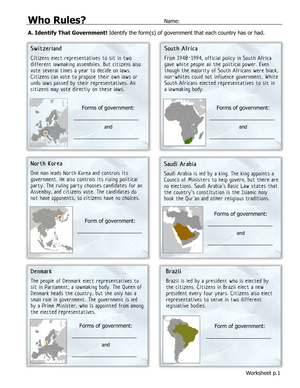
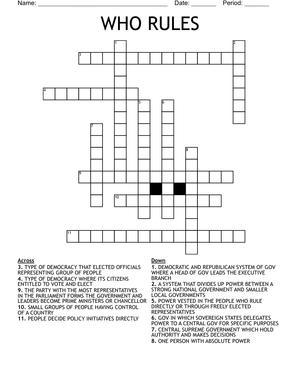
The packet isn't a single page. It bundles a Rules of Ruling comparison chart, a compare-and-contrast graphic organizer, a characteristics elimination exercise, a vocabulary crossword, and an Identify That Government activity that names real-world countries. Together they take students through defining, comparing, and applying government types, so you can assign the whole set or pull the one piece that fits your lesson.
Breaking Down the PALS Framework
The lesson turns on four ideas that iCivics abbreviates as PALS: Power, Authority, Legitimacy, and Sovereignty. Power is the ability to make people act; authority is the recognized right to use that power; legitimacy is whether people accept that right as valid; and sovereignty is supreme control over a territory. Students who can separate these four terms stop treating "government" as one blurry concept and start analyzing how any system justifies its rule.
iCivics, the nonprofit civic education organization founded in 2009 by former U.S. Supreme Court Justice Sandra Day O'Connor, designed the Who Rules? lesson around the PALS framework—Power, Authority, Legitimacy, and Sovereignty—giving teachers four concrete lenses students can apply to any government they study.
For formative assessment, PALS is a gift. Ask students to rate a fictional or historical government on each of the four dimensions and you'll see instantly who can distinguish authority from raw power. It also gives you a shared vocabulary you can reuse across later units on constitutions and comparative systems.
Inside the Worksheet Packet
Each activity does distinct instructional work, so it helps to know what you're assigning. The Rules of Ruling chart asks students to record how power is gained, who holds it, and how much the people participate across several government types. The compare-and-contrast organizer pushes them past the chart into written reasoning about similarities and differences.
The characteristics elimination exercise works like a process-of-elimination puzzle: students narrow down which government type matches a set of clues, which is ideal for partner talk. The vocabulary crossword reinforces terms like autocracy and oligarchy, and the Identify That Government activity connects those abstractions to actual countries.
Here's the sequencing detail most teachers miss: the packet is engineered so the elimination exercise should come before the compare-and-contrast organizer, not after. Elimination forces students to hold multiple government types in mind at once and test them against evidence, which primes the exact reasoning the organizer then asks them to write down. Reversing the order turns the organizer into rote copying instead of analysis, and you lose the lesson's built-in progression from recognition to explanation.
Classroom Implementation
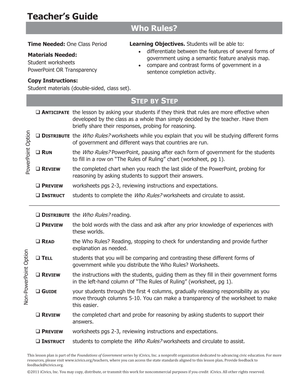
Start with the Rules of Ruling chart as a whole-class warm-up, filling in one government type together so students see the level of detail you expect. Then move to small groups for the remaining rows, assigning each group a type to become the "expert" on before a quick share-out. This keeps every student accountable while lowering the reading load per learner.
Reserve the compare-and-contrast organizer for independent or partner work once the chart is complete, since it depends on the vocabulary students just built. If your period runs short, the crossword makes a strong exit ticket or homework page, and the elimination exercise fits a bell-ringer slot the next day. Plan for one to two class periods overall, depending on how much writing you require.
Frequently Asked Questions
1. What grade levels is the Who Rules? iCivics worksheet designed for?
The lesson is most commonly used in middle school grades 6-8 and in high school civics or government courses. Its reading level and vocabulary load make it a strong foundational activity before deeper units on constitutional government.
2. What forms of government does the Who Rules? lesson cover?
Students identify and compare types such as democracy, oligarchy, and autocracy, analyzing how each gains and holds power. The worksheets push learners to describe differences rather than just name categories.
3. What does PALS stand for in the iCivics Who Rules? lesson?
PALS stands for Power, Authority, Legitimacy, and Sovereignty. These four terms are the analytical lenses students use to explain how any government justifies and exercises its rule.
4. Where can teachers find an answer key for the Who Rules? worksheet?
iCivics distributes the full lesson plan, including teacher materials, through its official lesson page. Create or sign in to a free educator account to access the downloadable packet and accompanying guidance.
5. How long does the Who Rules? lesson typically take to complete in class?
Most teachers cover it in one to two class periods. A single period works if you assign the chart and one activity, while two periods let students complete the compare-and-contrast organizer and the applied Identify That Government task.